
TL;DR
- YouTube sells six live ad formats: skippable in-stream, non-skippable in-stream, bumper, in-feed video, the Masthead, and vertical ads in the Shorts feed.
- Skippable in-stream can be skipped after five seconds, and on a view based buy a skip costs nothing, which is why it is the safest entry point on a small budget.
- Bumper ads are six seconds or less and cannot be skipped, so they repeat a message rather than explain one, and they are priced per thousand impressions.
- In-feed video only plays when the viewer taps the thumbnail, so it charges on that tap and maps to search intent rather than to reach.
- Overlay ads were retired by Google and are no longer part of the lineup, so any media plan still budgeting for them needs rewriting.
YouTube sells six live ad formats: skippable in-stream, non-skippable in-stream, bumper, in-feed video, the Masthead, and vertical video that runs in the Shorts feed. Each one was built for a different objective, and choosing the wrong one is the most common reason a video budget disappears without moving any number the brand actually cares about.
Format is only half of the decision. What you can run, where it is delivered and how you are billed all depend on the campaign type you pick inside Google Ads, because YouTube inventory is packaged across video campaigns, Demand Gen and Performance Max in different ways. Use the sections below for what the viewer sees and what triggers a charge, then confirm availability inside the campaign type you plan to build rather than assuming every format sits one checkbox away. If the wider account setup is new to you, the same logic that governs campaign structure in Google Ads search campaigns applies here.
Skippable in-stream ads
Skippable in-stream is the format most people picture when they think of a YouTube ad. It plays inside another video, before it starts, partway through a longer video, or after it ends, and a skip button appears after five seconds.
- Where the viewer sees it: inside the video player on phones, desktop, tablets and connected TV screens.
- When it can be skipped: after five seconds, and most viewers take that option the moment the button becomes active.
- When you pay: it depends on how the campaign is bought. On a view based buy you are charged when someone watches a qualifying amount of the ad, commonly thirty seconds or the full ad when it is shorter than that, or when they click it, though the threshold differs between campaign subtypes. On an impression based buy you pay per thousand impressions whether the ad is skipped or not.
- Sensible length: long enough to earn the watch, which usually means fifteen to sixty seconds for consideration work, with the product and the reason to care inside the first five seconds.
- What to measure: view rate, watch time, cost per view on awareness work, and clicks through to the site plus assisted conversions when the ad is asking for an action.
The billing model is what makes this format forgiving on awareness budgets. When you are buying views rather than impressions, a viewer who skips at second four costs nothing, so the skip is not a failure, it is a free filter that removes people who were never going to be interested. That also changes how the creative should be built. You are not paying for the skip, so there is no reason to hide the brand in the hope of holding an uninterested viewer for a few more seconds.
The honest limit is that skippable in-stream rewards a message that can survive being interrupted. If the offer only makes sense after thirty seconds of setup, most of the audience will never reach it, and reach numbers will look healthy while the brand message never actually lands. Storyboard the ad so that a viewer who sees only the first five seconds still walks away with the brand name and the single idea you are paying to deliver.
Non-skippable in-stream ads
Non-skippable in-stream runs in the same player position but removes the skip button, so the whole ad plays before the viewer gets back to the content they came for. That is a stronger claim on attention and it is priced accordingly.
- Where the viewer sees it: inside the video player, in the same pre roll, mid roll and post roll positions as the skippable format.
- When it can be skipped: it cannot. The viewer watches it or leaves the video.
- When you pay: on an impression basis, priced per thousand impressions, so every delivered ad costs money regardless of how the viewer reacts.
- Sensible length: the format is capped at a short duration, commonly around fifteen seconds, and the exact ceiling can differ by market, so check what the campaign type allows before the edit is locked.
- What to measure: completion rate, reach and average frequency, and recall or brand metrics rather than clicks.
Use it when the message has to arrive intact. A product launch with a name nobody has heard yet, a price change, a campaign line you need people to repeat back to you, all of these survive better in a fixed length spot than in a format the viewer can cut off. It is also the format that behaves most like a television spot, which makes it easier to line up with a broadcast or out of home plan running at the same time.
The cost of that guarantee is that you pay for indifference as well as attention. A forced view is not an interested view, and an irritating ad delivered in full can do more damage than an ad that was skipped. Keep the cut tight, put the brand in early anyway, and avoid the temptation to fill every second because the viewer cannot leave.
Bumper ads
Bumper ads are six seconds or less, cannot be skipped, and play in the same in-stream position as the formats above. Six seconds is not enough room for a story, so the format works as a repetition tool rather than a persuasion tool.
- Where the viewer sees it: in the video player, most often before the content the viewer selected.
- When it can be skipped: it cannot, but it is over before most people would have reached for the button.
- When you pay: per thousand impressions, which makes six second bumper ads an efficient way to buy incremental reach and controlled frequency against an audience you have already defined.
- Sensible length: six seconds, and treating that as five seconds of message plus a clean end frame usually produces a better cut than trying to use every frame.
- What to measure: unique reach, frequency, and any lift in branded search or direct traffic while the burst is running.
The strongest use is as a second wave. Run a longer skippable ad to carry the explanation, then follow the people who watched it with bumpers that repeat one line, one product shot and the brand. That sequence gives you the explanation and the repetition without paying long form rates for the repetition. Bumpers also work as a reminder layer around a sale period, a festival, or a launch date, where the audience already understands the offer and simply needs to be reminded that it is happening.
What bumpers cannot do is introduce a complicated product or carry a promotion with conditions attached. If the message needs a qualifier, the six second cut will either drop it or render it in type too small to read on a phone, and neither outcome is acceptable when the claim is commercial.
In-feed video ads
In-feed video is the only format on this list that the viewer has to choose. It appears as a thumbnail with a headline and a short line of text, and the video starts only after someone taps it, which makes the audience self selecting.
- Where the viewer sees it: in YouTube search results, alongside related videos, and in the YouTube home feed.
- When it can be skipped: the question does not apply, because nothing plays until the viewer clicks. They can leave at any point once it starts.
- When you pay: when someone clicks the thumbnail and the video begins, so an impression that is ignored costs nothing.
- Sensible length: longer than the in-stream formats is defensible here, because the viewer asked for the video. Demonstrations, comparisons, tutorials and full product walkthroughs all hold up.
- What to measure: click through rate on the thumbnail, watch time once the video starts, subscriptions or channel views earned, and conversions afterwards.
Because the viewer is searching or browsing when they meet the ad, this is the format that maps to intent. Someone typing a product category into YouTube search is closer to a decision than someone watching a music video, and an in-feed placement puts you in front of that moment. It is also the format where the thumbnail and the headline do most of the work, so budget real design time for them rather than exporting a random frame from the video. If the thumbnail set needs building, that is graphic design work, not an afterthought in the edit.
The trade off is volume. In-feed will not deliver mass reach quickly, because you are waiting for people to opt in, and a weak thumbnail can hold the whole campaign back while the video behind it never gets a chance to fail or succeed on its own merits.
The YouTube Masthead
The Masthead sits at the top of the YouTube home feed and is the only format here that you cannot simply switch on. It is a reservation buy arranged through a Google sales contact, sold on a fixed basis such as cost per day or a reserved impression volume, and it is usually spoken for well in advance.
- Where the viewer sees it: the top of the home feed, on desktop, mobile and television screens.
- When it can be skipped: the viewer scrolls past it like any other feed item, so the useful comparison is a billboard rather than a spot.
- When you pay: up front, on a reserved basis agreed before the campaign runs, not through an auction.
- Sensible length: short, because this is a poster that moves. The autoplay portion has to make sense without sound and without a click.
- What to measure: reach on the day, branded search volume during and after the placement, and site traffic against a clean before and after window.
It is worth the conversation only for a genuine event: a national launch, a flagship product, a campaign where being unmissable on one specific day is the point. For everything else the money buys more useful work spread across the auction formats.
YouTube Shorts ads
Shorts ads are vertical videos that appear between organic Shorts as the viewer swipes through the feed. The viewing behaviour is different from the rest of YouTube, because the audience is moving fast and expects to keep moving.
- Where the viewer sees it: in the Shorts feed, full screen and vertical, almost always on a phone.
- When it can be skipped: immediately, with a swipe, which is the lowest friction exit of any format here.
- When you pay: this depends on the campaign type and bid strategy you select, and delivery into the Shorts feed is tied to the campaign type and to whether you supplied a vertical asset, so check both before assuming your ad is eligible to appear there.
- Sensible length: short, with the hook in the first moment, and edited in a rhythm that matches what the viewer was already watching.
- What to measure: swipe through behaviour, watch time, and downstream actions rather than impressions alone.
The creative rule that matters most here is the aspect ratio. A sixteen by nine film letterboxed into a vertical frame reads as an advert before a single word is spoken, and it loses the viewer on that alone. Shoot or reframe to nine by sixteen, keep the important elements away from the edges where the interface sits, and treat the first frame as the whole pitch.
One format from older guides is worth closing out: overlay ads, the small banners that used to sit across the bottom of the player, were retired by Google and are not part of the current lineup, so any plan that still budgets for them needs rewriting.
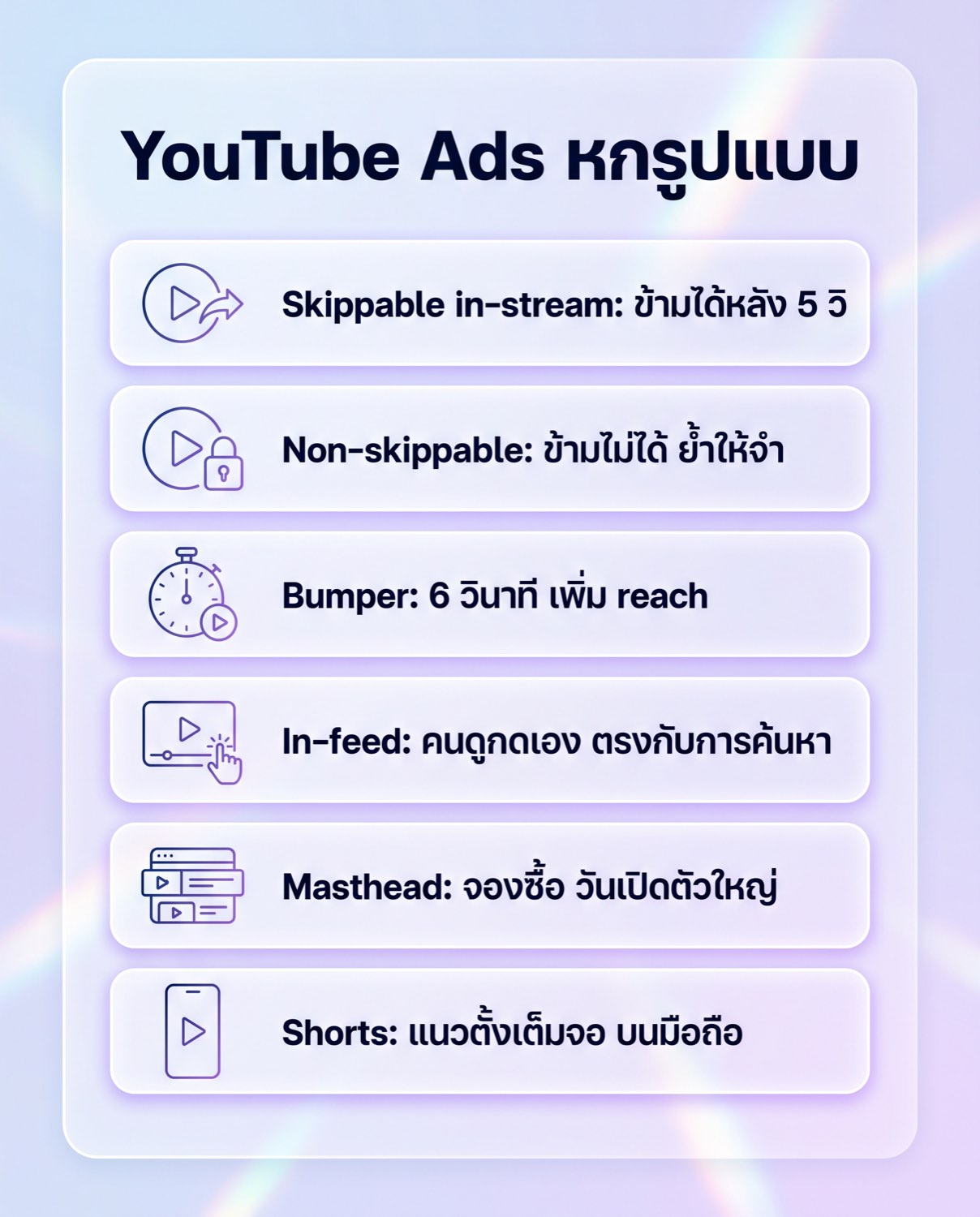
Format against objective against KPI
The table below is the short version of everything above, and it is the check to run before a media plan is signed off: read across the row and make sure the objective in the brief matches the format being bought and the number you will be judged on.
| Format | Objective it fits | KPI to measure |
|---|---|---|
| Skippable in-stream | Awareness and consideration, with room to explain | View rate, cost per view, watch time, assisted conversions |
| Non-skippable in-stream | Brand recall for a message that must arrive whole | Completion rate, reach, frequency, recall or brand study results |
| Bumper | Incremental reach and controlled frequency | Unique reach, frequency, branded search and direct traffic |
| In-feed video | Capturing existing intent and search behaviour | Thumbnail click through rate, watch time, subscriptions, conversions |
| Shorts | Reaching a younger, mobile first audience quickly | Watch time, swipe behaviour, downstream actions |
The Masthead is missing from the table on purpose. It is a reserved buy for a single high stakes moment rather than a line item you rotate through a quarterly plan, so it belongs in a launch conversation rather than in a standing format comparison.
What the creative has to do in the first five seconds
Every auction format on this list shares one problem: the viewer did not come for the ad, and on most of them the exit is available almost immediately. That makes the opening seconds the entire creative brief, not the warm up to it.
Four things belong in that opening. The brand should be visible in the first frames, as a logo, a pack shot, a product in use or a spoken name, because an ad that is only branded at the end is branded for the minority who stayed. The hook should be a reason to keep watching that is specific to the audience, which usually means a problem stated plainly or a result shown immediately, not a slow establishing shot. The core message should be readable with the sound off, because a large share of viewing happens muted, on a commute, in an office or beside someone who is asleep. And the claim you are making should be on screen as text as well as in the voiceover, so that the message survives a silent play.
Subtitles deserve their own decision. Burning them into the video file guarantees they appear everywhere, in every placement and on every device, and gives you control over the font, the size and the position. A separate caption file keeps the video clean and can be switched off by the viewer, which some audiences prefer, but it relies on the placement supporting captions. For advertising where the line has to be read, burned in text is the safer choice, as long as it is kept clear of the lower area of the frame where the player interface and the call to action sit.
Before any of it goes live, run the same short list on every cut: correct aspect ratio for the placement, important content inside the safe area rather than near the edges, text large enough to read on a phone held at arm length, brand present early, a clear next step at the end, and a version of the file in each ratio you actually intend to serve. Checking that list takes minutes. Discovering after a week of delivery that the vertical cut had its call to action hidden behind the interface costs a week of budget.
Shorts or TikTok
This is not a question with one correct answer, and treating it as a loyalty test between two platforms produces worse plans than treating it as a question about where a particular audience and a particular objective meet.
Four things decide it. First, where the audience you are actually targeting spends time, which is a question about your customers rather than about national platform popularity. Second, what the rest of your media looks like, because Shorts sits inside the same account, the same audience lists and the same measurement as your other YouTube and Google activity, which is a real operational advantage when the same team manages all of it. Third, what creative you can produce and sustain, since both feeds consume volume and a single polished film will not carry a quarter on either. Fourth, what you are optimising towards, because a campaign chasing measurable actions behaves differently from one chasing attention.
In practice the answer is often both, with the split decided by results rather than by preference. The same vertical master can be recut for both feeds, and the honest way to choose is to run comparable budgets against a comparable objective, then let the cost per outcome decide where the next month goes. If you are weighing a dedicated budget line, the mechanics of buying on the other platform are covered in TikTok Ads, and the decision should be made with both sets of numbers in front of you.
Budget and measurement: a view is not the final number
A view means someone did not leave immediately. It is a useful early signal and a terrible final KPI, because a campaign can produce an enormous number of views while the brand stays exactly where it was and the site sees no change at all.
Measurement on video splits into two honest questions. The first is whether the advertising changed what people think, which is what brand lift measurement exists for: a comparison between people who were shown the ad and people who were not, on questions such as recall or consideration. Availability depends on the campaign type and on spend conditions set by Google, so treat it as something to plan for at the media planning stage rather than something to bolt on when the campaign is already half spent. If it is out of reach, branded search volume and direct traffic during and after the flight are the closest usable proxies, provided you hold the rest of the media steady enough to read them.
The second question is whether the advertising produced action. That needs conversion tracking that was working before the video campaign started, and it needs realistic expectations about attribution, because video usually appears earlier in the decision than the click that gets credited. Look at assisted conversions and at the difference between periods with and without video running, not only at the last click report, and be honest about which conclusions the data can actually support.
The most undervalued asset a video campaign creates is the audience it builds. Once your YouTube channel is linked to the account, people who watched the ad, watched a meaningful portion of it, visited the channel or engaged with the content can be built into audience lists and addressed again with a different message. That is where video stops being a cost line and starts feeding the rest of the account, and the practical mechanics sit in remarketing: the first campaign pays for reach, the second campaign pays for the people who already showed interest, and the second is almost always the cheaper conversation.
What this means for advertisers in Thailand
Several of these decisions play out differently in the Thai market. Viewing is heavily mobile, so the phone is the reference screen for every approval, and a cut that was signed off on a large monitor should be reviewed again at actual size before it runs. Many people open YouTube every day and much of that viewing happens in public with the sound off, which moves Thai on screen text from a nice addition to a requirement.
Thai typography needs care in video. Thai script carries marks above and below the line, and tight line spacing or an aggressive crop will clip them, which turns a readable line into something that looks wrong without the viewer being able to say why. Thai copy also tends to run longer than the English equivalent for the same idea, so a six second cut that worked in English may need the line rewritten rather than shrunk. Use a font with proper Thai support, set the size for a phone rather than a laptop, and have a Thai speaker check the final render rather than the script.
On the Shorts against TikTok question, both feeds have serious attention in this market, and the difference usually comes down to who is being targeted and which team is producing the volume. If the same people already run your search and display activity, keeping vertical video inside the same account reduces the coordination cost. If your audience skews towards the platform where your organic content already performs, that is a reasonable place to start. Either way, the vertical master should be produced once and recut, and the same Thai subtitle discipline applies to both. Paid social running alongside should share the same creative decisions rather than starting from a separate brief.
FAQ
Which format should I start with on a small budget?
Start with skippable in-stream, because on a view based buy you are not charged when someone skips, which makes a limited budget go further while you learn what the audience responds to. In-feed video is the other sensible entry point if you already have a video that answers a question people search for, since you only pay when someone chooses to watch. Leave non-skippable and bumper formats until you have a message worth repeating, as both are priced per impression and will spend a small budget quickly.
Do I need to shoot a new video for every format?
No, but you do need different cuts and at least one vertical version. A single shoot can produce a longer explanatory edit for skippable in-stream and in-feed, a short fixed length cut for non-skippable, a six second version for bumpers, and a vertical reframe for Shorts, provided the shoot is planned with those outputs in mind. The mistake is finishing one landscape film and then trying to crop it into every other shape afterwards, which usually loses the framing and puts important elements outside the safe area.
Can six seconds actually sell anything?
Six seconds can remind, not persuade, so bumper ads work when the audience already knows the product and needs to be prompted rather than convinced. Use them as a follow up layer behind a longer ad, or around a date the audience already understands, and keep them to one idea, one product shot and the brand. If the message needs a condition or a qualifier, the format is the wrong tool.
What is the difference between a view and an impression?
An impression means the ad was delivered and had the chance to be seen, while a view means the person watched a qualifying amount of it, which is why impression based formats charge whether or not anyone paid attention and view based formats do not. The practical consequence is that impressions are the right currency for reach and frequency work, and views and watch time are the right currency when the point is whether the message was received.
Can YouTube advertising be measured against sales?
Yes, but only if conversion tracking was working before the campaign started and you accept that video rarely takes the last click. Compare periods with and without video, watch assisted conversions and branded search, and build audience lists from viewers so that the people the video reached can be re-engaged with a message built to close rather than to introduce.
If you want a second opinion on which format matches the objective in your brief, or help turning one shoot into a set of cuts that works across the formats, our YouTube Ads service page explains how we approach it.