Since 2025, consumer search behavior has changed noticeably. While people used to type search terms into Google, many now open ChatGPT, Gemini, or Perplexity and ask AI directly for information—receiving instant answers without needing to click through to any website. This has led many business owners and marketers to question whether the budget and time invested in SEO over the years might no longer matter.
But that's not actually the case. AI doesn't generate answers out of thin air—it must reference content that actually exists on websites. So the question worth asking isn't whether SEO has become obsolete, but rather: How do we get AI to choose our content when answering user questions?
There are two key points worth highlighting here: SEO is still necessary, but the goal has shifted. Instead of focusing solely on ranking on Google's first page, the goal now also includes getting content selected as an AI reference. And SEO for AI Search isn't an entirely new discipline that requires starting from scratch—it's an evolution of good SEO practices that already exist, with an added layer of consideration for AI.
Does SEO Still Matter to AI?
The first question most businesses want answered is whether SEO still matters when it comes to AI. The honest answer is: yes, it does—and in some ways, it may matter even more than before.
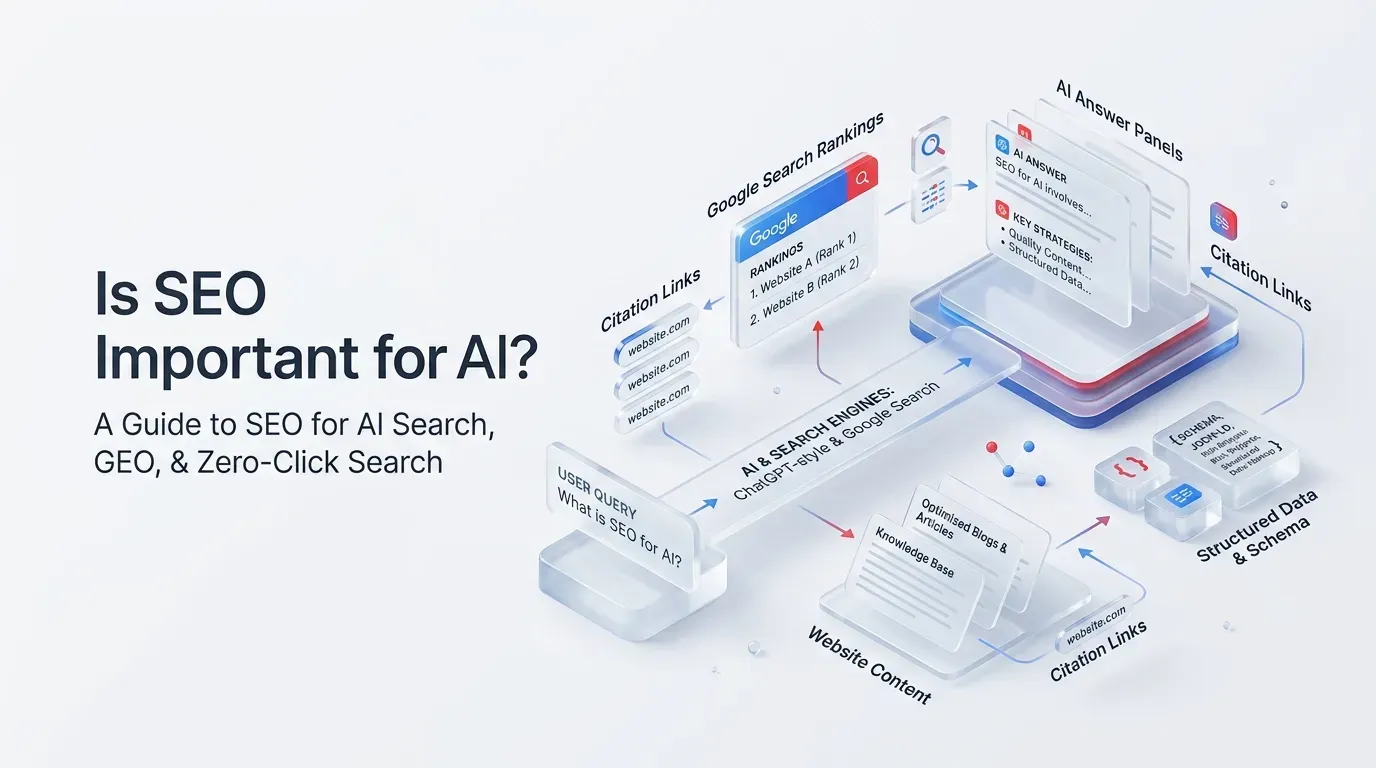
Large language models (LLMs) like ChatGPT or Gemini rely on current or specialized information to answer questions. AI uses a process called Retrieval-Augmented Generation (RAG), which searches for and pulls content from real sources on the web before processing it into an answer—rather than generating information entirely on its own.
Simply put, AI needs to pull answers from websites, and websites more likely to have their content retrieved tend to share these characteristics:
- Clear data structure, using proper semantic HTML markup
- Use of structured data or schema markup to help AI understand content context
- Trustworthy content with verifiable sources that stays current
On the flip side, if a business decides to stop doing SEO because it assumes AI will completely replace traditional search, that's essentially cutting off the channel that feeds information about the brand into AI systems. If a website doesn't have content that can be effectively crawled and processed, AI has no way to use that content to answer user questions—no matter how good the information actually is.
What has clearly changed is the goal of SEO. It used to focus on getting a website to rank on Google's search results page. Now the goal has expanded one level further: making sure AI can correctly interpret and understand the content so it can be used to answer user questions in the appropriate context. In short, SEO is still the same game—just with a new player added to the equation.
Are GEO, AEO, and LLMO the Same Thing?
As AI takes on a bigger role in the search process, a wave of new technical terms has emerged, including:
- GEO (Generative Engine Optimization) — optimizing content for generative AI engines
- AEO (Answer Engine Optimization) — optimizing content specifically for answer engines
- LLMO (Large Language Model Optimization) — optimizing content for LLM processing
Seeing these terms might make some people feel like they need to study a whole new set of theories. But in practice, most of these terms refer to the same underlying principle: making content that AI systems will choose to use when answering questions. The actual approaches involved are quite similar.
What matters isn't memorizing the exact definition of each term, but understanding the shared core principles:
- Making content easy to read and understand for both regular users and AI systems
- Structuring data so systems can process it efficiently
- Maintaining accuracy and keeping information current
If you follow these principles, whether you call the approach SEO for AI, GEO, or anything else, the results will move in the same direction.
In short, what businesses should focus on isn't chasing every new term that pops up, but going back to the fundamentals of whether website content answers customer questions accurately and thoroughly. That's the core factor AI systems care about too—regardless of what name we give the method.
What Are the Foundational Elements of SEO for AI?
Once you understand that SEO for AI isn't something entirely new, the more important question becomes: what are the foundational elements that make SEO for AI actually work? There are 5 core principles, and interestingly, all five are simply good SEO practices that digital marketers are likely already familiar with.
1. Clarity of Answers
When writing web content, answer the question directly right from the start of the paragraph (front-loading), without needing a long introduction before getting to the point. Both readers and language models want a clear answer starting from the very first sentences. If a reader or AI has to process three or four paragraphs before getting an answer, the chances of that content being pulled for reference drop significantly.
2. AI-Friendly Structure
Content structure matters just as much. Effective approaches include:
- Using question-format subheadings, since this matches the pattern of how people actually phrase queries to AI
- Adding comparison tables or step-by-step lists so AI can more accurately parse and extract information
- Including appropriate schema markup, such as FAQPage Schema or Article Schema, to help systems better understand page context through comprehensive structured data
None of this is too difficult for a team that already has an SEO foundation—it's simply adjusting how content is presented to align with how AI parses and interprets content. There's no need to start from zero.
3. Content Trustworthiness
When it comes to trustworthiness, clearly identify the author along with verifiable information (E-E-A-T: Experience, Expertise, Authoritativeness, Trustworthiness). AI tends to give more weight to content with clear citations and identifiable sources compared to content where the author or information source can't be verified. Websites that include the following elements will help AI assess trustworthiness more favorably:
- An author bio page that concretely demonstrates expertise
- Transparent, verifiable company or organization information
- Citations of credible external sources supporting the content
4. Content Depth
Content depth means presenting a topic comprehensively rather than scattering it across multiple shallow, short articles. If a business operates in the SEO space, it should build content that covers the basics, in-depth techniques, and frequently asked customer questions (topic clusters) to signal to AI that this website is a genuinely credible and comprehensive source on that subject.
5. Consistency in Content Updates
The last element is consistency in updating content. AI places significant weight on content freshness and accuracy. Content written three or four years ago without revision may contain outdated information that the website owner hasn't even noticed. Regularly reviewing and updating old content to reflect current circumstances should be an ongoing practice, not a "publish and forget" approach.
Looking at these five elements again, you'll notice they're no different from good SEO practices marketers should have been following all along. The difference now is there's more reason to prioritize them, since our audience is no longer limited to humans alone—it now includes AI, which will increasingly answer questions on our behalf in the future.
How to Actually Practice SEO for AI, and AI's Role in Content Writing
Once you understand the principles, the question most businesses really want answered is: how do you actually start doing SEO for AI in practice?
Understanding How People Ask AI Differently From Traditional Search
The most important starting point is understanding that the way people phrase questions to AI is quite different from how they search on Google.
Clear differences:
- Google search: People tend to type short phrases, like "SEO agency Bangkok" or "SEO services"
- Talking to AI: People tend to ask full, much more specific sentences, like "Which SEO agency understands AI Search best in Bangkok?" or "Where should a small business start with SEO for AI?"
This difference matters more than many people realize, because content written to answer short search queries may not be enough for these longer, more specific questions. Content that can thoroughly answer a specific question has an advantage over content that speaks broadly without a clear focus.
Recommended practices:
- Try compiling a list of questions customers might actually ask AI
- Check how well your website's existing content answers those questions
- If the content doesn't exist yet, write content that answers the question more clearly and thoroughly than what's currently available in the market
- Structure content so AI can easily extract it—using question-format subheadings with a concise answer at the start of each paragraph, followed by additional detail
This approach doesn't just help direct readers—it also helps AI summarize information more easily for users. Ultimately, it helps a brand cover both traditional Google search and AI chatbot search simultaneously, without having to choose one over the other.
Using AI to Help Write SEO Content Without Hurting Credibility
Another topic businesses care a lot about is using AI to write SEO content, allowing large volumes of comprehensive content to be produced in a short amount of time. However, using AI for content writing needs to be done systematically and with great care.
Where AI can genuinely help in the SEO process:
1. Finding topics the target audience cares about by analyzing recurring questions
2. Drafting initial content outlines, which saves time in the early stages—but AI shouldn't be allowed to write all the content without review
3. Analyzing competitors to see how thoroughly they've covered a topic and identify any content gaps that haven't been addressed
4. Refining tone and language to improve readability or make content more concise
That said, one thing to watch out for is letting AI write all the content and publishing it immediately without any review, since AI can produce inaccurate or outdated information. Content like this also damages a website's credibility over time, because both readers and AI are increasingly able to distinguish genuinely valuable content from content that's simply a generic compilation of information easily found elsewhere.
Where Businesses Should Start
Once businesses understand this concept, many want to overhaul their entire website immediately. But that's not the recommended approach—it wastes time and carries unnecessary risk.
A more effective starting point is:
- Review pages that are already performing well, such as high-traffic pages or pages ranking on Google's first page
- Improve those pages to make them easier for AI to use, such as adding question-format subheadings, inserting appropriate schema, or updating information to be current
- Expand to new topics that aren't yet covered, once you see results from the first step
This approach uses fewer resources than overhauling everything at once, and it also shows results faster.
For businesses whose internal team doesn't have the time or expertise to build this kind of system, bringing in an SEO agency in Bangkok that understands both traditional SEO and SEO for AI to help plan from the start is a good option that allows you to get moving faster, without having to spend time trial-and-erroring everything on your own.
The key point is that you don't need to wait for everything to be perfect before taking action. AI search behavior is changing rapidly, and businesses that start adapting today—even starting small—will have more time to learn and improve compared to businesses that wait until everything is certain before starting.
In summary, SEO hasn't lost its importance in an age where AI plays a role in search. What has changed is the shape of the goal and how content is presented to suit a new type of audience—one that's no longer just human. SEO for AI, then, is about making good SEO even better, by considering both human readers and AI together at every step of content creation.
Elevate Your AI SEO & GEO Strategy with Relevant Audience
Relevant Audience is a Performance Digital Marketing agency with experience delivering marketing solutions to over 500 clients across various industries, leveraging expertise and the latest AI technology to drive modern marketing strategies. We're ready to help your brand stand out both on Google's search results and in AI Search answers, with precise and forward-thinking solutions to create an advantage in the era of Zero-Click Search.
Our Core Services
- AI SEO & GEO Strategy: Comprehensive visibility solutions covering both Google rankings and building citations in AI Search, creating an advantage in the era of Zero-Click Search
- Paid Performance: Effective ad management across Google, Meta, TikTok, and LINE
- Creative & Branding: Communicating your brand identity through standout, high-quality content
- Web Development: Building websites that serve both users and the structure AI requires
- Growth Services: Customized marketing solutions aligned with business goals for sustainable growth
Contact us and request a quote today
- Phone: 02 038 5055
- E-mail: info@relevantaudience.com