TL;DR
- BrightEdge tracked health queries over 18 months: AI Overview coverage of condition and symptom searches rose from 82% in May 2024 to 93% in December 2025, and general education queries from 50% to 74%.
- Semrush recorded 16% of health keywords triggering an AI Overview as of November 2025, a 9.58% decrease from earlier in the year, 7.78% of finance keywords, and a 4.78% drop in legal and government AIO presence between March and November 2025.
- BrightEdge broke finance down by query type: educational queries such as what is an IRA trigger an AI Overview 91% of the time, trading queries 44%, tools and calculators 11%, and stock tickers or real-time prices 7%.
- Top-10 overlap between AIO citations and organic results stands at 24.0% for healthcare, 22.4% for insurance and 11.3% for finance, so nearly 89% of finance citations come from pages outside the organic top 10, while entertainment moved from 3.2% to 18.5%.
- The structural fixes named are Answer-First writing that puts the direct answer in the opening sentence, disclaimers moved into collapsible elements or placed after that answer, and author credentials, reviewer attribution, dates and schema markup kept near the top of the page.
Ranking number one on Google used to mean something. Now, an AI-generated box sits above your blue link, summarizes the topic, and cites someone else. For publishers in health, finance, and legal niches, this isn’t a hypothetical. It’s already happening at scale, and the publishers still measuring success through position tracking are working with incomplete information.
The situation is more complicated than most people realize. AI Overviews now appear for the majority of health-related queries, are rapidly expanding across finance and legal categories, and they pull citations from sources that traditional SEO would never identify as winners. Nearly 9 out of 10 cited finance sources, for example, don’t even appear in the organic top 10 for the same query. That’s not a small gap in strategy. That’s a completely different game.
Getting cited in an AI Overview requires a fundamentally different approach than ranking in organic search. Most Your Money or Your Life (YMYL) publishers haven’t made that shift yet. This article breaks down what the data actually shows, what structural changes move the needle, and how to build a measurement framework that reflects where AI search is heading.
- What AI Overviews Actually Are (And Why YMYL Plays by Different Rules)
- The Data: How Often AI Overviews Appear Across Health, Finance, and Legal
- Ranking vs. Being Cited: The Gap Most Publishers Do Not Know Exists
- Why Institutional Sites Are Losing Citations (And the Structural Fix)
- Building a YMYL Citation Strategy: Tracking AI Visibility Beyond Rankings
What AI Overviews Actually Are (And Why YMYL Plays by Different Rules)
AI Overviews are Google’s AI-generated summaries that appear at the top of search results. They pull from multiple sources and answer the query before a user clicks anything. Previously called the Search Generative Experience (SGE), they’ve expanded significantly since their full rollout. But not all queries get one, and nowhere is that selectivity more obvious than in YMYL content.
The YMYL Categories Google Treats With Extra Caution
Your Money or Your Life (YMYL) is Google’s designation for topics where low-quality or inaccurate information can cause real harm. The categories are broader than most people assume:
- Financial security: investments, taxes, retirement planning, banking, and loans
- Health and wellness: illnesses, treatments, medical advice, pharmaceuticals, and mental health
- Physical safety: emergency procedures, food safety, and injury prevention
- Legal, civic, and government: legal advice, immigration, government services, and public safety
- Major life decisions: high-stakes guidance on education, career, and housing
- Groups of people: content about race, religion, gender, or nationality that could lead to discrimination
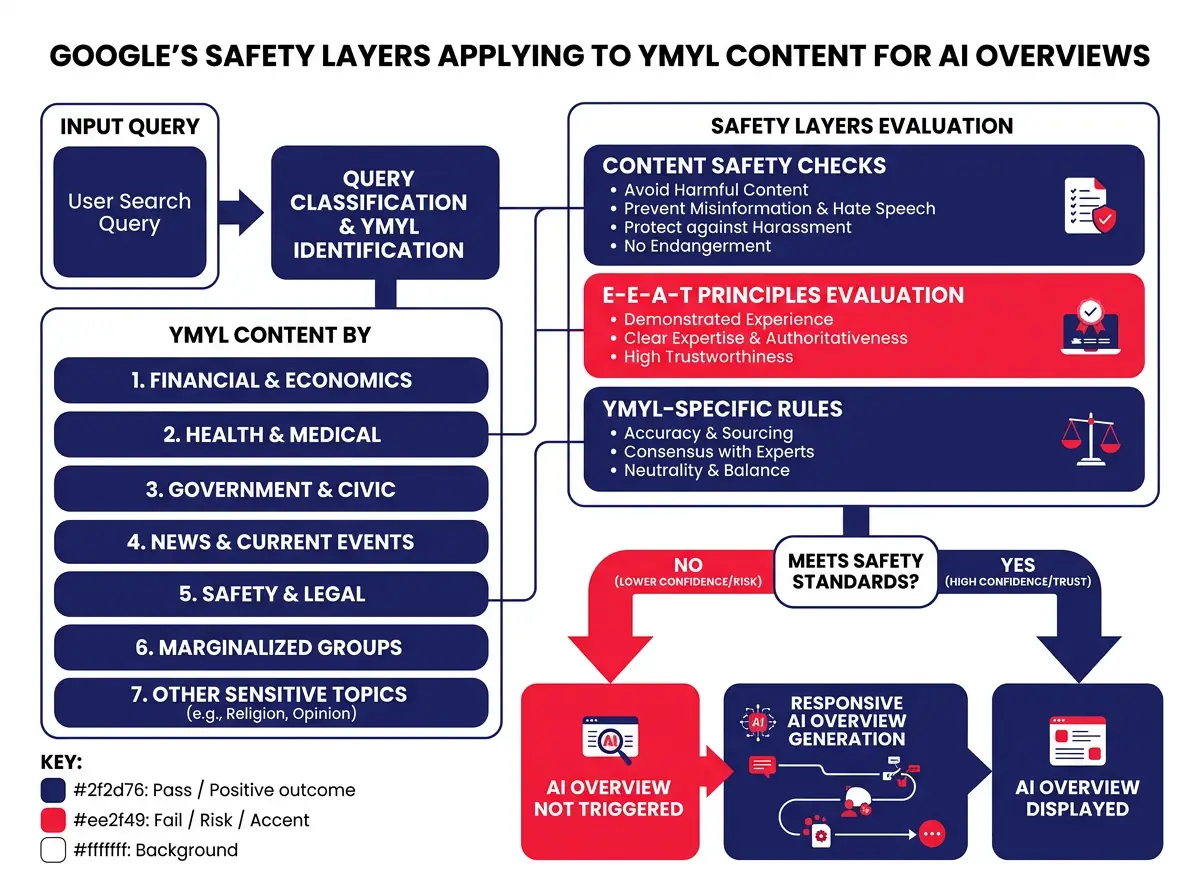
For all of these, Google applies stricter source standards before surfacing AI-generated summaries. A poorly researched article is far less likely to surface above a doctor’s or financial advisor’s guidance because the system is explicitly built to prevent that outcome.
How Google’s Safety Guardrails Change the AIO Equation
Google is open about the fact that it holds YMYL queries to a higher bar in AI Overviews. Its documentation states that for these queries, there is “an even higher bar for showing supporting information from reliable and trustworthy sources.”
Several mechanisms enforce this in practice:
- Safety guardrails: Google’s core safety systems, including SafeSearch, are built directly into AI Overviews to keep harmful or misleading content out
- Spam prevention: SpamBrain, Google’s AI-based anti-spam system, is applied specifically to AI Overviews to filter low-quality sources
- Selective triggering: AI Overviews appear only when Google has high confidence in the quality of its response, so YMYL queries will often trigger no AI Overview at all rather than a low-confidence one
- Avoiding data voids: where high-quality information is scarce, Google suppresses AI Overviews entirely
That last point is worth sitting with. Google would rather show nothing than show something wrong on a health or financial query. That constraint shapes everything downstream.
The Reliability Gap: High Trigger Rates, Uneven Source Quality
Here’s the tension that makes YMYL so strategically complicated. Despite all those guardrails, AI Overviews still appear for the majority of condition and symptom health queries. The system is both cautious and widespread at the same time. Sources that do get cited are operating under a very high standard, but competition for those citations is enormous. Understanding how to clear Google’s trust threshold while structuring content for extractability is what separates publishers who earn citations from those who only earn organic rankings.
 —
—
How Often AI Overviews Appear Across Health, Finance, and Legal
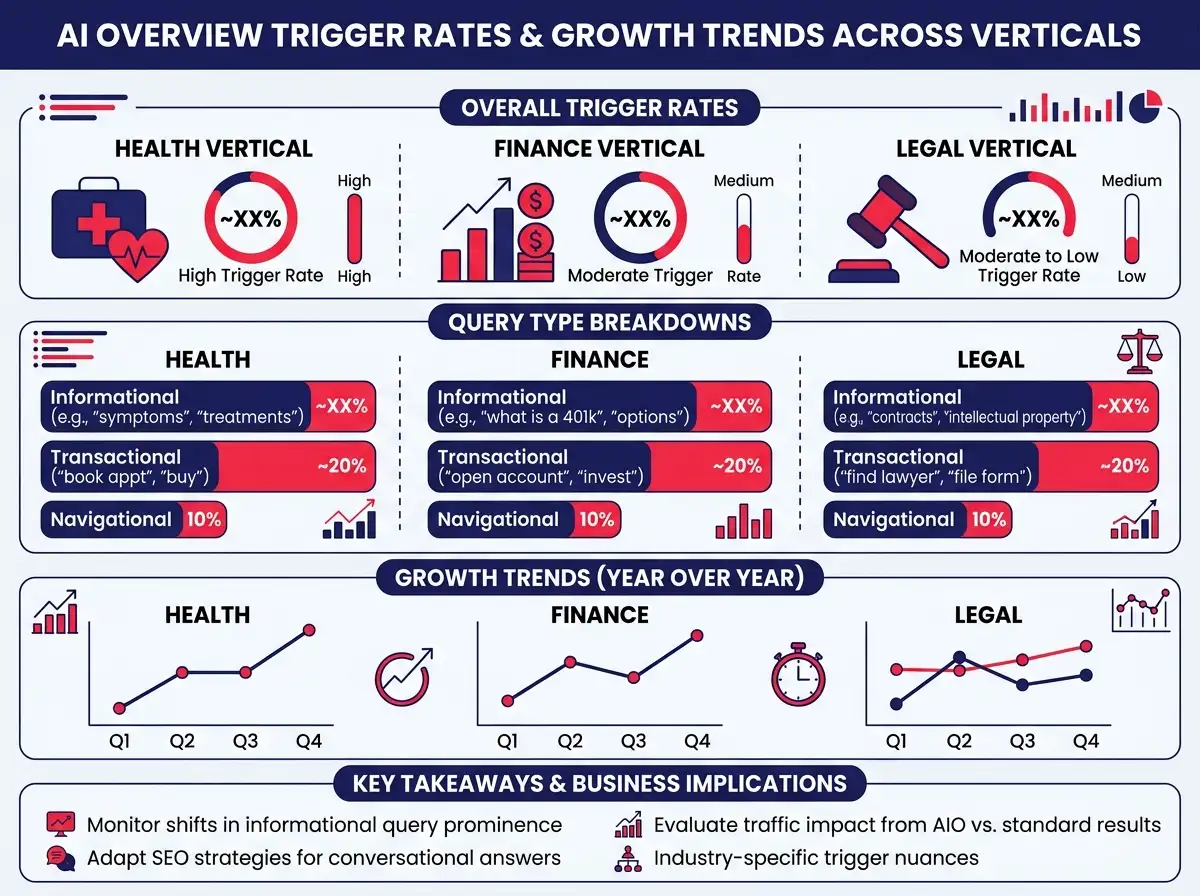
The numbers across YMYL verticals tell three distinct stories, and lumping them into one strategy misses the nuance. Each vertical has a different trigger rate, a different growth trajectory, and different query types driving AIO coverage.
1. Health: Near-Saturation for Symptom Queries
BrightEdge’s 18-month tracking across three health query types shows how far coverage has expanded. Condition and symptom queries began at 82% AIO coverage in May 2024 and reached 93% as of December 2025, near-saturation territory. General education queries climbed from 50% to 74% over the same period. Local health queries have been more unpredictable, peaking at 14% in May 2025 before settling at 11% by December.
Semrush’s data adds important texture: 16% of all health keywords trigger an AI Overview as of November 2025, a figure that reflects a 9.58% decrease from earlier in the year. That contraction matters. It shows that even in a near-saturated vertical, Google keeps recalibrating.
For health publishers, the practical implication is direct. If you create condition or symptom content, an AI Overview almost certainly appears above your organic result for those queries. Tracking traditional rankings without tracking AIO visibility gives you an incomplete and, frankly, misleading picture of how your content is actually performing.
2. Finance: Educational Content Surges While Real-Time Data Stays Out
Finance looks very different from healthcare on the surface. Semrush data shows just 7.78% of finance keywords triggered an AI Overview as of November 2025. But that aggregate figure obscures a critical distinction that BrightEdge’s query-type breakdown makes visible:
| Finance Query Type | AI Overview Trigger Rate |
|---|---|
| Educational (“what is an IRA”) | 91% |
| Trading queries (“premarket futures”) | 44% |
| Tools and calculators | 11% |
| Stock tickers and real-time prices | 7% |
Educational finance queries sit at 91% coverage, nearly identical to healthcare’s symptom queries. Stock ticker queries sit at 7%. The overall finance average looks low because real-time, transaction-adjacent queries drag it down. For publishers focused on planning, explainer, and educational finance content, saturation is approaching healthcare territory.
Categories showing the fastest AIO growth in finance include cash management, financial planning, and tax planning, all of which have grown by more than 60 percentage points since May 2024.
3. Legal and Government: A Rare Contraction in AIO Presence
Legal is the outlier. Semrush recorded a 4.78% decrease in legal and government AIO presence between March and November 2025. Unlike finance, which saw modest growth over the same period, legal actually contracted.
Google appears to be actively refining which legal queries it considers safe to summarize. General explainer queries, such as “how does the appeals process work,” still trigger AI Overviews. Election-related queries are explicitly restricted. Anything requiring real-time accuracy or nuanced expert judgment is increasingly being passed over.
For legal publishers, this contraction is a signal, not a setback. Publishers focused on clear educational content, explaining legal concepts, outlining processes, and breaking down rights, are better positioned than those producing content that edges toward specific legal advice.
 —
—
Ranking vs. Being Cited: The Gap Most Publishers Do Not Know Exists
This is where most YMYL publishers are making their biggest strategic mistake. They optimize for organic rankings, reach page one, and assume that AI visibility will follow. The data says otherwise, and in some verticals, the gap between ranking and being cited is dramatic.
BrightEdge measures what it calls the “top-10 overlap”: the percentage of sources cited in an AI Overview that also rank in the organic top 10 for the same query. A high overlap means AIO citations and organic rankings are closely aligned. A low overlap means Google is citing different sources than the ones winning on page one.
Here’s where the YMYL verticals currently stand:
| Industry | Top-10 Overlap (Last Year) | Top-10 Overlap (Today) | Change |
|---|---|---|---|
| Healthcare | 23.9% | 24.0% | +0.1pp |
| Insurance | 22.7% | 22.4% | -0.3pp |
| Finance | 7.6% | 11.3% | +3.7pp |
| Entertainment | 3.2% | 18.5% | +15.2pp |
| Ecommerce | 2.9% | 13.4% | +10.5pp |
Two things stand out immediately. Healthcare’s overlap has barely moved in a year, which suggests Google has a well-established trusted source pool it isn’t dramatically reshuffling. Finance’s overlap sits at just 11.3%, meaning nearly 89% of AI Overview citations in finance come from pages that don’t rank in the organic top 10 for the same query. Traditional SEO metrics would never surface those pages as winners.
Why Finance Has an 11% Overlap?
The low overlap in finance isn’t random. It reflects a structural reality: the sources Google trusts for AI synthesis are not always the sources that have accumulated the most backlinks or engagement signals. Financial institutions, government agencies, and specialized educational sites frequently earn AIO citations because of their institutional authority, even when they’re not optimized for organic search performance.
This is both a challenge and an opportunity. If you’re a YMYL publisher competing against institutional sources, you’re not going to out-domain-authority a government site. But you can out-structure them. And structure, as it turns out, is one of the main reasons those high-authority sites often lose citations to smaller, better-organized competitors.
The ‘Extractability’ Principle: How AI Selects Its Sources
AI systems don’t reward depth or comprehensiveness the way search ranking algorithms do. They reward content that is immediately extractable, meaning a direct answer appears early, without navigating through preamble, disclaimers, or marketing copy first.
When an AI model processes a page to generate a summary, it looks for a clean, quotable answer near the top. If the first 200 words of a page are a legal disclaimer, a company history, or a navigation menu, the AI is likely to move on to a page that gets to the point faster. This is directly parallel to why Wikipedia earns outsized AI mentions relative to its organic authority: the structure leads with the answer, every time.
Extractability reframes the entire content strategy question for YMYL publishers. The question isn’t just “does this content rank?” It’s “can an AI system find and extract a direct answer from this content in the first paragraph?”
Why Institutional Sites Are Losing Citations
Here’s the counterintuitive finding that surprises most YMYL publishers when they first see the citation data: highly authoritative institutional sites are frequently being passed over for AI Overview citations, while smaller, structurally well-organized sites earn them consistently. The reason comes down to a problem that’s entirely within your control to fix.
The Compliance Burden: How Legal Disclaimers Kill Extractability
Institutional sites, government agencies, hospital systems, and large financial firms have legitimate legal reasons to front-load their content with disclaimers. “This is not medical advice.” “Past performance is not indicative of future results.” “Consult a licensed attorney before taking any action.” These are reasonable and necessary, but they create a structural problem when AI systems process the page.
When a disclaimer pushes the actual answer 300 words down the page, AI systems frequently skip to a source that leads with the substance instead. The content is authoritative, but it isn’t extractable. Google’s own documentation acknowledges that AI Overviews will inform users when expert consultation is recommended, which means the disclaimer content doesn’t need to live in the opening paragraph to serve its purpose.
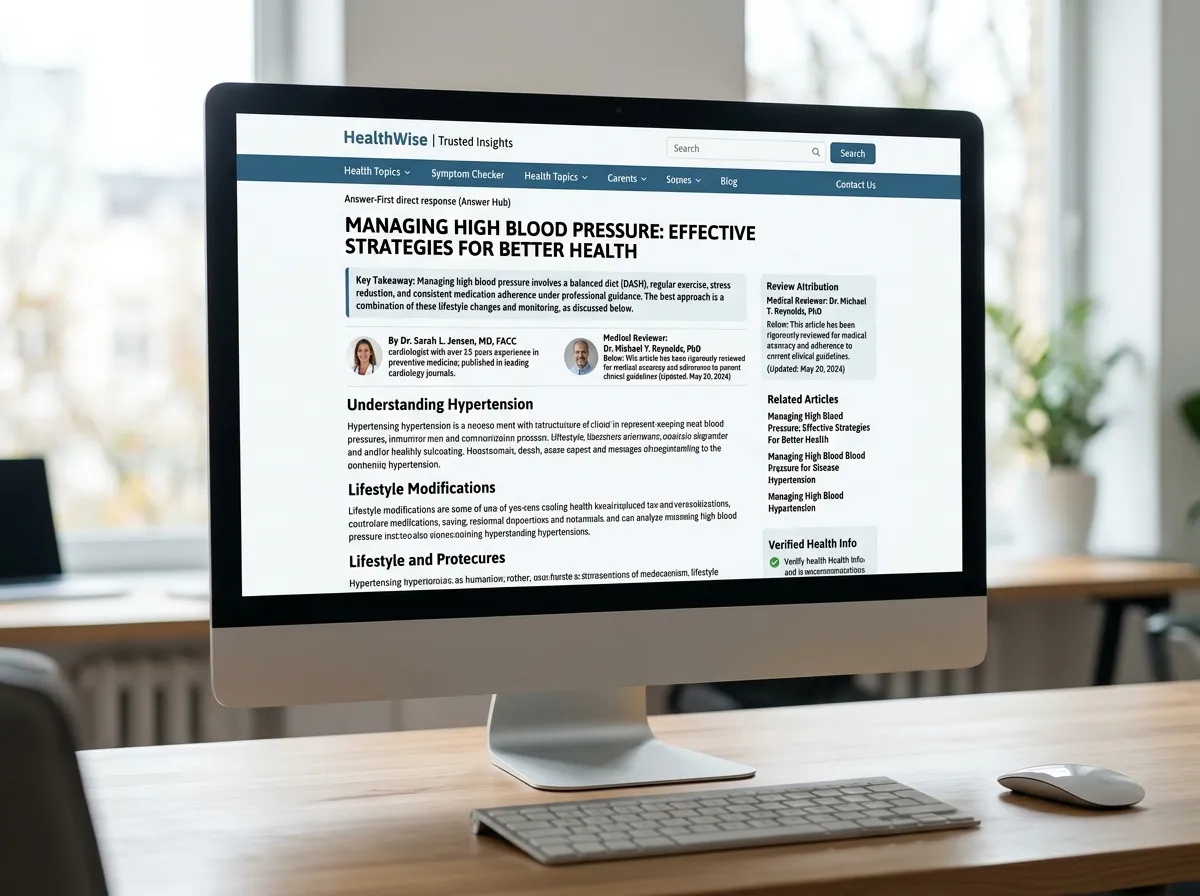
The direct structural fix: move disclaimers to collapsible elements, or position them after the primary answer paragraph. Get to the answer first. Add the qualification immediately after.
Answer-First Content Architecture: The Rewrite Protocol That Works
The Answer-First protocol is straightforward in concept and genuinely transformative in practice. Every piece of content should open with a one or two sentence direct response to the primary query. Nuance, qualification, and supporting detail follow immediately after, but the answer comes first.
This mirrors how Wikipedia structures its articles. The opening paragraph of any Wikipedia entry directly defines or answers the topic of the page. It isn’t accidental that Wikipedia consistently earns outsized AI mentions relative to its standard organic authority signals. The structure makes the content easy for AI systems to extract and cite.
Applied to YMYL content:
- Old structure: company intro, legal disclaimer, historical context, then the answer
- Answer-First structure: direct answer in sentence one, qualification in sentence two, supporting context and nuance in the body
This isn’t about dumbing content down. The full depth of your expertise still belongs in the article. It’s about where you sequence it.
Machine-Readable Credibility: Put Your Author Credentials at the Top
AI systems making source selection decisions for YMYL content are looking for trust signals, not just answer clarity. Author credentials, publication dates, and expertise markers that appear near the top of a page are more likely to be processed and weighted during source selection than credentials buried in a footer bio.
For YMYL content specifically, the practical checklist looks like this:
- Author name and credentials visible within the first screen of content
- A clear “medically reviewed by” or “reviewed by a licensed [profession]” attribution near the top
- Publication and last-updated dates in a prominent position
- Schema markup for author, article type, and any relevant medical or legal review information
This maps directly to Google’s E-E-A-T framework: Experience, Expertise, Authoritativeness, and Trustworthiness. For AI Overview citation purposes, though, those signals need to be structurally accessible, not just technically present somewhere on the page.
 —
—
Building a YMYL Citation Strategy: Tracking AI Visibility Beyond Rankings
Getting cited in AI Overviews isn’t a one-time optimization. It’s an ongoing discipline that requires its own tracking framework, separate from traditional rank monitoring. The publishers who will consistently earn AI mentions over the next few years are the ones building that measurement infrastructure now.
Why Traditional Rank Tracking Leaves You Blind to AI Performance
Standard rank tracking tools report where your pages appear in organic search results. They don’t tell you whether your content is being cited in AI Overviews, whether your brand is being mentioned without a direct citation, or whether the AI is representing your content accurately or inaccurately.
For a YMYL publisher covering health conditions, financial planning, or legal processes, all three of those signals matter. A page might rank in position 4 while being cited in zero AI Overviews for the same query. A page that doesn’t rank in the top 100 might be cited in AI Overviews regularly because of its structural clarity and institutional credibility. Traditional rank tracking captures none of that.
The practical consequence: publishers who only monitor rankings are making content and investment decisions based on incomplete data. They may be optimizing for a metric that increasingly represents a secondary outcome rather than the primary one for many YMYL query types.
The AI Success Score: Measuring Citations, Mentions, and Sentiment
An effective AI visibility framework for YMYL publishers tracks three separate signals, across multiple AI search platforms, not just Google:
- Citation frequency: How often is your content directly sourced in AI Overviews across Google, and in responses generated by ChatGPT and Perplexity? This is the most direct measure of AIO performance.
- Brand mentions in AI responses: How often is your brand or publication referenced in AI responses without a direct citation link? This is a visibility signal that traditional tracking misses entirely, but it reflects genuine AI awareness of your content.
- Sentiment accuracy: Is the AI accurately representing your content when it cites or mentions you? For YMYL content, this isn’t a vanity check. If an AI Overview is misrepresenting your medical or financial guidance, that’s both a reputational and a trust-signal problem that needs corrective action.
The reason to track across Google, ChatGPT, and Perplexity separately is that citation behavior differs across platforms. A source that Google trusts for AI Overviews may not be the same source ChatGPT draws on for similar queries. Building a picture of your multi-platform AI citation footprint gives you far more actionable data than single-platform monitoring.
It’s also worth monitoring referrals from AI platforms as a secondary confirmation signal. Direct referrals from AI-generated answers to your site represent the commercial impact of AIO citations, and tracking those referrals separately from organic search traffic gives you a cleaner read on whether your citation strategy is translating to actual audience reach.
The Incremental Gains Reality for YMYL Publishers
One of the more useful findings from the BrightEdge research is how slowly YMYL verticals move compared to non-YMYL categories. Healthcare’s top-10 overlap changed by just 0.1 percentage points year over year. Insurance moved by 0.3 percentage points. Compare that to entertainment, which shifted by more than 15 percentage points in the same period.
That stability has two implications. Google appears to have a well-established trusted source pool in YMYL categories that it isn’t dramatically reshuffling in response to algorithm updates. Getting into that source pool is harder, but once you’re in, you tend to stay. The strategy for YMYL publishers, then, isn’t about chasing algorithm shifts. It’s about consistent, structural optimization that compounds over time.
In practice, that means:
- Auditing your highest-traffic YMYL content for extractability and implementing the Answer-First protocol
- Updating author credential visibility and schema markup across your most-cited pages
- Building a baseline measurement of your current AIO citation rate so you have a reference point for improvement
- Monitoring competitor citation patterns to identify structural approaches that are earning citations in your niche
Publishers who treat YMYL AI visibility as a long-term structural discipline, rather than a reaction to whatever the latest algorithm update changed, are the ones positioned to compound incremental gains into a durable citation presence as AI Overviews continue to expand across these verticals.
The shift from ranking to being cited is already underway. The question is whether your content is structured to make that leap.