TL;DR
- Forrester research across 18,000 buyers in 2026 found that 80 percent of the B2B buying journey now happens without any vendor involvement, with the shortlist largely settled before a buyer makes contact.
- The Seer Interactive 2026 study covered 5.47 million queries and 2.43 billion organic impressions across 53 brands: brands present on AI Overview pages but not cited saw organic click-through rates fall 67 percent over 2025, while cited brands earned 120 percent more organic clicks per impression.
- A credibility-grade case study needs a named client, a quantified baseline, specific work performed, a defined timeline, outcomes in absolute terms, a client quote tied to the outcome and a named author with a linked profile, budgeting three to four weeks per case study.
- Editorial outreach is expected to convert at 10 to 15 percent, so five placements per quarter needs 35 to 50 individual contacts, while review requests assigned to account managers convert at 30 to 40 percent on warm personal outreach.
- Timelines given: four to six months for measurable movement in AI citation visibility with existing content and PR infrastructure, and six to nine months when building from scratch, with four roles running in parallel.
- Why Your Inbound Traffic Dropped and Pipeline Got Stronger
- 5 Steps to Get Cited by AI Before Your Competitor Does
- How Marketing Teams Can Coordinate This Strategy Without Starting From Scratch
Your inbound traffic dropped. Your sales team is quietly closing bigger deals. That’s not a coincidence, and understanding why could reshape how your entire marketing team operates in 2026. For two decades, B2B marketing ran on a simple enough logic: drive traffic, capture leads, convert pipeline. More volume at the top meant more revenue at the bottom. That model is fracturing, and AI Overviews are the main reason why.
AI Overviews have absorbed the early research phase of the B2B buying journey. Buyers are now arriving at your site much later in the decision process than they used to, often with a shortlist already formed and a vendor preference already leaning one way. The brands winning in this environment aren’t chasing traffic volume. They’re building credibility signals that AI models trust and cite. Those two things are very different strategies, and most marketing teams are still running the wrong one.
Why Your Inbound Traffic Dropped and Pipeline Got Stronger
Before your team treats declining organic traffic as a crisis, it helps to understand what actually changed on the search engine result page, and why some companies are seeing smaller but more productive pipelines as a result.
Where Your Top-of-Funnel Traffic Actually Went
When a procurement manager searches for something like “best CX outsourcing vendors for mid-market SaaS,” they don’t scroll through ten blue links anymore, they get an AI-generated summary that pulls vendor information from across the web, including case studies, review platforms, analyst mentions, and editorial coverage. A near-final shortlist forms before they ever click a single result.
This isn’t a temporary quirk of search behavior. According to Forrester research across 18,000 buyers in 2026, 80% of the B2B buying journey now happens without any vendor involvement. By the time a buyer makes contact, the shortlist is largely settled. The research phase still exists. It just doesn’t happen on your website anymore.
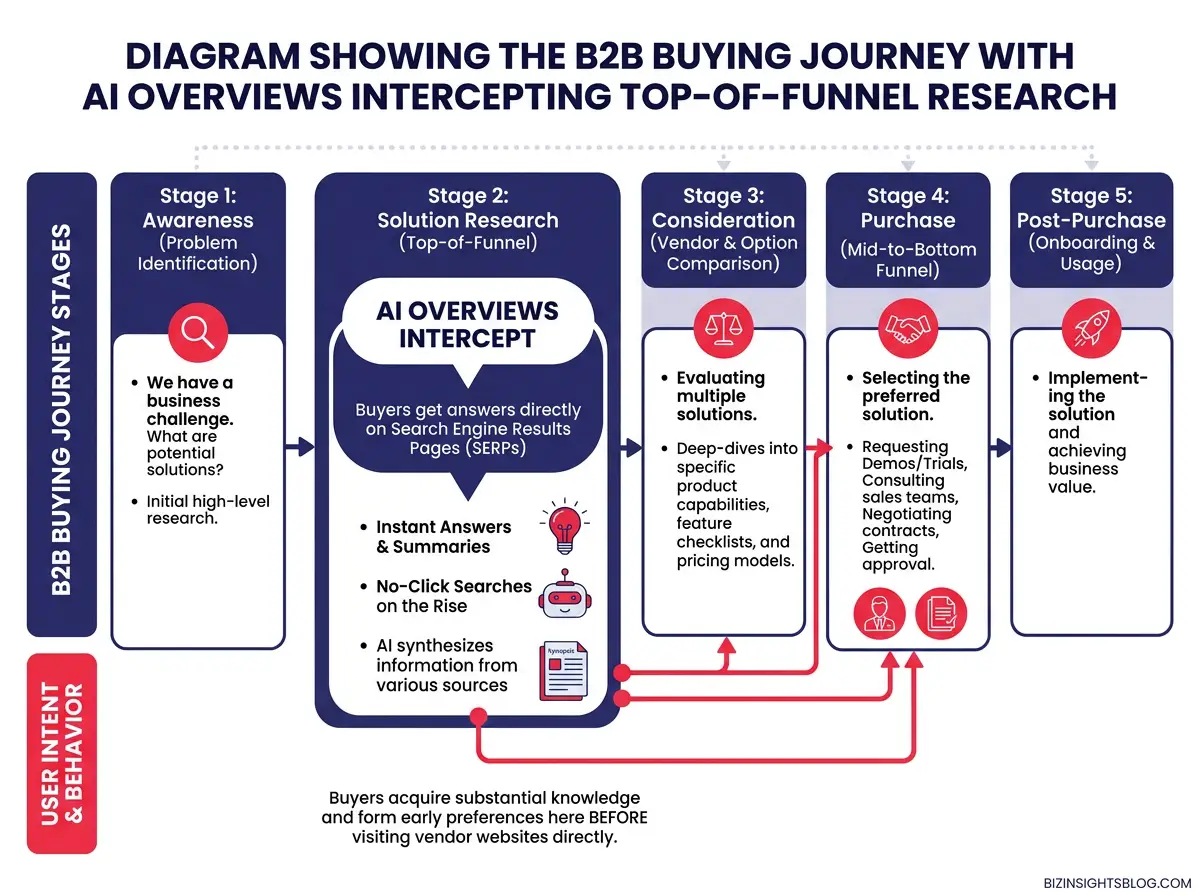 What this means practically is that your top-of-funnel content is being consumed at the search engine result page level, not on your landing pages. Informational queries that used to drive awareness traffic are now resolved by AI-generated answers. Your impressions may stay flat or even rise while clicks fall.
Why a Smaller Pipeline Is Probably a Better One
The Seer Interactive 2026 study, which covered 5.47 million queries and 2.43 billion organic impressions across 53 brands, found that brands appearing on AI Overview-present search pages but not cited within the AI Overview saw organic click-through rates fall 67% over 2025. Brands cited in the AI Overview earned 120% more organic clicks per impression than uncited competitors on the same page.
The gap is between cited and non-cited brands. It’s not a universal traffic collapse that hits everyone equally.
AI models surface vendors based on corroborated credibility signals. Vendors with strong third-party citations, named case studies, verified reviews, and editorial coverage get surfaced. Vendors without those signals get bypassed at the research stage, before a buyer ever forms an intent to contact them. They don’t rank lower. They simply don’t appear in the conversation.
What this produces is a filtered pipeline. Buyers who reach your site have already done their vendor research. They arrive with a procurement decision forming, not a discovery question. For sales teams, that shift means fewer tire-kickers and more conversations that actually go somewhere. For marketing teams, it means traffic volume matters less than it used to, and credibility signals matter more than they ever have.
5 Steps to Get Cited by AI Before Your Competitor Does
Getting an AI citation isn’t a passive outcome of publishing good content. It requires building a specific kind of presence across the platforms, publications, and databases that AI models actually draw from when generating answers.
Step 1: Audit Your Visibility
Before changing anything, you need to know where you actually stand. Pull your top 50 organic landing pages from Google Search Console over the last 90 days. Record query clusters, query types, and click-through rates. High impressions with low click-through on transactional queries points to a credibility problem, not a visibility gap.
Run a third-party mention audit using both Ahrefs and SEMrush. They return different datasets, so you need both. Classify each mention by type: editorial, directory, review platform, analyst citation. Calculate your ratio of earned mentions to unearned ones. For most B2B service companies, this ratio is worse than expected.
Then open ChatGPT, Claude, and Perplexity and run queries the way your buyer would. Screenshot every response. Note where you appear, how you’re described, which competitors surface consistently, and which sources seem to be shaping the answers. That audit tells you exactly what you’re working with.
Step 2: Fix Your Case Studies
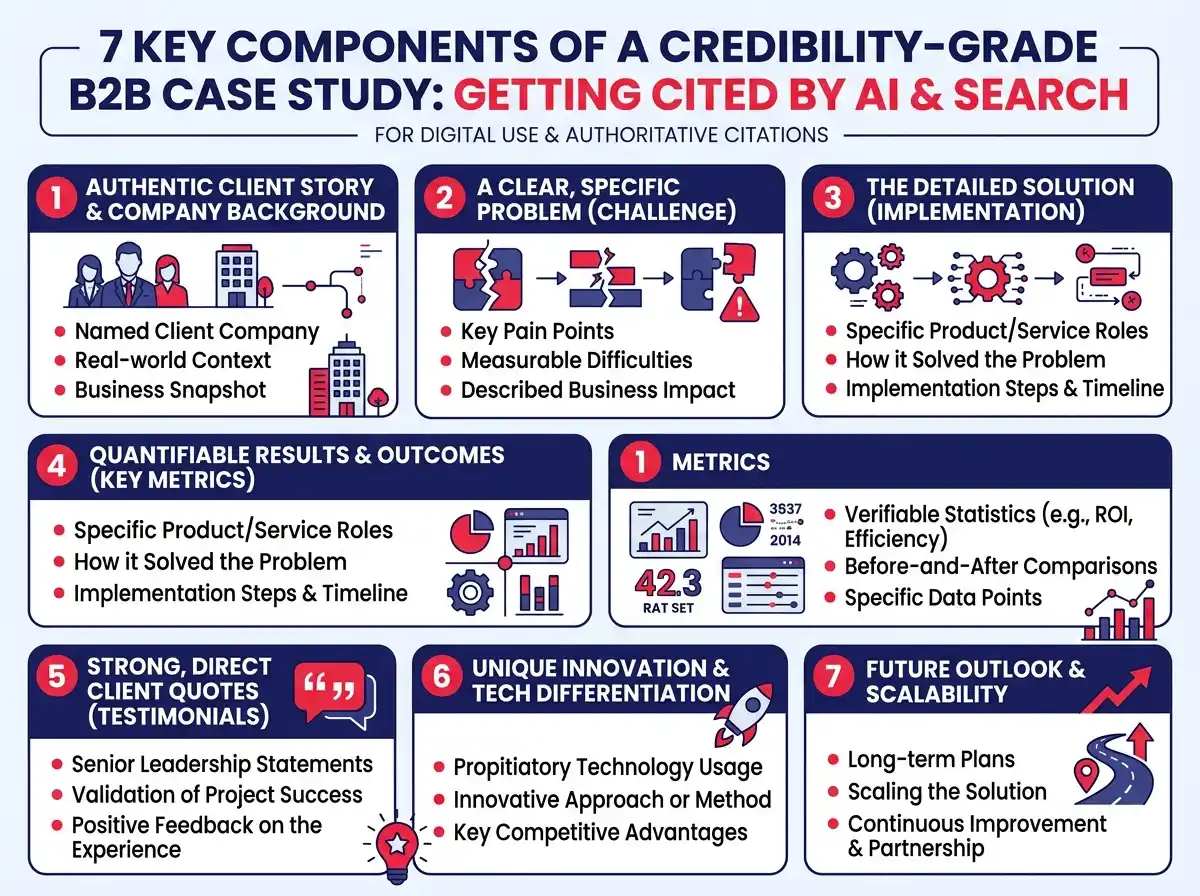
Fixing your case studies is the second priority, and most companies underestimate how much work this actually takes. A credibility-grade case study needs:
- A named or specifically described client
- A quantified baseline with actual numbers, not vague descriptions of a problem
- A specific description of work performed, including key decisions made
- A defined timeline with a clear start and end point
- Outcomes stated in absolute terms, not percentages alone
- A client quote tied to the specific outcome, not a generic endorsement
- A named author with a linked professional profile
Anonymous case studies with vague outcome language carry minimal weight with AI models or search algorithms. If your case study library is full of unnamed clients and phrases like “significant improvement,” you have a credibility gap that publishing more content won’t fix.
 Production requires scheduling structured interviews with both the client contact and your internal delivery lead, using a fixed template that forces specific metrics. Assign a named senior author (a real person with an existing professional presence) and get written client approval on a public metric citation. Budget three to four weeks per case study from interview to publication.
Step 3: Earn Editorial Placements
Getting an AI citation means showing up in the review platforms, editorial publications, and analyst reports that LLM systems draw from when generating answers. That requires intentional outreach, not passive content publishing. Build your media list from actual bylines published in the last 90 days in your category. For each pitch, write three paragraphs: why this story fits the editor’s beat right now, what the story is in one sentence, and what you’re offering. Expect a 10 to 15 percent positive response rate. For five placements per quarter, plan 35 to 50 individual outreach contacts.
Step 4: Build Your Review Platform Presence
Prioritize the platforms that came up in ChatGPT, Claude, or Perplexity citations during your Step 1 audit. Assign outreach to account managers rather than the marketing team. The request carries more weight from the relationship owner. Build the review request into your delivery process at 90 days post-engagement and at project completion. Expect 30 to 40 percent conversion on warm personal outreach.
Step 5: Establish Author Identity
Every team member who produces content needs a verifiable presence across multiple web properties. Update their LinkedIn with specific expertise domains. Create an author bio page on your website that links to their LinkedIn. Make sure all content links to that bio. When external placements land, include a link to their company author page in the byline. This gives an LLM system something to cross-reference. A named individual appearing consistently across your website, external publications, and LinkedIn reads as a genuine subject-matter expert rather than a brand voice. Without this infrastructure, even strong content produces a fraction of its potential credibility signal.
How Marketing Teams Can Coordinate This Strategy Without Starting From Scratch
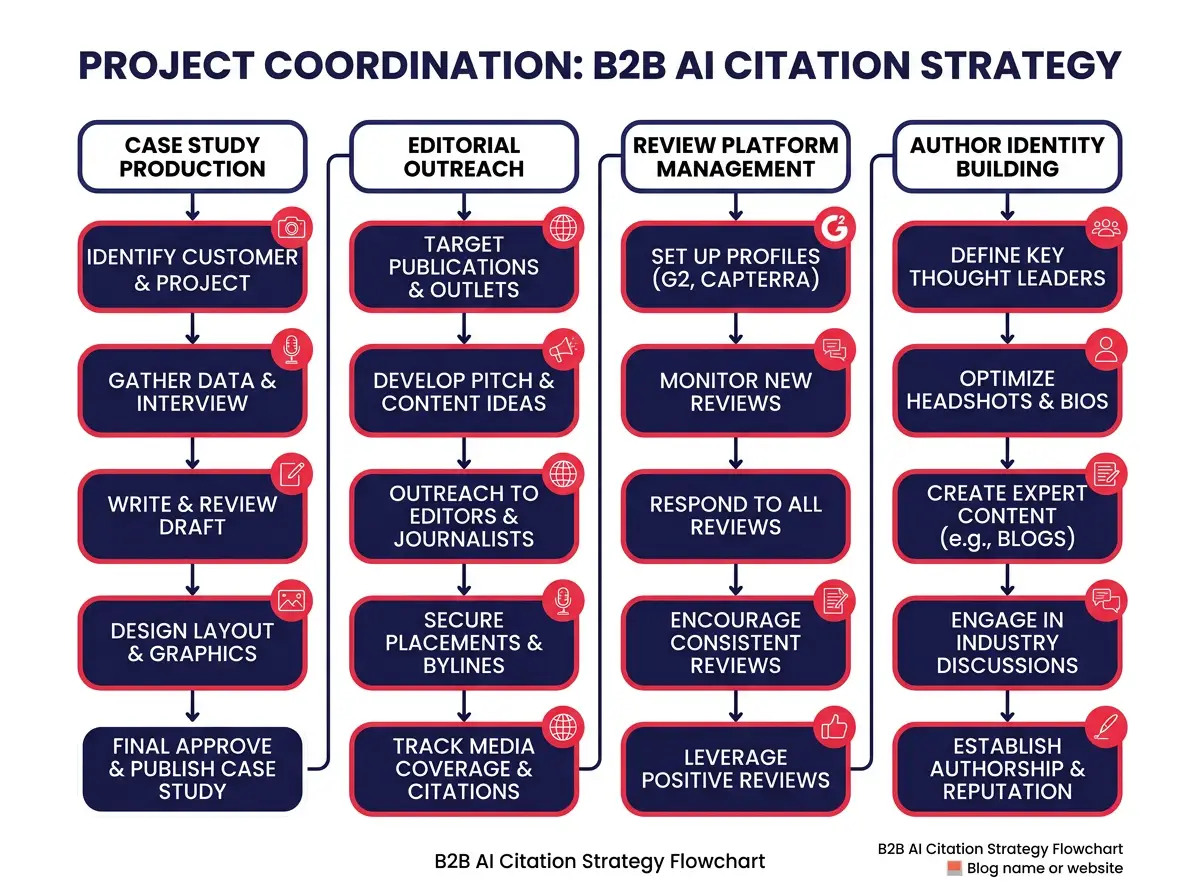
Running four to five workstreams in parallel is where most teams stall. The strategy makes sense on paper. The resourcing question is harder.
Who Owns What and When to Expect Results
At a minimum, running this well requires four roles working in parallel:
- A content strategist who can run structured client interviews and draft external publication pitches, not just blog posts
- An account management resource for review outreach, since relationship-based requests convert significantly better than marketing-driven ones
- A senior subject-matter expert available for media interviews and named author attribution on case studies and editorial pieces
- A project coordinator managing client approvals across multiple case studies simultaneously, since approval cycles are the most common bottleneck
Timeline expectations depend heavily on your starting point. For teams with existing content infrastructure and PR relationships, four to six months is a realistic window for measurable movement in AI citation visibility. For teams building from scratch, plan for six to nine months before seeing consistent results in AI-generated answers.
Trying to sequence these workstreams rather than run them in parallel pushes that timeline out considerably. The case study production, editorial outreach, and review platform work need to happen at the same time because they reinforce each other. Editorial placements reference case study outcomes. Review platforms provide social proof that editorial editors and AI models both weigh. Author identity trails make both more credible.
 ### Why Credibility Compounds Where Visibility No Longer Does
The older model of B2B search rewarded volume. More content meant more indexed pages, more indexed pages meant more impressions, and more impressions eventually meant more inbound traffic. That math is less reliable now.
What the AI search era rewards is corroborated credibility. A named author with editorial bylines, verified reviews on cited platforms, and structured case studies with real outcomes creates a consistent signal across multiple web properties. When an LLM system encounters content from that author, it can cross-reference that identity against external sources and weight the content accordingly.
That kind of credibility builds on itself. Each editorial placement strengthens the author’s verifiable presence. Each review adds to the platform-level signal. Each case study gives the AI more structured outcome data to draw from when generating vendor summaries. The compounding effect is real, but it takes months to establish and requires consistent execution across all channels at once.
Marketing teams running this strategy well are also shifting how they measure success. Organic traffic volume is still a metric, but it sits alongside AI citation frequency, review platform presence, and lead quality indicators like sales cycle length and deal size. Teams treating a traffic decline as a signal to publish more content are optimizing for a metric that matters less than it used to. Teams treating that same traffic decline as evidence of a credibility gap are solving the actual problem.
Traffic is a byproduct of credibility now. Building credibility first is the more durable approach, and based on where AI Overviews are headed, it may soon be the only approach that works at all.