TL;DR
- Ads follow you because your browser was added to an audience list on a site visit, not because a phone listened. The advertiser sees list totals, not names.
- Google needs at least 100 active users in 30 days for Display and at least 1,000 for Search and YouTube, with membership duration capped at 540 days.
- Meta website audiences look back up to 180 days, engagement audiences up to 365 days, which sets how long a follow up window can realistically run.
- Frequency capping exists on Display and Video campaigns under additional settings. Search has none, and all channel campaigns do not expose one.
- Thailand's PDPA took full effect on 1 June 2022: marketing tags must not fire before consent, and refusing has to work as easily as accepting.
Remarketing means buying ads shown only to people who already interacted with a business: visited the website, watched a video, added something to a cart and did not pay, or bought before. The reason the same ad follows you around is not that your phone is listening. Your browser was added to an audience list when you visited that site, and the ad auction keeps picking that list.
This article covers how remarketing and retargeting differ, the two pieces of psychology behind why repeated exposure works and where they stop working, the platform types with the limits that break plans, the six audiences worth separating, how to set a frequency cap, what Thailand's data protection law requires, and how to measure results without fooling yourself.
What remarketing is
The mechanism runs in three steps. First, the website carries the ad platform's tracking code, and when someone visits a defined page the system records that browser's identifier into an audience list. Second, the advertiser builds a campaign targeted only at that list. Third, when someone on the list opens a site or app that sells ad space, the system enters the real time auction for that slot, and the ad appears if it wins.
The most common misunderstanding is that the advertiser can see who you are. In practice the advertiser sees the size of the list and the campaign totals, not individual names. Major platforms also enforce a minimum list size before anything can be shown, partly so advertisers cannot work backwards from results to identify a person.
The other point worth separating is that remarketing is not customer acquisition. It works with people who already know the brand, so the number of people available is capped by how many visited earlier. With nothing bringing new people in, the list stays too small to do anything with. That is why this belongs as the second layer of a plan rather than the only layer.
How remarketing and retargeting differ
In everyday use the two words mean mostly the same thing, and the difference comes from the history of the terms rather than the mechanism. Google has always used remarketing in its documentation and inside its own interface, while parts of the ad technology industry use retargeting for behaviour based ads on the web and reserve remarketing for email follow up to people who abandoned a cart.
The useful advice is to skip the argument about words and ask three questions instead. Why did this person get added to the list, what message do they see next, and when do they leave the list. Those three decide the outcome. The label changes the cost per purchase by nothing at all.
The psychology of why repeated exposure works
The Zeigarnik effect
Bluma Zeigarnik, a Lithuanian psychologist, reported in 1927 that people remember interrupted tasks better than completed ones. That observation lines up neatly with an abandoned cart. Choosing a product, adding it, then stopping partway leaves an open loop in the buyer's head, so an ad showing the same product is not introducing something new. It is reminding them of something unfinished.
The caveat is that later attempts to reproduce the experiment gave inconsistent results. The size of the effect depends on how committed the person was to finishing. Someone who added an item while comparing prices does not carry the same sense of an unfinished task as someone who typed half a shipping address. Splitting audiences by how deep into the process they got matters more than blanketing everyone who touched a cart.
The effect of seeing something often
Robert Zajonc published his work on mere exposure in 1968, concluding that repeated encounters with the same stimulus make people like it more, even when they cannot recall seeing it. The usual explanation is that familiarity makes the brain process the thing more easily, and that ease gets read as a good feeling. In advertising terms, a brand someone has seen before gets chosen more often than one they have not, all else being equal.
The effect does not keep climbing though. Liking rises early, then flattens, and once exposure gets too frequent it turns into boredom and irritation, which advertising people call creative wearout. That is exactly why setting a frequency cap is a strategic decision rather than a technical setting.
Where both effects stop
Those two effects explain why repeated exposure helps. They do not mean that more frequency sells more. There is an opposing force called reactance: people who feel pushed into a choice push back, to preserve the sense that they are the one deciding. An ad that follows someone to the point of annoyance creates a negative that never shows up in campaign reporting, because people who lose interest do not click anything.
The workable conclusion is that frequency does the reminding while the content does the work of answering whatever stopped the purchase the first time. Raising frequency without changing the message is saying the same sentence louder, which has rarely changed anyone's mind.
Remarketing types by platform
Each platform builds audiences differently and carries limits that make a plan on paper unworkable if nobody checked first. The table below covers the ones that affect planning most.
| Platform | Audience built from | Limit to check before planning |
|---|---|---|
| Google Display Network | Site tag, page based lists and custom events | The list needs at least 100 active users in the last 30 days before anything serves, and membership duration tops out at 540 days |
| Google Search Network | The same lists, used to adjust bids or restrict targeting when the person searches again | Needs at least 1,000 people, and the ad only appears if someone in the list runs a matching search, so volume cannot be controlled |
| YouTube | Video viewers, channel interactions and website lists | Needs at least 1,000 people, and the channel has to be linked to the ads account first or there is no viewer data to use |
| Meta | Website pixel, uploaded customer lists, and engagement with a page or video | Website behaviour audiences look back a maximum of 180 days, while engagement audiences reach back up to 365 days |
| LINE and TikTok | Official account followers, people who watched a video to a set point, and web tags | Minimum sizes and data retention follow each platform's own rules, so check inside the live account before committing budget |
Beyond those five, two more channels work differently. The first is email, which follows up on abandoned carts with no cookie involved at all, because it relies on an address the person handed over. The second is buying media through automated systems, which reaches inventory well beyond the big platforms' own networks and suits campaigns that need tight control over where ads appear. That approach is covered on the programmatic advertising page.
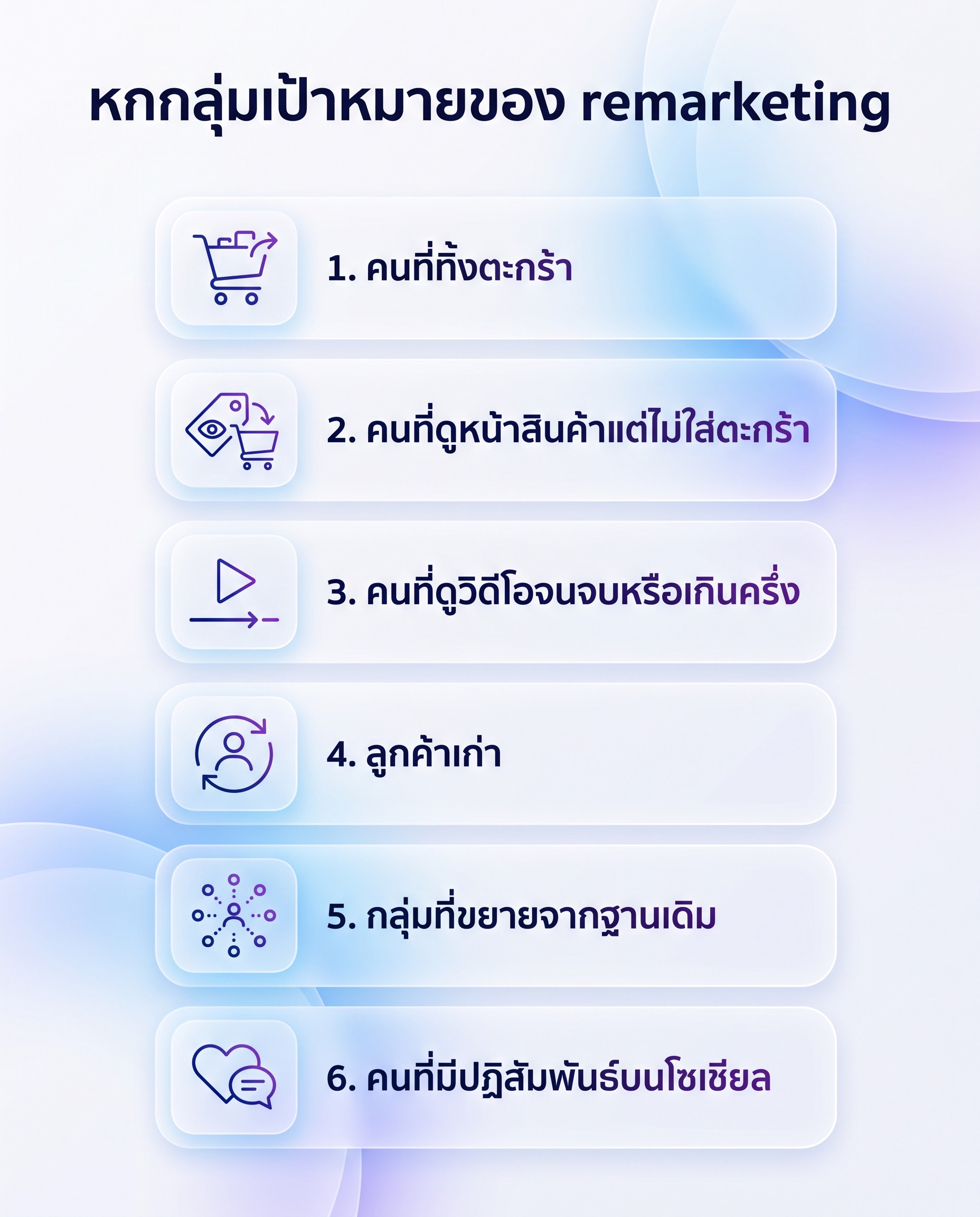
Six audiences worth separating
The mistake that hurts these campaigns most is putting everyone who ever visited into one list and sending them all the same message. Someone who read one article and someone who filled in half a payment form are in completely different states. The six below can all be built with standard tools.
- Cart abandoners are the highest value group and should see the same product together with answers on shipping cost and returns. The follow up window should be short, since intent falls off quickly after a few days.
- Product page viewers who did not add to cart are still comparing. What works is the reason to pick this model plus evidence from real users, not a discount, because cutting price before the decision throws away margin for no reason.
- People who watched a video past the halfway point or to the end gave a clearer interest signal than a scroll past. The right next step for them is a visit to the site, not an immediate sale.
- Existing customers should be excluded from acquisition campaigns and given their own, such as consumables due for reorder or products that pair with what they bought. Letting them see a first purchase pitch means paying again for something already won.
- Audiences expanded from an existing base, where the platform finds people resembling real buyers. This is not remarketing by definition, but it uses the same base as raw material, and its quality follows the quality of the source list. Feed it everyone who ever visited and the result is broad and shallow.
- Social engagers, meaning likes, comments, messages and saved posts. This group can be collected with no website visit at all, which makes it valuable for businesses whose traffic sits in apps rather than on the web.
Once the groups exist, the immediate next job is stopping them from overlapping. A person in both the cart abandoner list and the product viewer list gets counted twice and sees two sets of messages. The fix is always to add the deeper list as an exclusion on the shallower campaign.
Frequency capping: how much repetition is enough
The control is the frequency cap, which in Google Ads sits under campaign settings in the additional settings section and applies to Display and Video campaigns. It sets how many times one user may see an ad per day, week or month, counted at campaign, ad group or ad level. Search campaigns have no such setting, since ads appear only on a search. Campaigns that run across every channel at once do not expose a frequency cap either, which is a limit worth knowing before moving a whole budget there.
There is no standard number that works for every business, because it depends on price and on how long people take to decide. The rule that does hold is to cover the period during which that group actually decides. A few hundred baht item decided on the same day does not need thirty days of follow up. A service people compare over a month is abandoned too early if the follow up stops after seven days.
Three things belong alongside the cap. Exclude buyers the moment a purchase happens. Set membership duration to match the decision cycle rather than leaving it at the maximum default. Rotate the creative when accumulated frequency climbs, because what the audience tires of is the creative, not the brand.
Thai data protection law and the cookieless future
Thailand's Personal Data Protection Act took full effect on 1 June 2022. What touches advertising directly is that collecting and using data needs a lawful basis, the purpose has to be stated clearly before collection, and withdrawing consent must be as easy as giving it. In practice that means a cookie banner where refusing genuinely works, rather than one accept button, and marketing tags that do not fire before consent.
On the technical side, Safari and Firefox already block third party cookies by default, while Chrome announced a plan to end them, then delayed and revised it repeatedly, and has not removed them. The effect already in place is that cookie based audiences are smaller and shorter lived than the number on screen suggests, because some users drop out early without the system reporting it.
Three responses are available now. Collect data people hand over directly, such as an email or phone number from a signup or an order, and upload it as a customer list in hashed form. Move event collection to the server side to depend less on browser scripts. Use channels that carry their own subscriber base, such as email and official accounts on chat apps, which browser cookie policy does not touch.
How to measure without fooling yourself
Reporting on these campaigns usually flatters them, because they mostly serve people who intended to buy anyway. A share of those who left a cart and paid the next day would have come back with no ad at all, and the measurement system credits the last ad they saw.
Three things help. Separate conversions from people who saw an ad without clicking from conversions after a click, since the two carry very different weight and combining them inflates the result. Run a holdout, keeping a control group that sees no ads and comparing purchase rates, where the gap is what the campaign actually created. Run a geographic test by pausing ads in some provinces temporarily and checking whether sales there really drop.
The last two take time and give up some sales along the way, but they are the only way to answer whether the money added sales or simply moved credit from another channel. Businesses that never test tend to keep adding budget to whichever campaign looks most efficient in the report, which is the campaign overlapping most with sales that were happening anyway.
What this means in the Thai market
First, list size. Plenty of small and mid sized businesses do not get enough monthly visitors to clear platform minimums, particularly the thousand needed for search. Workarounds that hold up are combining several pages into one list, extending membership duration, and starting on the channels with lower minimums.
Second, a large share of Thai purchases finish inside a chat app or a marketplace app rather than on the brand's own website. Tracking only website events leaves the most committed buyers out of the lists entirely. Collecting audiences from social engagement and from official account followers is a main part of the plan here, not an optional extra.
Third, placement quality. Part of a display budget flows to mobile app inventory with a high rate of accidental taps. Checking the placement report monthly and cutting what produces nothing is one of the highest return jobs per hour spent, and it fits alongside general account management under Google Ads management.
Last, message spread across platforms. The same person can see the same creative on a social feed, on video and on a news site in one day, because frequency caps are set separately in each account and do not talk to each other. The way to reduce it is to assign each platform a stage of the path, letting Facebook ads handle people still comparing and YouTube ads handle explanation that needs to be seen, instead of every platform firing the same message at once.
Common mistakes and what each one costs
- One list used by every campaign. The cost is messages that do not match the recipient's state, plus reporting that cannot separate which group worked.
- Not excluding buyers. The cost is ad spend against people who already paid, plus discounts redeemed a second time for no reason.
- Leaving membership duration at the longest option without thinking. The cost is paying to remind people who have forgotten they were interested, which returns less than finding new people with the same money.
- Running one creative too long. The cost is rising accumulated frequency alongside a falling click rate, plus negative feeling toward the brand that appears in no report.
- Serving ads before consent. The cost is legal exposure and data that may have to be deleted in full later, which is far more expensive than setting the banner up correctly at the start.
Frequently asked questions
How much traffic does a site need before remarketing is possible?
For the Google Display Network the list needs at least 100 active users within 30 days, while use on the search network and on YouTube needs at least 1,000. A business below those thresholds should spend on becoming known first, because a campaign with an undersized list does not serve at all rather than serving less.
Why do ads keep following someone who already bought?
Because that campaign has no buyer exclusion set, or purchase tracking is broken so no signal of the purchase exists. The fix is to build a list of people who reached the order confirmation page and add it as an exclusion on every campaign aimed at the pre purchase stage. Recheck it after every website change, since the page used as the condition often moves without anyone announcing it.
What frequency counts as the right amount?
There is no standard number that suits every business, so set it from the decision cycle of the product, then watch two figures: average frequency per person and click rate over time. If accumulated frequency rises while the click rate keeps falling, the sensible point has passed, and the creative should change before the frequency drops.
Once third party cookies are gone, is remarketing finished?
No, but the base shifts from cookies to data people hand over and to server side event collection. Large platforms can still recognise users inside their own systems because those users are logged in. What takes the real hit is third party tracking across different websites. Businesses that start collecting emails and phone numbers properly now will feel the least of it.
Is it necessary to choose between remarketing and retargeting?
No, since in general use the two words describe the same mechanism. The questions worth asking instead are why this group was collected, what they see next, and when they leave the list. Those decide the outcome, while the label changes nothing in the ad account settings.
If building the audience lists, splitting messages by the recipient's state, controlling frequency across platforms and checking that data collection is lawful needs a team, the remarketing service from Relevant Audience covers it from the list structure through to testing whether the sales were genuinely incremental.