
TL;DR
- Email is not dead because of cost structure: once someone has consented, the next contact does not re-enter an impression auction. You pay in domain reputation instead.
- There is no reliable public Thai open-rate benchmark for 2026, so build your own baseline from the same message type to the same segment over several cycles.
- Apple Mail Privacy Protection pre-fetches images through a proxy, recording opens nobody made, which is why click rate is the sounder primary metric.
- The five automations worth building first fire on events, not a calendar: welcome, cart abandonment, post-purchase, re-engagement and VIP.
- PDPA consent must be separate from other terms, state its purpose, and be as easy to withdraw as to give. Keep the form wording as evidence, not just the timestamp.
Email marketing is not dead, and the reason has nothing to do with whether people enjoy reading email. It has to do with the cost structure of the channel. Email is a channel where you own the list, so contacting the same people a second time does not re-enter an auction for impressions the way platform advertising does. The incremental cost sits in the tool subscription, which is usually priced by contact count, plus the hours of the people doing the work.
The claim on the other side, that email returns more than any other channel, deserves the same scepticism. The figures passed around in sales decks rarely say which kind of business they came from, in which country, or which costs were counted. So this article cites no borrowed numbers. It explains the mechanism that makes email work or fail, then shows how to measure your own numbers well enough to decide something.
Why email marketing is not dead, and where the myth comes from
The feeling that email is dead usually comes from the marketer's own inbox: it is full of messages they never open, so they conclude customers behave the same way. The flaw is that a marketer's inbox is not a sample. Someone who signed up to hear from a brand they are about to buy from behaves nothing like someone whose address was added without their knowledge.
The second misreading is treating email as a competitor to LINE or social. The three sit at different points in a customer's path. Email is the searchable record, it carries documents and receipts, and it still works in Thai B2B when you have to send a quotation to someone who will not hand over a LINE contact. LINE has the advantage on immediate replies and on how reliably a message is seen. Picking one over the other is the wrong question.
The third misreading is about the numbers. Plenty of brands look at a report, see a low open rate, and write off the channel without checking whether the mail reached the main inbox or landed in a spam folder. If the problem is delivery, raising frequency or rewriting subject lines changes nothing, because people are not ignoring the message. They are not seeing it.
The mechanism that makes email economics different from bought media
In platform advertising, every time you want the same person to see your message again, you pay to enter another auction. The price per impression moves with how many buyers are competing for that audience at that moment, which is why the end of year costs more than an ordinary month without you doing anything wrong.
In email, once you hold an address the person consented to give, the next contact does not pass through an auction. The main cost moves to two places: the tool, priced by contact tier or send volume, and the time of whoever writes, configures and maintains the list. That is why the cost of sending again does not spike seasonally the way media rates do.
The trade is that you pay in domain reputation instead. Receiving providers decide whether your mail reaches the main inbox based on your sending history, how often people mark it as spam, whether your domain is authenticated, and whether unsubscribing is easy. Send to people who did not want it and the cost does not appear as media spend. It appears next month as your mail landing in spam folders, including the order confirmations customers are supposed to receive.
In the Thai market there is a clear comparison with LINE Official Account. Broadcasting through LINE OA is charged by message volume once the plan quota is used, so reaching a large audience repeatedly carries a visible per-send cost. Email shows its cost as a block tied to contact tiers. Neither is better; they should hold different jobs, and customer data should be connected across both. There is more on that under LINE CRM
There is no citable Thai open-rate benchmark for 2026, so how to measure your own open rate
There is no reliable public dataset for Thai email open rates broken down by industry for 2026. The figures that circulate in articles are usually global averages drawn from one provider's customer base, skewed toward the kinds of businesses that use that provider. Comparing them to your report cannot tell you whether you are doing well. Your own baseline can.
Before measuring, know how an open is counted. The system embeds a single tiny image in the message. When the mail client loads that image from the server, an open is recorded. This misses in two directions. First, someone who reads without loading images is never counted. Second, and more consequential, Apple Mail Privacy Protection, shipped with Apple's operating systems, pre-fetches images in email through a proxy, which records opens the recipient never made.
The consequence is that open rates on a list with many Apple users read higher than reality, and drift upward with the share of Apple users rather than with interest. If you have built automation that follows up whoever opened, you are following shadows instead of people. The metrics that survive this are click rate, and clicks measured against opens, because a click requires a person to act.
Here is the workable procedure. Do it once and use it as a long-running baseline.
- Open the campaign report in your sending tool, and read that tool's metric definition page first, every time. Providers set different denominators. Some compute open rate over messages delivered, others over messages sent, which diverge as soon as bounces are significant.
- Separate unique counts from total counts. A report counting every event inflates whenever one person opens repeatedly. Use the unique figure as your primary.
- If your tool can filter opens generated by image pre-fetching, turn that on and record the date you did, because reports either side of that date are not directly comparable.
- Compare only comparable things: the same message type, to the same segment, on a similar day and time. A welcome email and a promotional email were never comparable.
- Set the target on the downstream number instead: orders or leads that follow a click from email, checked against your own sales records rather than trusting the sending tool's report alone.
- Split the list by how recently someone engaged: clicked in the latest cycle, clicked once but long ago, never clicked. Measure the three separately, because combining them hides both the good and the bad.
Read the receiving side alongside this. Google Postmaster Tools shows the reputation of the domain you send from, your authentication results, and the rate at which recipients report your mail as spam. If your sending tool looks healthy and this does not, your problem is delivery, not copy.
Five email automations worth building first
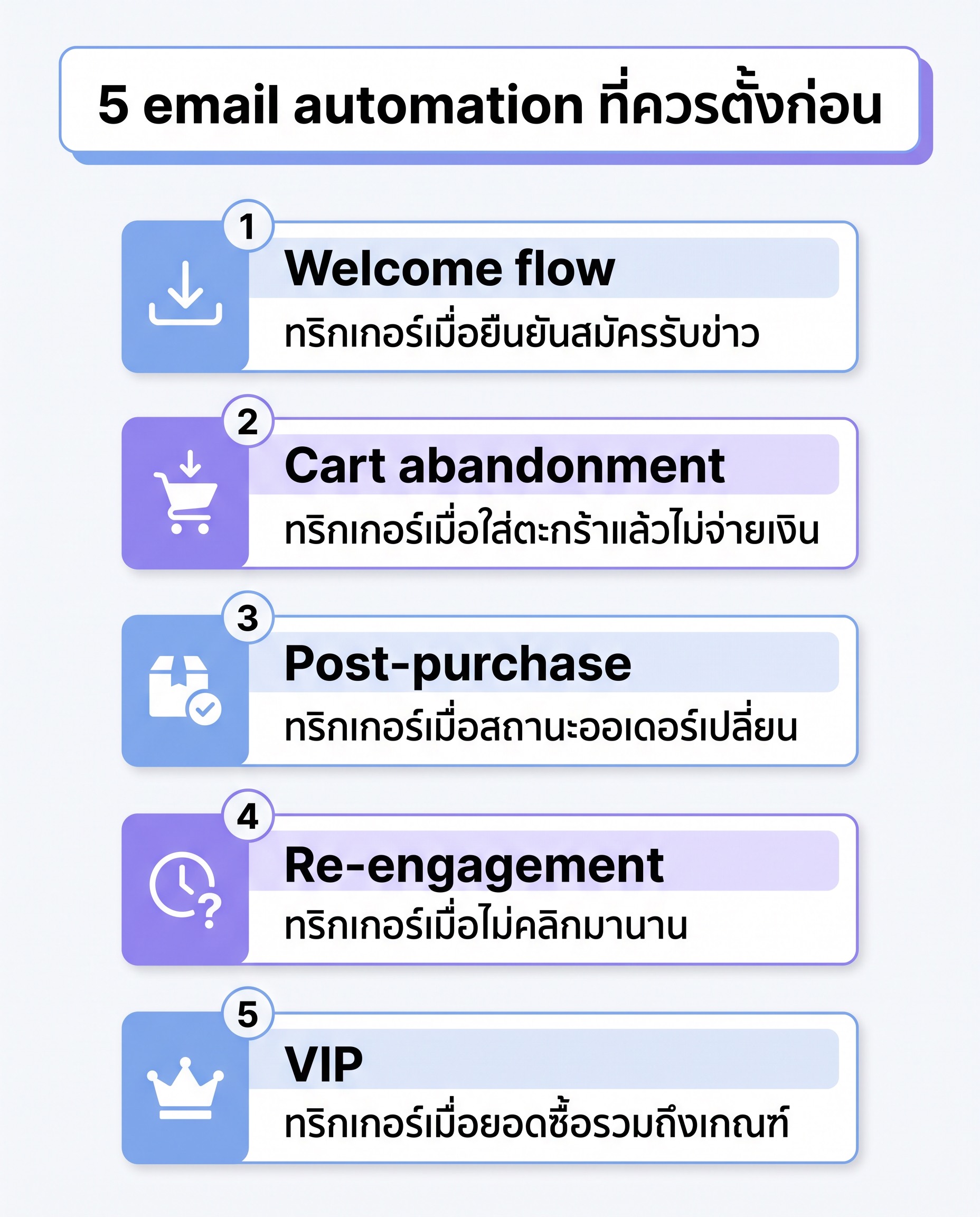
The order below runs by ease of setup against payoff. Each one fires on an event the system can detect, not on a send calendar. The advantage of automation is that you write it once and it keeps working; the disadvantage is that a mistake also keeps working, so send a test to a real inbox of your own before switching any of them on.
- Welcome flow, triggered on confirmed signup. Send it immediately, while the person still remembers filling in the form. Two things belong in it: confirmation of what they will receive and how often, and the single action you want next.
- Cart abandonment, triggered when something is added to a cart and payment does not follow. Your store platform has to pass both events into the sending tool, the add and the completed payment. Pass only the first and you will chase people who already paid.
- Post-purchase, triggered on an order status change such as paid or shipped. Use it for how to use the product, when a repeat purchase makes sense, and a review request. People open these because they concern something they actually bought.
- Re-engagement, triggered when someone has not clicked for a long window you define. Ask directly whether they still want to hear from you and offer a lower frequency. If they do not respond, stop sending rather than sending more, because raising frequency to a disengaged audience is the direct route to spam complaints.
- VIP, triggered when cumulative spend crosses a threshold you set. Use it for early access, a direct contact, or something not sold publicly. The group is small and tends to respond to things that are not discounts.
The table sets out email automation triggers and timing alongside the data each flow needs and what to measure. The middle column is the one most often skipped, because an automation that never receives events from the store platform simply does not run.
| Flow | Events the system must pass in | What to measure |
|---|---|---|
| Welcome flow | Confirmed signup, with the source form recorded | Clicks to the intended page, and a first order within a window you define |
| Cart abandonment | Add to cart and completed payment, both required | Orders recovered, checked against the order list in the store platform |
| Post-purchase | Order status changes and the items in the order | Repeat purchase rate you calculate from store data, and reviews submitted |
| Re-engagement | Date of each contact's most recent click | How many click again, and how many should be suppressed when the flow ends |
| VIP | Cumulative spend or order count per contact | Repeat purchase rate for this group against the rest of the list |
Wiring up that middle column is the part that consumes the most time in a real email project, because the store system, the customer system and the sending tool all have to agree on customer and order identifiers. If your back office runs on separate systems, read the scope of ERP and CRM integration before starting.
Why Thai brands run email and get nothing back
The failure patterns repeat, and nearly all of them are fixable before the first send.
- The list did not come from consent. Bought lists and scraped lists carry a legal problem first, and a technical one second: they tend to contain addresses seeded specifically to catch senders without consent. Send to one and your domain reputation drops, taking your order confirmations with it.
- One message to everybody, with no split by how recently people engaged. Someone actively shopping gets the same message as someone who forgot the brand two years ago.
- Thai subject lines cut mid-word on mobile. Thai does not put spaces between words, so the client truncates by displayable characters. Put the word that identifies the subject at the front, and let the preview text carry the rest.
- Sending from a domain with no authentication. Major providers require bulk senders to authenticate with SPF and DKIM, publish a DMARC policy, and offer one-click unsubscribe through the message headers. Miss those and mail can be rejected before anyone reads it.
- An email that is one large image. When the client does not load images the recipient sees an empty block and no open is recorded. Build with real text and use images as support.
- Nobody owns it. Email gets done by whoever has a free afternoon, nobody reads the reports, and nobody remembers what went out last month, so the same content ships again and nothing is learned.
- Never suppressing the permanently unresponsive. Addresses that never open and never click become a drag, because receiving providers read engagement share as a signal. Keeping them because the list count looks better makes delivery harder for the people who do want to read.
The cheapest precaution is to send marketing mail from a subdomain separate from the one carrying system mail such as receipts and order confirmations. If a campaign damages reputation one day, the system mail does not fall over with it. This is a one-time setup decision and much harder to retrofit.
PDPA and consent for email
Thailand's Personal Data Protection Act requires consent to be clear, separate from other terms, specific about the purpose the data will be used for, and as easy to withdraw as it was to give. In practice that rules out pre-ticked boxes, and it rules out folding acceptance of marketing email into the same line as acceptance of the terms of service.
What you should keep as evidence is a record of when consent happened, on which page, and what the wording said at that moment. If a complaint arrives, that record is what you produce, not a reconstruction after the fact. Most sending tools already store the timestamp and the signup source, but not the text on the form, so save a copy or a version of the form yourself each time you change the wording.
The unsubscribe link is the other common gap. It has to work, and take effect quickly, without a login step first and without demanding a reason. Making it hard does not retain anyone. It converts unsubscribes into spam complaints, which cost you considerably more in domain reputation.
This describes the general mechanism and is not legal advice. If your business handles sensitive data or transfers data out of the country, have counsel review your form wording and privacy policy before you use it.
How email and LINE should divide the work in Thailand
In Thailand, LINE is where consumers normally talk to brands. Email still holds three things LINE does not handle well. Documents first: receipts, quotations and attachments that need to be found again later. B2B second, because decision makers inside companies still work in a corporate mailbox. Ownership third: an email list can be moved to another tool, while a platform following cannot.
A workable split gives LINE the work that needs a reply and urgency, and gives email the work that needs detail and a paper trail, with customer identifiers joined across both so one person does not receive the same message twice in a day. The thing to avoid is collecting both an email address and a LINE contact on one form without saying what each will be used for, which conflicts with the requirement to state a purpose.
An application still underused in Thailand is feeding your existing customer addresses into advertising platforms as an audience. The major platforms accept hashed lists to match against their users, which lets you either reach existing customers or exclude them from campaigns meant to find new ones. Check that your consent wording covers this use before you do it. There is more on audience structure under remarketing.
FAQ on email marketing
Is email marketing dead for Thai businesses?
No, and the reason is cost structure rather than popularity. Once you hold addresses people consented to give, the next contact does not require buying impressions again. What is genuinely finished is the single newsletter sent to everyone with no segmentation and no triggering event. That format returns less every year, because recipients and filtering systems both got better.
What counts as a good email open rate?
There is no central figure that answers this honestly, and that is the most useful answer available. Open rates are inflated by image pre-fetching in some mail clients, and the denominator differs between tools. The workable method is to build your own baseline from the same message type sent to the same segment over several cycles, then move your primary metric to clicks and the orders that follow.
Can we buy an email list?
No, and not only for ethical reasons. Bought lists tend to contain addresses planted to catch senders operating without consent. Once you hit one, your domain reputation suffers, and that hits the system mail customers need, such as order confirmations. On the legal side, sending without consent that names a purpose is exposure under the Personal Data Protection Act.
How often should we send?
Let frequency be set by two numbers from your own list: the unsubscribe rate and the spam complaint rate, read against clicks each cycle. If raising frequency raises total clicks while unsubscribes and complaints hold steady, that frequency is affordable. If clicks stay flat while unsubscribes rise, you are burning the list for a short-term number. State the frequency at signup so people can choose it themselves.
Should we run it in house or buy the service?
If someone on your team can build the form, write the content and read the report, start with a single welcome flow and finish it properly. The work that usually pays to buy is the data connection between the store platform and the sending tool, domain authentication, and the segment structure set up correctly at the start, because all three are hard to retrofit and are where projects most often collapse.
If you would rather set the plumbing up correctly from the start, Relevant Audience builds list structure, automation and back-office data connections. See the scope of email marketing services, and if your customers live mainly on LINE, read it alongside LINE CRM so both channels work from one set of customer data.