TL;DR
- Meta has moved Advantage+ into the standard ad creation flow, with Advantage+ Audience and Advantage+ Placements enabled by default in new campaigns.
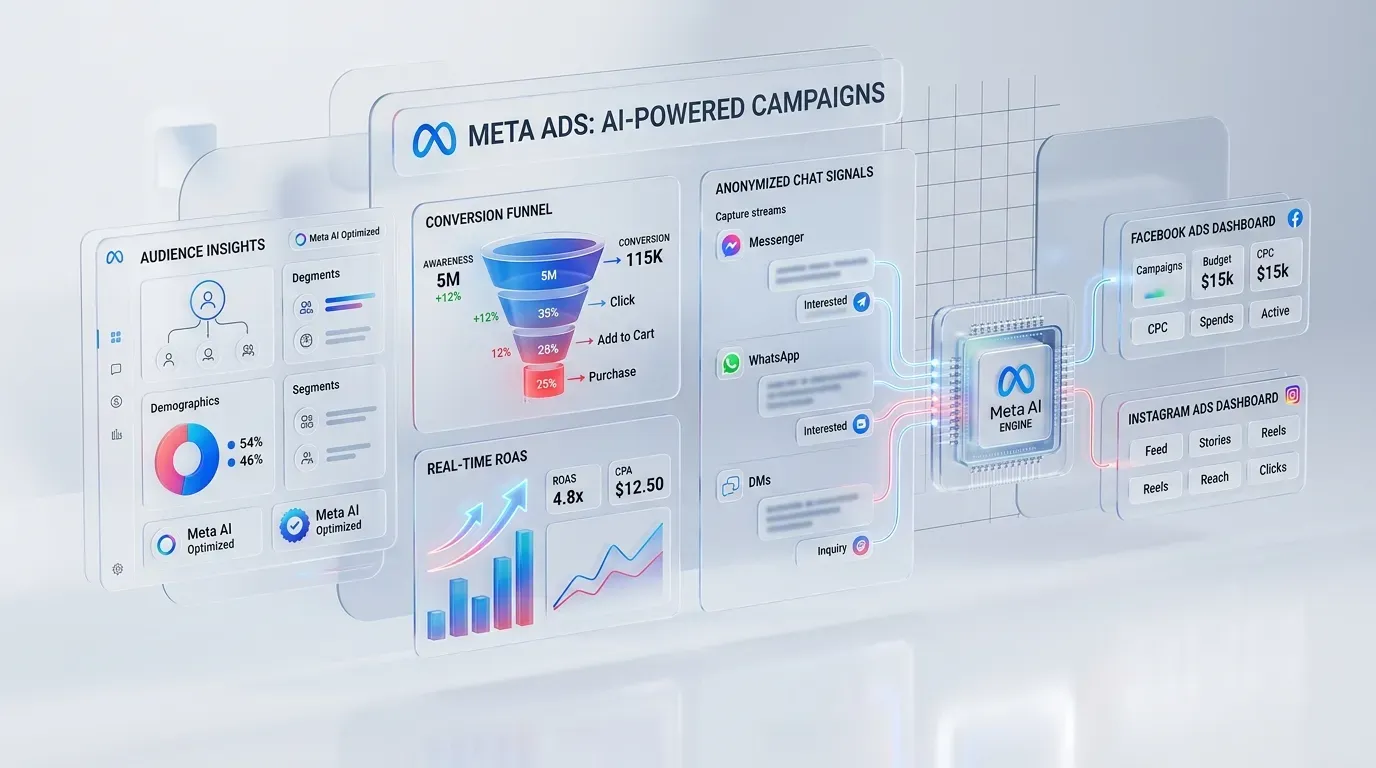
- The Opportunity Score is a 0-100 indicator of how well a setup fits Meta's optimization; the formula is not public, but it rewards Advantage+ being on, fewer overlapping interest groups, diverse creative and clean pixel and Conversions API signals.
- Meta says its newest ad models are four times more efficient at extracting gains from the same data and compute and twice as effective at transferring knowledge across contexts, over a base of more than three billion active users.
- Advantage+ Placements opens delivery across Facebook, Instagram, Audience Network and Reels, while geography, age, language and exclusion guardrails stay under the advertiser's control.
- Launch guidance: at least three creatives per ad set in 1:1, 9:16 and 16:9, a stable daily budget aiming for 50 or more optimization events a week, and no major edits for the first 3 to 5 days because each one resets learning.
Introduction
Meta is shifting toward automation in 2025, with AI-powered recommendations that have proven their value over the past few years. Meta is integrating more Advantage+ features into the standard ad-creation flow rather than treating them as an optional, secondary path. These tools now live within your normal setup process, often switched on by default. The goal is simple: let the system find the best people and placements at scale, with less manual guesswork and fewer delivery constraints.
You'll see a new Opportunity Score built into the interface, a 0–100 indicator that scores how well your campaign setup is positioned to benefit from Meta's optimization. Used correctly, it can help you catch missed fundamentals and unlock quick wins. But used carelessly, it can tempt you to chase a number rather than what truly drives profit. This guide will walk you through what's changing, how Advantage+ works under the hood, and how to use these updates to improve your results while staying in control.
What's Changing in Meta's Ad Setup
The most important change is how deeply automation is now embedded in the creation flow:
- Advantage+ options appear in budget, audience, and placements during campaign setup
- Advantage+ Audience and Advantage+ Placements are enabled by default in new campaigns
- The Opportunity Score shows the potential to improve performance through automation and best practices
Meta reports that its latest AI-powered ad systems are significantly more powerful than previous generations. According to Meta, the new models are four times more efficient at extracting gains from the same data and compute, twice as effective at transferring knowledge across contexts, and faster thanks to greater computing resources. Combined with a base of more than three billion active users, Meta's AI systems can learn quickly, detect intent signals, and find pockets of performance that manual setups often miss.
Why This Matters Now
- Broader signals: Privacy changes have reduced the granularity of single-user tracking. AI systems fill the gaps by learning from aggregated behavioral patterns, creative signals, and conversion feedback.
- Creative becomes the lever: Because audiences are broader, the quality and relevance of your creative sends the strongest signal to the algorithm about who should see your ad next.
- Faster feedback loops: With more data, models adjust bids, placements, and audiences in real time, so small gains compound into big results.
How the Opportunity Score Works
The Opportunity Score is a quick summary of how well your setup aligns with Meta's recommended best practices for performance and machine learning. While the exact formula isn't public, cross-account patterns show that it generally rewards:
- Enabling Advantage+ Audience and Advantage+ Placements
- Removing narrow interest groups and overlapping audiences
- Providing diverse creative and multiple formats
- Using clear conversion goals and quality conversion events
- Ensuring the pixel and Conversions API send clean, timely signals
- Enabling budget optimization at the campaign level when appropriate
What Moves the Score
- Setup completeness: Adding events, enabling placements, verifying your domain, and mapping events sensibly tends to raise the score.
- Signal quality: Accurate, deduplicated server and browser signals lift the score and improve delivery stability.
- Creative coverage: Having a variety of aspect ratios and creative types helps the system match people, placements, and messaging more effectively.
When to Ignore the Score
- If a recommendation conflicts with brand safety standards or legal requirements
- If your offer requires narrow geographic limits or compliance (for example, age-restricted services)
- If a change would break optimizations that have already been proven in controlled tests
Use the score as a guide, not a target. Profit matters more than a perfect score of 100.
How Advantage+ Actually Works
Advantage+ is a suite of automation features that adjusts your delivery variables for you.
Budget
Campaign-level budget optimization can route spend toward the ad sets and ads that deliver the highest return based on live performance signals. It learns how your mix of creative, audience, and placements builds toward your objective and adjusts the budget accordingly.
What it fixes:
- Poor delivery in strong ad sets due to rigid allocation
- Wasted spend on weak segments due to manual constraints
- Slow responses to performance changes
Audience
Advantage+ Audience starts from a broad reach range and lets the system find the people most likely to convert, using conversion data, on-platform behavior, and creative signals. You can still add guardrails such as geography, age, language, and exclusions.
What it fixes:
- Interest groups that are too narrow and overlap among similar audiences
- Audience fatigue from narrow targeting
- Intent channels you can't see but the model can
Placements
Advantage+ Placements opens delivery to all available placements across Facebook, Instagram, Audience Network, and Reels. The model finds the performance and cost efficiency you often miss with manual placement selection.
What it fixes:
- Overpaying for a single placement (for example, Feed only)
- Missing cheap, incremental reach in Stories or Reels
- Mismatching creative aspect ratios with where the audience actually is
The Pros and Cons of Leveraging Meta's Automation
Pros
- Scale: The models evaluate more signals than any human could across billions of impressions.
- Efficiency: Faster learning cycles reduce wasted testing and accelerate optimization.
- Flexibility: Broader targeting and placements reduce volatility in the auction.
- Simplicity: Fewer knobs to tune reduces setup time and human error.
Cons
- Less direct control: You can't manage the exact path the system takes to reach your goal.
- Diagnostic transparency: It can be hard to pinpoint why results changed on a given day.
- Creative pressure: Weak creative is penalized faster because the targeting safety net is smaller.
The net result for many advertisers is positive—Meta reports significant gains for brands that adopt these tools—but guardrails and measurement discipline are essential.
Setup Steps You Can Use Today
Pre-Setup Checklist
- Confirm that your primary events align with your core business goals
- Install both the pixel and the Conversions API, and make sure events aren't duplicated
- Verify your domain and prioritize events for Aggregated Event Measurement
- Prepare at least three creatives per ad set in different aspect ratios (1:1, 9:16, 16:9)
- Build a clean exclusion list (past purchasers if appropriate, churned users, or sensitive segments)
Build the Campaign
- Objective: Choose a conversion or sales objective that reflects your KPI.
- Budget: Start with a campaign-level budget. Avoid over-fragmenting early on.
- Audience: Use Advantage+ Audience with age/geo guardrails. Avoid stacking interests unless required.
- Placements: Leave Advantage+ Placements on. Provide creative suited to vertical video and feed.
- Creative: Use a mix of formats (static, short video, UGC style, product demos). Add clear value and CTAs.
- Learning: Give each ad set a stable daily budget so learning can stabilize (often 50+ optimization events per week, if possible).
Guardrails at Launch
- Frequency: Monitor ad frequency to prevent fatigue early on. Rotate creative rather than splitting audiences.
- Limits and exclusions: Use block lists and brand safety settings if needed.
- Pacing: Avoid major edits in the first 3–5 days. Each major change resets learning.
Creative Strategy in an AI-First System
As targeting broadens, your creative becomes the primary target. The model studies the content of your ad, a key part of Content Marketing, to infer who is likely to engage and convert. This is where meta ai stands out when you give it clear, distinct signals.
Signals Your Creative Should Send
- Who it's for: Show the audience within the first few seconds (role, problem, context).
- What it does: Demonstrate the core outcome, not just features.
- Why now: Add urgency or a timely hook (limited sale, seasonality, price change).
- Proof: Quick social proof—ratings, quotes, a fast before/after, or user-generated elements.
- Clarity: One offer, one CTA, clean visuals, and copy that's easy to read on mobile.
Testing Without Wasting Budget
- Swap creative, not audiences: Leave Advantage+ Audience on and test messaging.
- Test big angles: Change the angle (problem, solution, status), not minor variations.
- Use holdout logic: Run tests with a control cell if budget allows.
- Refresh frequency: Rotate or repeat every 2–3 weeks or when you see signs of fatigue.
Measurement, Learning, and Performance
Automation will find a path to your goal. You still need to verify that the goal aligns with real business outcomes.
- Event integrity: Track events that correlate with revenue or qualified opportunities—the core goal of a Lead Generation Service—not vanity actions.
- Attribution window: Choose a window that reflects your sales cycle. Review both click-through and view-through data.
- Lift testing: A geo or audience holdout, run periodically, reveals the true lift beyond optimization or other channels.
- Cohort returns: Compare CAC or ROAS, key metrics in Ecommerce Marketing, across new and existing customers to detect LTV differences.
- Trend checks: If platform-reported results jump but overall sales don't, investigate your tracking or other leakage.
Meta notes that time spent watching video on Facebook and Instagram has increased significantly year over year thanks to improvements in its recommendation system. This extra attention can benefit your reach, but make sure your KPIs account for quality outcomes, not just cheaper impressions.
Privacy, Control, and Brand Safety
AI-first doesn't mean a free-for-all on control. Build responsible guardrails:
- Geographic and age limits: Set mandatory boundaries at the ad-set level.
- Inventory filters and block lists: Exclude categories and pages that don't fit your brand.
- Sensitive categories: If you're in a regulated sector, lock your compliance settings first, then scale.
- Data handling: Keep your Conversions API secure, deduplicate events, and respect users' privacy choices.
- Creative claims: Support benefits and explicitly disclaim limitations to avoid policy issues.
Common Mistakes to Avoid
- Fighting the model with tight interest groups and many tiny ad sets. Start broad, then let creative and conversion signals guide delivery.
- Starving learning with budgets that are too small. If the budget is limited, run fewer ad sets with stronger creative depth.
- Over-editing in the first week. Major changes reset learning and blur what's working.
- Testing too many minor variations. Focus on bold creative differences to unlock new demand.
- Chasing the Opportunity Score at all costs. Follow it when it aligns with brand and legal constraints, and ignore it when it doesn't.
Frequently Asked Questions
Can I still use lookalike audiences and interest groups?
Yes, but Advantage+ Audience often outperforms stacked interest groups. Use lookalikes when you have quality seed data, and add guardrails or limits as needed.
What if my brand requires strict control?
Maintain the necessary age and geographic limits at the ad-set level. You can still benefit from Advantage+ Placements and budget optimization within those boundaries.
Do I need a lot of creative?
You need enough variety for the system to match messaging to people and placements. Three to five strong variations is a good baseline.
How long should I wait before making changes?
Give it at least 3–5 days unless there's a clear problem. After that, iterate on creative first, then consider budget and bid changes.
How does “meta ai” relate to all of this?
The term meta ai refers to Meta's broader AI capabilities that power recommendations, ranking, and optimization in Facebook Ads. It's really the engine behind Advantage+ features and the Opportunity Score, learning from patterns to deliver your objective at a lower cost.
Conclusion
The shift to native Advantage+ in Meta's standard creation flow is more than a UI change. It's a strategic bet on automation. With Advantage+ Audience and Placements enabled by default and the Opportunity Score guiding your setup, the platform is steering advertisers toward broader signals, faster learning, and creative-driven optimization. For most brands and Agencies, that means better scale and efficiency—as long as you provide clean conversion signals, creative variety, and clear guardrails.
Use the Opportunity Score as a useful checklist, not an end in itself. Leave Advantage+ on unless there's a compliance or brand-safety reason not to. Invest in creative that immediately signals who it's for and why. Verify results with sensible attribution and periodic lift tests. With these practices in place, you can put Meta's automation to work without losing control.