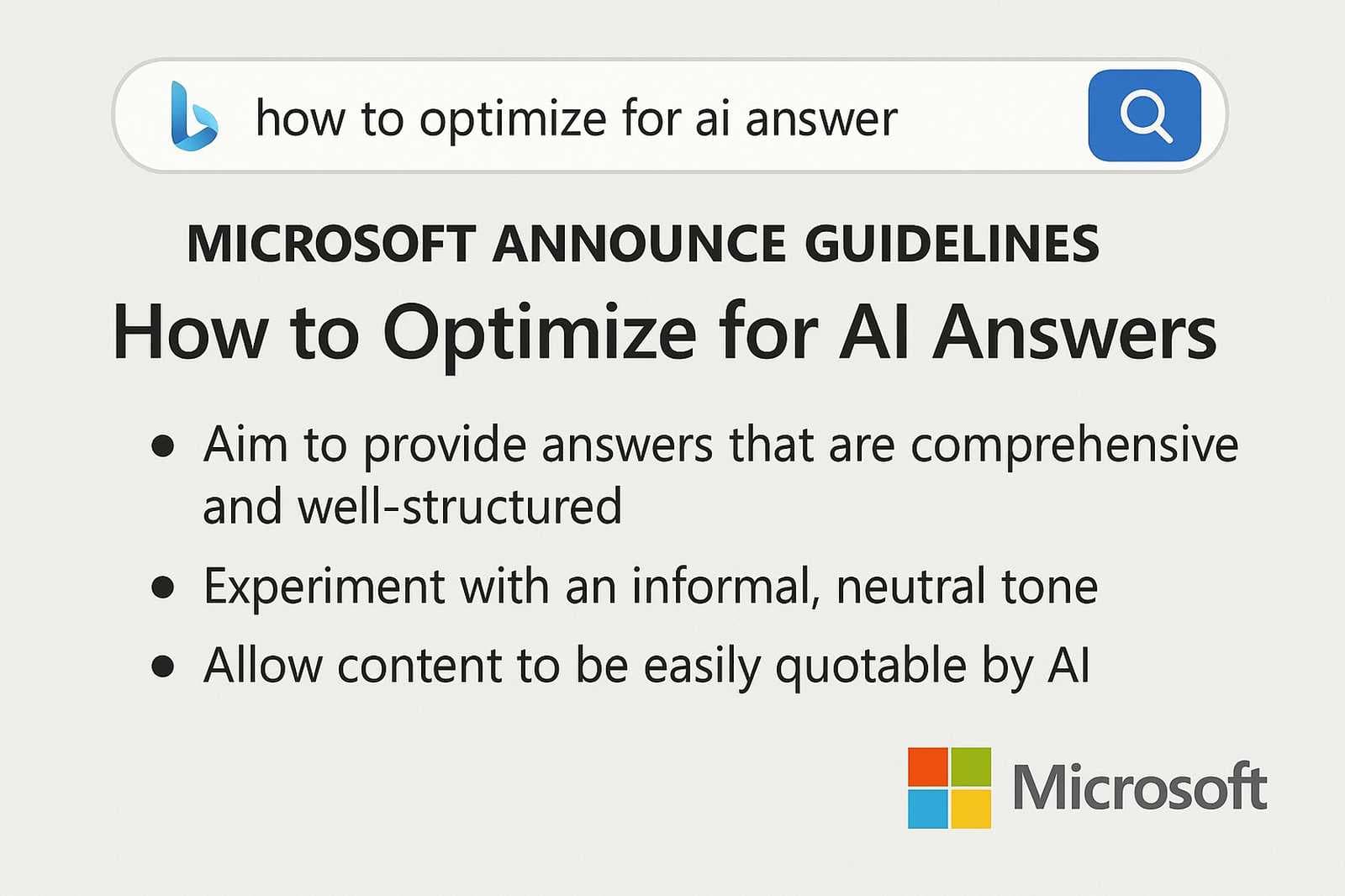
TL;DR
- Microsoft Copilot is an AI layer built on Bing's live index that powers AI answers in Windows, Microsoft Edge, Microsoft 365 and Bing.com, and it selects and extracts passages rather than ranking pages.
- Content must clear two gates: Bingbot must crawl and index the page, then the page must be citation-worthy through clear structure, factual sentences and proper markup.
- The AI Performance report in Bing Webmaster Tools tracks Total Citations, Average Cited Pages, Grounding Queries and Page-Level Citation Activity; Copilot can use a page without displaying its URL, so grounding queries show the truer footprint.
- Foundation steps: verify the site and submit an XML sitemap in Bing Webmaster Tools, implement IndexNow (via Rank Math or Yoast on WordPress), and keep LCP under 2.5 seconds.
- FAQPage, Article and HowTo are named the three highest-return schema types, and LinkedIn carries extra weight in B2B because Microsoft owns it.
Quick Summary: Microsoft Copilot now has 33 million active users globally and pulls answers directly from Bing's live search index. If your content is not structured for AI extraction, you are invisible — regardless of your organic ranking. This guide covers every optimization layer: Bing indexing, content structure, schema markup, E-E-A-T signals, the Microsoft ecosystem, and how to measure your AI citation performance in the new Bing Webmaster Tools AI Performance dashboard.
Why Bing AI Optimization Is Not Optional in 2026
AI-powered search is no longer a trend to watch — it is the channel your competitors are already optimizing for. Microsoft Copilot, the AI layer built on top of Bing's search index, reached 33 million active users globally in 2026 and powers AI-generated answers inside Windows, Microsoft Edge, Microsoft 365, and Bing.com. AI-driven referrals to websites jumped 357% in a single year. That traffic goes somewhere — and right now, most of it is going to the small percentage of sites that have structured their content for AI selection.
The core insight is simple: Copilot does not rank pages the way traditional search does. It selects content. It reads your page, extracts the most citable sentences, and assembles an answer. If your content is vague, poorly structured, or buried in tabs and PDFs, it will be skipped — regardless of how long it has been online. If you want to optimize content for Microsoft Search to show in AI, you need to treat structure, clarity, and authority as ranking signals in their own right. This guide explains exactly how.
Whether you are working on GEO, traditional SEO, or a full Content Marketing strategy, AI search visibility now belongs in every roadmap.
How Microsoft Copilot Actually Selects Content
Before optimizing, you need to understand what is happening under the hood. Microsoft Copilot is not a search engine in the traditional sense. It is a generative AI model that uses Bing's live index as its primary data source. Every time a user asks Copilot a question, the system runs one or more Bing searches in the background, retrieves the top candidate pages, and uses those pages as "grounding data" to construct a synthesized answer.
This means there are two gates your content must pass through before it can ever be cited:
- Gate 1 — Bing Indexing: If Bingbot has not crawled and indexed your page, it does not exist to Copilot. Full stop.
- Gate 2 — Citation-Worthiness: Once indexed, the page must contain content that Copilot can lift and use in an answer. Clear structure, factual sentences, and proper markup determine whether you clear this gate.
In February 2026, Microsoft launched the AI Performance report in Bing Webmaster Tools (currently in public preview). This dashboard tracks four key metrics:
| Metric | What It Measures |
|---|---|
| Total Citations | How often your pages are referenced as sources in Copilot answers |
| Average Cited Pages | Daily average of unique URLs displayed as sources in AI surfaces |
| Grounding Queries | The key phrases Copilot used when retrieving your content |
| Page-Level Citation Activity | Which specific URLs earn the most citations |
One critical finding from early adopters: 99.6% of AI influence is invisible. Copilot can use your content to shape an answer without ever displaying your URL as a visible citation. This means grounding queries — not just visible citations — are the metric that matters most for understanding your true AI search footprint.
Step 1: Build the Bing SEO Foundation
Copilot optimization is Bing SEO first, citation optimization second. You cannot shortcut the foundation. Here is what Bing prioritizes differently from Google — and what that means for your setup.
Bing Webmaster Tools and IndexNow
Bing crawls smaller sites less frequently than Google. Without active submission, your new or updated pages can sit unindexed for weeks — weeks during which Copilot cannot cite them. The fix is a two-step setup:
- Verify your site in Bing Webmaster Tools and submit your XML sitemap. If you already have Google Search Console set up, you can import your settings directly — this copies your sitemap and URL data in a few clicks.
- Implement IndexNow. IndexNow is a real-time URL notification protocol supported by Bing (and several other search engines). When you publish or update a page, a single API ping tells Bing to crawl it immediately. Most modern CMS platforms have IndexNow plugins. For WordPress sites, Rank Math and Yoast both support it natively.
Bing's Core Ranking Signals
Bing's algorithm shares DNA with Google's but places different weights on individual signals. Key differences that affect Copilot eligibility:
- Social signals: Bing gives more weight to social sharing and engagement signals — especially from LinkedIn (a Microsoft-owned platform).
- Domain age and authority: Bing favors established domains with consistent publishing histories.
- Keyword relevance: Keyword relevance accounts for approximately 30% of Copilot's ranking formula — the single largest individual factor. Your title, H1, and first paragraph must clearly match the query intent.
- Reviews and trust signals: Reviews represent around 25% of the ranking formula for locally-oriented queries. Sentiment and recency matter more than volume.
- Page speed and Core Web Vitals: Bing tracks LCP (Largest Contentful Paint) with a target under 2.5 seconds. Slow pages are systematically deprioritized for Copilot grounding.
If your current SEO Thailand strategy focuses only on Google, you are likely leaving Bing indexing gaps that directly reduce your Copilot eligibility.
Step 2: Structure Content for AI Extraction
This is where most sites fail. They produce good content but structure it for human readability rather than machine extractability. AI systems need content they can lift verbatim — complete, self-contained answers that make sense without surrounding context.
Answer-First Writing
The most important structural shift you can make: put the answer in the first one or two sentences after every heading. Copilot reads the heading, then looks at what immediately follows. If the answer is buried three paragraphs down after scene-setting and preamble, it will be skipped.
Weak example:
"When we consider the many factors involved in choosing a quiet dishwasher, especially for open-concept living spaces where noise can carry…"
Strong example (answer-first):
"The quietest dishwashers for open-concept kitchens run at 42 dB or below. Models in this range include the Bosch SHPM88Z75N (40 dB), the Miele G7000 (42 dB), and the KitchenAid KDTM804KPS (39 dB)."
The second version is citable. The first is not. Every H2 and H3 section in your content should open with a citable, answer-first statement.
Heading Hierarchy That Signals Topic Boundaries
AI systems use your heading structure to identify where one topic ends and another begins. Vague headings like "Learn More" or "Additional Information" provide no signal. Descriptive, question-shaped headings tell the AI exactly what the following section answers.
Use <h2> tags for primary topic sections and <h3> tags for sub-topics within each section. Aim for 6–10 H2 sections on a comprehensive guide. Each section should be self-contained enough that Copilot could extract and use it independently.
Q&A Formatting for Conversational Queries
Copilot is inherently conversational. Users type questions, and the AI responds in kind. Including explicit Q&A sections in your content — whether in the body or as a dedicated FAQ — significantly improves citation probability.
Structure each Q&A pair with the question as a heading (<h3>) and a direct, complete answer in the following paragraph. Avoid answer fragments that require context to make sense. Every answer should read cleanly as a standalone statement.
Lists, Tables, and Structured Formats
Structured content formats are consistently the highest-performing elements for AI citation. The hierarchy of AI-friendly formats, from most to least effective:
- Comparison tables — Copilot can extract entire rows or columns to answer comparison queries
- Numbered step-by-step lists — ideal for how-to queries; each step is independently citable
- Bulleted feature lists — strong for product/service content
- Definition blocks — "X is defined as Y" sentences are highly citable
- Statistics with context — every data point needs a number, a timeframe, and attribution
Avoid burying this structured content inside expandable accordions, tabs, or JavaScript-rendered components. Bingbot may not execute JavaScript when crawling, and hidden content is invisible to AI grounding.
Step 3: Implement Schema Markup for Copilot
Schema markup is structured metadata that tells AI systems the type and purpose of your content. Structured data increases Copilot citation probability by approximately 40% compared to pages without it. For AI search optimization specifically, three schema types deliver the highest return.
FAQ Schema
FAQ schema is the single highest-impact markup type for Copilot optimization. When your FAQ section is marked up with FAQPage schema in JSON-LD, Copilot can directly parse the question-answer pairs without inferring structure from the HTML. This is particularly valuable for conversational queries and People Also Ask content.
Implementation example (JSON-LD in <head>):
{
  "@context": "https://schema.org",
  "@type": "FAQPage",
  "mainEntity": [{
    "@type": "Question",
    "name": "How do I get my content cited in Microsoft Copilot?",
    "acceptedAnswer": {
      "@type": "Answer",
      "text": "First ensure your site is indexed in Bing. Then structure your content with answer-first paragraphs, FAQ schema, and descriptive H2/H3 headings. Submit your sitemap in Bing Webmaster Tools and implement IndexNow."
    }
  }]
}
Article and HowTo Schema
For guides and how-to content, Article schema communicates authorship, publish date, and topic to AI systems — all of which feed into E-E-A-T scoring. HowTo schema lets you mark each step explicitly, making numbered guides highly extractable for step-by-step queries.
Common schema types and their optimal use cases:
| Schema Type | Best Used For | AI Benefit |
|---|---|---|
| FAQPage | Q&A sections, support content | Direct Q&A extraction for conversational queries |
| Article | Blog posts, guides, news | Author authority, publish/update dates, topic signal |
| HowTo | Step-by-step tutorials | Individual steps extractable as micro-answers |
| Product | Product pages, reviews | Price, availability, review data directly parsed |
| Organization | About pages, homepages | Entity validation, brand authority signal |
| LocalBusiness | Local service pages | NAP data, service area, review aggregation |
For businesses managing complex content across multiple page types, working with a specialist on backlinks and technical SEO ensures schema is implemented correctly at scale.
Step 4: Build E-E-A-T Signals Copilot Can Verify
Experience, Expertise, Authoritativeness, and Trustworthiness (E-E-A-T) are not just Google concepts — Copilot applies the same framework when deciding which sources to cite. The AI system cross-references your content against other trusted sources to assess whether your claims are "grounded" in fact. Content that cannot be corroborated is less likely to be cited.
Author Credentials and Bylines
Content from identifiable authors with demonstrated expertise gets cited more frequently than anonymous or byline-free content. Add author bio pages with verifiable credentials, link those bios to relevant author pages on LinkedIn, and include the author property in your Article schema.
For B2B businesses, this signal extends to the organization level. A well-maintained LinkedIn Company Page, active profiles for key team members, and consistent thought-leadership content on LinkedIn all contribute to how Copilot perceives your brand's authority — because LinkedIn is a Microsoft-owned platform with direct data access to Copilot.
Citing Sources and Using Specific Data
Every statistic in AI-optimized content needs three elements: a number, a timeframe, and a source. "AI search is growing quickly" will never be cited. "AI-driven referrals to websites jumped 357% year-over-year as of June 2025, according to data from multiple analytics providers" is citable.
Content with inline citations and authoritative language saw up to 40% improved visibility in generative-engine results. Write with specificity, attribute your data, and avoid vague claims like "next-gen" or "cutting-edge" without supporting facts. Unanchored promotional language is a red flag to AI systems assessing grounding quality.
Step 5: Leverage the Microsoft Ecosystem
Copilot is not just a Bing product — it is embedded across the entire Microsoft stack. Understanding where Copilot draws signals from helps you optimize across more surfaces than just your website.
LinkedIn as a Copilot Signal
LinkedIn is particularly important for Copilot visibility in B2B contexts. Because Microsoft owns LinkedIn, Copilot has preferential access to LinkedIn data when constructing answers about people, companies, and industry topics. Optimizing your LinkedIn Company Page, ensuring team member profiles list your organization clearly, and publishing regular thought-leadership content on LinkedIn all contribute to Copilot's perception of your brand's authority and relevance.
Bing Places and Microsoft Business Profiles
For any business with a local or regional presence, claiming and optimizing your Bing Places profile is a foundational step that many sites skip because they are focused entirely on Google Business Profile. Bing Places data feeds directly into Copilot answers for local queries. Ensure your NAP (Name, Address, Phone) data is consistent across Bing Places, your website's LocalBusiness schema, and all third-party directory listings.
Microsoft Clarity for Behavioral Signals
Microsoft Clarity is a free behavioral analytics tool (heatmaps, session recordings, engagement metrics) that shares data with the Microsoft advertising and search ecosystem. Sites running Clarity give Microsoft direct behavioral signals about how users interact with their content — signals that can inform how Copilot perceives content quality and relevance. It is worth installing even if you do not actively use the analytics.
Step 6: Content Depth and Quality Standards
Surface-level content rarely earns citations for complex queries. Copilot evaluates content depth and comprehensiveness relative to query intent. Comprehensive topic coverage — not word count per se — is the quality signal. That said, data consistently shows that content in the 1,500–2,500 word range earns 50% higher Copilot response rates than thin content under 800 words. For competitive topics, comprehensive guides of 2,500–4,000 words perform best.
Common Mistakes That Kill AI Visibility
These are the most frequent errors that prevent otherwise good content from being cited:
| Mistake | Why It Hurts | Fix |
|---|---|---|
| Walls of text | AI cannot identify extractable chunks | Break into H2/H3 sections with 2–4 paragraphs each |
| Content in tabs or accordions | May not be crawled; hidden from AI | Use plain HTML; put key content in the visible DOM |
| PDF-only content | PDFs lack structural signals | Publish all key content as indexed HTML pages |
| Image-only data (charts, infographics) | AI cannot reliably extract image text | Always provide an HTML text version alongside images |
| Vague promotional language | Cannot be grounded; not citable | Replace with specific, attributed facts |
| Missing or incorrect schema | AI cannot determine content type | Validate schema with Bing's Markup Validator |
| Slow page speed (LCP > 2.5s) | Deprioritized for grounding | Optimize images, reduce render-blocking scripts |
| No Bing sitemap submission | Pages may not be indexed for weeks | Submit sitemap + implement IndexNow |
Step 7: Measuring Your Copilot Citation Performance
You cannot optimize what you cannot measure. The launch of the AI Performance dashboard in Bing Webmaster Tools in February 2026 changed this — for the first time, publishers can see exactly how their content is being used in Copilot answers.
Early data from AI search analysts reveals some striking findings. One analysis of a 173-page site found that just 5 pages carried 74.6% of all citations — a classic power-law distribution. The homepage alone generated 32.3% of all citations. Branded queries (about 30% of all grounding queries) generated 75 citations per query, while non-branded queries averaged 35 citations per query.
A practical monitoring workflow:
- Identify your highest-grounding pages — these are your citation assets. Protect and update them first.
- Map grounding queries to content gaps — if Copilot is using a page to answer queries the page does not directly address, create a more targeted section or a new page.
- Track cross-platform visibility — Copilot citations appear in Bing.com AI answers, Microsoft Edge sidebar, and Microsoft 365 Copilot. Visibility in one surface does not guarantee visibility in others.
- Monitor competitor co-citations — when Copilot cites you and a competitor in the same answer, it is a signal you are competing in the same "answer cluster." Analyze what the competitor's page does differently.
For businesses investing in paid channels alongside organic, understanding how AI search affects attribution is also relevant to your Google Ads and broader content strategy. AI-influenced sessions often look like direct or branded traffic in analytics — requiring more sophisticated attribution models.
Step 8: Optimizing Specific Content Elements for Snippet Selection
In AI search, snippets are the building blocks of answers. Every element of your content should be evaluated for its "snippet-ability" — can this sentence, list item, or table row stand alone as a useful answer?
Checklist for snippet-ready content:
- Every heading answers a question — use descriptive, question-shaped headings, not vague category labels
- First sentence after each heading is a direct, complete answer — no preamble, no "In this section, we will explore…"
- Statistics include all three elements — number + timeframe + source attribution
- Lists use parallel structure — each bullet should be grammatically consistent and independently readable
- Tables have clear column headers — Copilot can extract individual rows only if headers are present
- Definitions follow a clear pattern — "[Term] is [definition]" without unnecessary qualifiers
- CTAs and promotional content are separated — keep them in dedicated sections so they do not contaminate extractable content
One formatting note: keep punctuation clean and simple. Use periods and commas. Avoid decorative symbols (★★★, →, ✓), excessive em dashes, and emoji in body content. These characters disrupt AI parsing and reduce the liftability of your sentences.
If your business also uses Display Advertising or Programmatic campaigns, aligning your paid media messaging with the same answer-first framing you use for AI search creates a consistent brand voice across every channel where your audience encounters you.
Complete Checklist: Optimize Content for Microsoft Search AI
Use this checklist to audit any page you want to optimize for Copilot citation:
Bing Foundation
- Site verified in Bing Webmaster Tools, sitemap submitted
- IndexNow implemented for real-time crawl notifications
- robots.txt allows Bingbot on all key pages
- HTTPS enabled; Core Web Vitals within acceptable thresholds (LCP < 2.5s)
Content Structure
- Clear, aligned title tag, H1, and meta description
- 6–10 descriptive H2 sections with answer-first opening paragraphs
- At least one comparison or data table with headers
- Q&A section or dedicated FAQ with question-shaped H3 headings
- Content length: 1,500 words minimum; 2,500+ for competitive queries
Schema and E-E-A-T
- FAQPage schema implemented on Q&A sections
- Article schema with author name and dates
- Author bio page with verifiable credentials
- All statistics attributed with number + timeframe + source
- No vague promotional claims without factual support
Microsoft Ecosystem
- Bing Places profile claimed and NAP data consistent
- LinkedIn Company Page optimized and actively maintained
- Microsoft Clarity installed on key pages
Avoid These Errors
- No key content hidden in tabs, accordions, or JavaScript-rendered elements
- No image-only data (charts, infographics) without HTML text alternative
- No PDF-only content for pages intended for AI citation
- No decorative symbols or excessive em dashes in body text
Measurement
- AI Performance report enabled in Bing Webmaster Tools
- Citation-heavy pages identified and added to content refresh schedule
- Grounding queries mapped to content gaps
Frequently Asked Questions
Is Microsoft Copilot the same as Bing AI?
They are closely related but not identical. Microsoft Copilot is the branded AI assistant that uses Bing's search index as its primary data source for web queries. Bing AI refers more broadly to AI features embedded in Bing Search results, including AI-generated summaries. For SEO purposes, optimizing for one effectively optimizes for the other — both draw from the same Bing index.
How long does it take to get cited in Microsoft Copilot?
There is no guaranteed timeline, but most sites that have implemented IndexNow and submitted their sitemap to Bing Webmaster Tools begin seeing grounding data within 2–4 weeks of publishing optimized content. Older, well-established pages that are already indexed in Bing can start appearing in Copilot grounding data within days of a content refresh.
Does optimizing for Copilot hurt my Google rankings?
No. The optimization principles for Copilot — clear structure, answer-first paragraphs, descriptive headings, schema markup, E-E-A-T signals — are fully aligned with Google's quality guidelines. There are no trade-offs. In practice, content optimized for Copilot citation typically improves in both Bing and Google search performance simultaneously.
Is schema markup required to be cited in Copilot?
Schema is not strictly required, but it increases citation probability by approximately 40% compared to pages without it. FAQ schema and Article schema are the two most impactful types for Copilot optimization. Pages without schema must rely entirely on Copilot's ability to infer structure from HTML — a less reliable process than providing explicit structured data.
What is the ideal content length for Copilot optimization?
Research shows that content in the 1,500–2,500 word range earns 50% higher Copilot response rates than thin content under 800 words. For competitive queries, comprehensive guides of 2,500–4,000 words perform best. The key is that length must correspond to genuine depth — comprehensive coverage of all sub-topics the query audience would expect, not padded repetition.
How do I access the Bing Webmaster Tools AI Performance report?
The AI Performance report launched in public preview in February 2026. To access it, log in to Bing Webmaster Tools (webmaster.bing.com) with your Microsoft account, verify your property if you have not already, and look for the "AI Performance" section in the left navigation. The dashboard shows Total Citations, Average Cited Pages, Grounding Queries, and Page-Level Citation Activity.
Does LinkedIn activity affect Copilot rankings?
Yes, particularly for B2B content. Because Microsoft owns LinkedIn, Copilot has preferential access to LinkedIn data when constructing answers about businesses, people, and industries. An active LinkedIn Company Page, credentialed team member profiles, and regular thought-leadership content all serve as authority signals that Copilot can verify independently of your website. For B2B brands, LinkedIn optimization is arguably the most underutilized lever in Copilot SEO.
How do I track AI search traffic in my analytics?
AI-referred traffic is notoriously difficult to track. A portion appears as direct traffic (Copilot answers where users click through without a visible referrer), some appears as Bing organic traffic, and some appears as referral traffic from bing.com with specific AI-surface parameters. The most reliable measurement is the Grounding Queries and Citation data inside Bing Webmaster Tools AI Performance report, supplemented by monitoring for branded query volume increases that often accompany AI-driven brand awareness.
Conclusion: AI Search Visibility Starts With Structure
The rise of Microsoft Copilot has added a new selection layer on top of traditional search rankings. Being indexed and ranked in Bing is necessary but no longer sufficient. To be cited — to have your content used as the grounding data that shapes Copilot's answers — you need content that AI can actually extract, verify, and trust.
The framework is clear: start with Bing indexing fundamentals, structure every page with answer-first sections and descriptive headings, implement FAQ and Article schema, build verifiable E-E-A-T signals, leverage the Microsoft ecosystem (especially LinkedIn and Bing Places), and measure your performance in the new Bing Webmaster Tools AI Performance dashboard.
This is not a speculative future investment. With 33 million active Copilot users and AI-driven referrals growing at 357% year-over-year, the content that earns citations today is building a compounding advantage that will only grow as AI search adoption accelerates. The sites that structure their content for AI extraction now will be increasingly difficult to displace as AI search becomes the default mode of information retrieval.
To optimize content for Microsoft Search to show in AI, start with the fundamentals, be specific, be structured, and measure everything. The tools are available. The playbook is clear. Whether you need help with technical SEO Thailand implementation, a full Content Marketing strategy, or Lead Generation Service tactics that work alongside AI-driven discovery, the principles of AI search optimization belong at the center of your 2026 digital strategy.