TL;DR
- A marketing plan is a written set of decisions with owners, numbers and review dates: the objective, the buyer, the message, the channels, the budget in money and hours, and the kill rules.
- Build it in order. Objective first, then buyer, then your own funnel arithmetic, then positioning, and only then channels. Choosing channels first is the most common planning mistake.
- On a small budget, run cheap experiments with a success criterion and a decision date written before you start. Most will fail, and the discipline is stopping them on schedule.
- There is no honest standard marketing budget percentage. Derive yours from what a customer is worth, your sales cycle and your runway, and treat any quoted benchmark with suspicion.
- Use the sample plan as a shape to copy. Every figure in it is a placeholder, and the reasoning beside each budget line matters more than the proportion itself.
Most early-stage companies do not fail because nobody wrote a marketing plan. They fail because money ran out before they found a repeatable way to reach buyers. A plan is the document that makes that search deliberate instead of accidental. It records who you are selling to, what you will say, where you will say it, what you will spend, and what result would justify spending it again next month.
The reason marketing plans for startups get skipped is understandable. Planning feels like work that produces nothing, while posting, calling and launching feel like progress. The trouble is that unplanned spending is reactive by nature. A competitor runs a campaign, so you run one. A platform sales rep offers credits, so you take them. A quiet week arrives, so somebody boosts a post. None of those decisions are connected to each other, and at the end of the quarter there is no way to say which of them worked.
Why marketing matters for a small business
A small business converts attention into revenue, and it has to do that at a cost lower than what a customer is worth. Marketing is the function that manages both halves of that sentence. Skip it and the business is relying on whatever attention arrives by chance: a referral, a walk-in, somebody who happened to search at the right moment. That flow is real, but it is not controllable, and it usually does not scale with the hiring plan.
There is a second reason that matters more for small companies than large ones. Attention either compounds or resets. A page that answers a buyer's question keeps being found after it is published. An email list keeps being reachable at no additional media cost. A social ad stops delivering the day the card stops working. Neither type is better than the other, but the mix decides what happens to the business in a bad month. A company funded entirely by rented attention has no floor beneath it when budget is cut.
The third reason is competitive rather than financial. A buyer comparing options usually finds the vendor who is easiest to find and easiest to understand, which is not always the vendor with the best product. Distribution and clarity are the levers a smaller company can pull without outspending anyone.
It is worth being blunt about the limit. Marketing cannot rescue a product that nobody wants. It will make you discover that faster, and at greater expense, which is genuinely useful information but not the outcome anyone is hoping for. If early customers do not come back and do not recommend you, that is a product conversation, not a campaign conversation, and no plan fixes it.
What a marketing plan is
A marketing plan is a written set of decisions with owners, numbers and review dates attached. That is the whole definition. It is not a content calendar, though a calendar may fall out of it. It is not the marketing slide in the investor deck, which is a summary written for a different audience. And it is not a list of channels, because a list of channels without a budget, an owner and a decision date is a wish.
A workable plan for a company with a handful of people fits on one page and answers six questions.
- What business result are we buying? Written as a number with a date attached, in units the finance side recognises: paying accounts, signed contracts, qualified conversations, orders. Not impressions, and not brand awareness.
- Who exactly are we selling to? Narrow enough that the description excludes people. If the answer includes almost everyone, no channel targeting or message will work well.
- What are we saying, and why would a sceptical buyer believe it? One claim, plus the evidence that supports it.
- Where will we say it? A short list of places, each with a reason tied to where the buyer already is.
- What will we spend, in money and in hours? Founder hours are a budget line even when nobody invoices for them.
- How will we know, and when do we decide? The metric, where the number lives, and the date the decision gets made.
Everything longer than that page is supporting material. The reason to keep the plan short is that a short plan gets reread. A forty-slide plan gets written once and never opened again, which means the decisions in it stop influencing anything within about a month.
One distinction is worth keeping straight, because it saves arguments later. Strategy is the set of choices about who you will not serve and what you will not do. Tactics are the activities that follow. Teams often write a document full of tactics, call it a strategy, and then discover it cannot help them say no to anything.
How to make a marketing plan for a startup
The order below matters. Each step depends on the answers from the one before it, and the most common failure in planning is choosing channels before knowing the buyer or the numbers.
- Write the objective as a business number. Something like: reach a stated number of new paying customers per month by a stated date, at an acquisition cost the business can absorb. If the objective cannot be written that way, it is not yet an objective. Awareness goals belong under this line as a means, never as the headline.
- Describe the buyer using evidence you already have. If you have customers, interview the most recent handful and the best few: what triggered the search, what they compared you against, what nearly stopped them buying, and the words they used to describe the problem. If you have no customers yet, list the twenty accounts or people you would most want, then write down what they have in common. That list is a hypothesis, and you should label it as one.
- Do the arithmetic of your own funnel before you shop for channels. You need four of your own numbers: how many conversations it takes to close one customer, what a first order is worth, how much a customer is worth over the relationship, and how long the cycle takes from first contact to payment. If you do not have them, write unknown next to each and treat the first period as measurement rather than growth. Do not import someone else's conversion rate, because it was produced by a different product, a different price and a different market.
- Write the positioning as one sentence. Name the alternative the buyer would otherwise choose, including doing nothing, and state what you do differently that they care about. Then write the evidence underneath it. If the sentence would still be true with a competitor's name substituted in, it is not positioning yet.
- Choose channels by where demand already sits. There are two situations and they need different tactics. When people already search for what you sell, the work is capturing demand that exists: pages that answer those queries, listings, comparison content. When nobody searches because the category is new, the work is creating demand: outbound, partnerships, communities, paid social that interrupts. Most startups sit somewhere between the two, and the plan should say which side it leans on and why.
- Pick one asset you will own. Rented attention is fine, but decide early which asset accumulates: an email list, a library of pages that keep getting found, or a community you host. Owning something means a bad month does not take you back to zero.
- Set a budget you can sustain for longer than the sales cycle. A channel needs enough time to produce a readable result, and a sales cycle of several weeks means a one-month test tells you nothing. If a channel is only affordable for one month, it is not affordable. Budget in hours as well as money, because for a small team founder attention runs out before cash does.
- Set up measurement before anything launches. Agree a naming convention for campaign links so traffic does not arrive unattributed, put every number in one place that one person maintains, and separate the number you look at weekly from the number you judge the quarter by. Weekly numbers are for spotting breakage. Monthly and quarterly numbers are for decisions.
- Write the review cadence and the kill rules on the same page. Decide in advance what result would make you stop a channel, what would make you double it, and on which date you will look. A rule written before the money is spent is far easier to follow than a judgement made afterwards, when sunk effort is arguing on the channel's behalf.
Startup marketing on a small budget
The phrase growth hacking has collected a lot of noise, so it helps to define it as what it actually is when it works: cheap, measurable experiments run in a disciplined sequence, with most of them killed quickly. The discipline is the part people skip. Running twelve scrappy experiments is not a strategy if none of them had a success criterion written down beforehand.
An experiment worth running has five parts written before it starts: the belief being tested, the smallest version that could test it, the number that would count as a result, the date the decision gets made, and what happens if it fails. That last part is what stops a mediocre channel from surviving on hope for six months.
Expect most of them to fail. That is not a sign of poor execution, it is the arithmetic of searching a space you do not have a map of. The cost of a failed experiment is small if it was designed to be small and stopped on schedule. The expensive failure is the one that keeps getting one more month.
Approaches that work on a constrained budget, and the mechanism behind each:
- Capturing search demand that already exists. Pages that answer the questions buyers type before they are ready to buy keep working after publication, which is why the cost is mostly hours rather than media spend. The trade-off is speed: this is slow to start and rarely rescues a bad quarter. It is the right first move when people are clearly already searching for the problem you solve, and organic search work is where that effort belongs.
- Building an email list from the moment of interest. Someone who reads a useful page and leaves is gone unless you have a reason for them to give you an address. A short, genuinely useful thing behind a form, followed by a sequence that answers objections in order, is one of the cheapest ways to keep a slow-cycle buyer in reach, and lifecycle email costs almost nothing per additional send.
- Doing outreach that does not scale. Contacting a small number of well-chosen people by hand teaches you the language buyers use, which then improves every ad, page and email you write afterwards. Treat the first round as research with a chance of revenue rather than a sales channel.
- Partnering with a business that shares your audience but not your product. A joint webinar, a shared guide, or a simple mutual introduction reaches an audience someone else spent years assembling. The currency is your own audience or your own effort rather than media budget.
- Making one piece of work serve several channels. A single substantial article can supply an email, a set of social posts and the script for a short video. Small teams lose more time to producing new material for every channel than to any other habit. The same discipline applies to content work generally: fewer, better pieces used harder.
- Using small paid budgets as research rather than as a growth channel. A modest spend across two or three messages tells you which wording earns attention faster than argument in a meeting will. The output is a message, not a customer acquisition engine, and paid social is well suited to that role because feedback arrives within days.
- Making sure AI answer engines can read you. More buyers now start with a question in an assistant rather than a search box, and those systems quote pages that state things plainly and structure them clearly. Work on visibility in AI answers overlaps heavily with writing clear pages, so the incremental cost is low.
Things that reliably waste a small budget: broad awareness campaigns with no defined action attached, maintaining a presence on every platform because the accounts exist, hiring help or buying tools before the message is proven, and discounting to win the first customers, which teaches the market a price you cannot sustain.
The honest limit of all of this: cheap tactics buy time and information. They do not replace budget once you find a channel that works. The point of the experiments is to identify the one thing worth funding properly, and then to fund it.
A sample marketing plan you can copy the shape of
What follows is a template, not a recommendation. Every number in it is a placeholder chosen to show the shape of the document, and the reasoning next to each one matters more than the figure itself. Replace all of them with numbers derived from your own funnel.
Objective. Reach [number] new paying customers per month by [date], at an acquisition cost at or below [your figure, derived from what a customer is worth to you over the relationship].
Buyer. [Role or segment], at [type of company or life situation], who currently solves this with [named alternative, including doing nothing]. Trigger to buy: [the event that starts the search]. Excluded from this plan: [who you are deliberately not selling to this quarter].
Positioning sentence. For [buyer] who [situation], we [what you do] so that [outcome they care about]. Unlike [alternative], we [the specific difference]. Evidence: [what makes that believable].
Channels. One compounding channel that builds an asset, one fast-feedback channel that returns results within days, and one experiment slot that rotates each quarter. Naming the slots this way stops the plan from filling up with channels that all behave the same way.
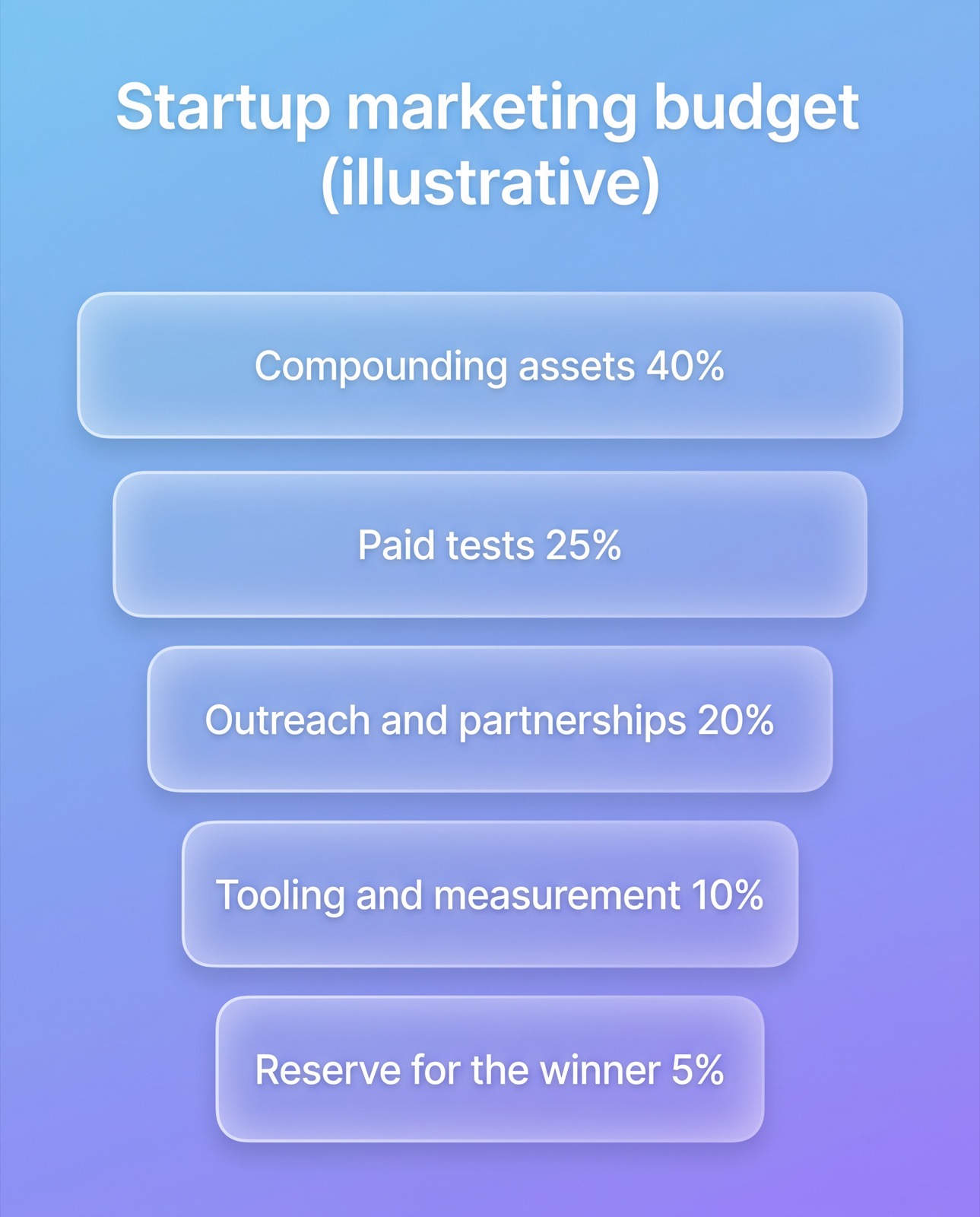
Budget. The split below is illustrative. It exists to show that every line needs a reason and a condition that would change it, not to suggest these proportions suit your business.
| Budget line | Illustrative share | What moves your share up or down |
|---|---|---|
| Compounding assets: pages, content, email programme | 40 percent | Higher when buyers already search for what you sell and the sales cycle is long. Lower when the category is new and nobody is searching for it yet. |
| Paid tests used to find the message | 25 percent | Higher while you are still unsure which message works. Lower once one message clearly wins and the budget shifts to scaling it. |
| Direct outreach and partnerships | 20 percent | Higher for high-value sales where a hundred named accounts decide the year. Lower for low-price, high-volume products. |
| Tooling and measurement | 10 percent | Mostly fixed. Keep it small until the message is proven, since analytics nobody reads still costs money every month. |
| Reserve for whichever channel wins | 5 percent | The line most plans leave out. It funds doubling down mid-quarter without waiting for a new approval round. |
Measurement. Weekly: leads or sign-ups by source, spend to date, anything broken. Monthly: cost per qualified conversation, cost per customer, and how much of the pipeline each channel produced. One person owns the sheet. Every campaign link is tagged before it goes out, because traffic that arrives unattributed cannot be argued about usefully later.
Review cadence and kill rules. Fifteen minutes weekly to check nothing is broken. Ninety minutes monthly to decide. A channel that has run for at least one full sales cycle and has not produced a qualified conversation gets stopped, not extended. A channel that beats the target twice in a row gets more budget from the reserve line.
A ninety-day shape for the same plan, again as structure rather than prescription:
- First month. Fix measurement, interview buyers, write the positioning sentence, publish the pages that answer the questions buyers already ask, and start one small paid test purely to compare messages.
- Second month. Keep the winning message, retire the losing ones, start the email sequence for people who arrived but did not buy, and open one partnership conversation.
- Third month. Judge each channel against the numbers agreed in month one, kill what failed, move the reserve into whatever worked, and write next quarter's plan from what the data actually said rather than from the original guesses.
Frequently asked questions
What should a startup marketing plan include as a minimum?
Six things: a business objective with a number and a date, a narrow description of the buyer, one positioning sentence with supporting evidence, the channels chosen with a reason for each, a budget in money and hours, and the measurement and review rules. Anything beyond that is supporting detail. If the plan cannot be reread in five minutes, it will stop being reread.
How much should a startup spend on marketing?
There is no honest universal percentage, and any figure presented as the standard is worth treating with suspicion. The amount depends on what a customer is worth to you over the relationship, how long the sales cycle runs, and how much runway you have. A more useful way to set it: work out what a customer is worth, decide what fraction of that you can afford to pay to acquire one while staying solvent, multiply by your monthly customer target, and check whether the result is a number you can sustain for longer than one sales cycle. If it is not, the target needs to change before the budget does.
How long before marketing produces results?
It depends on which channel and how long your sales cycle is, and the honest answer is that anyone quoting a fixed timeline for your business is guessing. Paid channels give feedback on the message within days, though feedback on profitability takes at least one full sales cycle. Search and content build slowly and keep working. The practical rule is to give a channel no less than one complete sales cycle before judging it, and to decide that duration in advance so the deadline is not negotiated later.
Should a startup do search or paid ads first?
Start with whichever matches where demand already is, not with whichever is cheaper. If people are already searching for the problem you solve, capturing that demand is the higher-return first move because the intent is already there. If nobody is searching because the category is unfamiliar, search work will return very little at first and creating demand through outbound, partnerships or paid social makes more sense. Many businesses run a small amount of paid activity early purely to learn which message works, then apply what they learn to the slower channels.
Do we need an agency to write the plan?
No. The first version should be written by the founders, because the answers depend on knowledge only they have about the product, the buyers and the money. Outside help is more useful once the decisions exist and the question becomes execution: producing the pages, running the media, building the measurement. Bringing help in before the positioning is settled tends to produce well-executed activity aimed at the wrong person.
Where to go from here
A plan is worth writing at any stage, and the first version is always partly wrong. That is acceptable, because a written wrong assumption gets corrected when the data arrives, while an unwritten one just quietly keeps costing money. Write the page, put dates on it, and change it when the numbers say so.
Relevant Audience works with early-stage companies on the execution side of that page: search visibility, paid media, content and email programmes, and the measurement that tells you which of them is working. The startup marketing service is built around the same sequence described here, starting from the objective and the buyer rather than from a channel list.