
TL;DR
- LinkedIn suits Thai B2B because the profile is a professional record, so readers arrive with job title, company size and seniority attached, and the feed weights conversation over bare reactions.
- The three-layer LinkedIn content system: the executive profile carries voice and point of view, the company page carries proof, and employee advocacy carries distribution beyond the page followers.
- Suggested cadence a small team can hold: two to three executive posts a week plus daily commenting, two to four page posts a week, one post recommended to employees weekly through the My Company tab.
- No reliable public figure exists for LinkedIn's Thai user base or for AI citation share. Size your own audience free in Campaign Manager, which needs at least 300 members before a campaign can run.
- Measure comments and profile viewers by job title, page visitor mix, and employee reshares. Build a baseline from 8 to 12 weeks of your own data instead of borrowed benchmarks.
LinkedIn works for Thai B2B once you stop treating it as one more posting channel and start running it as a three-layer LinkedIn content system that operates at the same time: the executive profile, the company page, and distribution through employees. The first job in week one is not building a posting calendar. It is fixing the profile of the person a buyer will click on while deciding whether to keep talking to you.
That order matters because behaviour on this platform differs from elsewhere. People read a post and open the author's profile almost immediately. If the profile is a stale resume or a bare job title, good content dies right there. This article explains what each of the three layers publishes, at what cadence, who owns it, how they feed each other, and what breaks when one is missing, plus how to measure results without relying on industry benchmarks that do not exist for Thailand.
LinkedIn B2B Thailand: why the platform is structurally different from other social networks
The first difference is that a LinkedIn profile functions as a person's professional record rather than a free-form identity space. Users fill in company, job title, dates, industry and skills because they want other people to see that information for reasons of their own career. The side effect is that your readers arrive with job title, company size and industry attached, where on other platforms you have to guess from behaviour or pay for that guess. In B2B work where the real buyers in a country number a few hundred people, knowing who read the post is worth more than knowing how many read it.
The second difference is what the feed rewards. LinkedIn ranks the feed with weight on signals that a post produced conversation people stayed with: comments with substance, replies inside the comment thread, and reshares carrying the sharer's own view. A bare reaction does not carry the same weight. In practice a post that takes a position, asks a real question and draws ten arguing comments from people in the same field usually travels further than an announcement with a hundred silent likes. This is why teams that measure impressions as their headline number walk in the wrong direction from month one.
The third difference is the time frame. Thai B2B deals run for months, involve several roles, and the person who signs is rarely the person who did the early research. LinkedIn content works as repeated presence in front of a buying committee during the period when they are not ready to buy, not as a mechanism that closes a deal now. Anyone expecting leads from their third post quits in month two.
How much do Thai companies really use LinkedIn for B2B, and how to check it yourself instead of trusting a floating number
There is no reliable public figure for the size of LinkedIn's user base in Thailand, and the numbers passed around in marketing slides usually have no traceable source. The more workable fact is that you do not need the size of the national market. You need to know how many of the people who buy from you are on this platform, and that is something you can measure yourself, free, in half a day.
Here is how. Open an ad account in Campaign Manager, which is free to create and does not require you to run ads. Then create a new audience and enter the real conditions of your customers: location Thailand, then stack filters such as job function, seniority, industry and company size. The system shows an estimated audience size straight away. Run through several filter sets, for example finance directors at manufacturers with more than two hundred employees, and write the numbers down. That is the size of your addressable market, not the country's, and it is far more useful. Two cautions: the estimate is the platform's own approximation and not a census, and LinkedIn requires an audience of at least 300 members before it will run a campaign. If your conditions come in below that, it means your buyer group is small enough to reach one person at a time by hand.
Check the quality of profiles in that group alongside the count. Search the job titles you sell to, filter results by location Thailand, and open about twenty profiles. Look at when they last posted, whose posts they comment on, and whether they wrote the profile in Thai or English. If most of this group never posts but does comment and does open other people's profiles, the correct strategy is to make your profile and content easy to read for quiet people, not to try to build a community they never wanted to join.
personal brand LinkedIn: why an executive with a real presence gets further than a company page alone
The reason is not personal charm. It is two clearly different mechanics. The first is reach. A company page post goes mainly to people who follow the page. A post from a personal account goes to that person's connections and followers, and when somebody comments or reshares it, the post can appear in the feeds of the next degree of connections, a route the page does not have. An executive who has worked in an industry for ten years usually already has customers, former customers and industry peers in those connections. That is a list a new page needs years or an ad budget to build.
The second is trust across a long deal. B2B buyers weigh the risk of choosing wrong more heavily than the upside of choosing right. What reduces that risk in their eyes is evidence that a real person who genuinely knows the subject is accountable behind the company. A post explaining why the method popular in an industry does not work for a mid-sized factory provides that evidence. A page post saying the company is committed to delivering the best possible service does not.
The boundary worth watching is that none of this is about building personal fame for its own sake. For a B2B company the executive profile is a pipeline asset. Its job is to make the person comparing three vendors feel that this one has someone who understands their problem best. If you want the executive presence deliberately aligned with the company's brand position, the LinkedIn executive branding service is the piece that handles this, and it should run alongside digital branding work so the message on the profile and the message on the website do not contradict each other.
LinkedIn content 3 layer: the three-layer system that is the spine of all of this
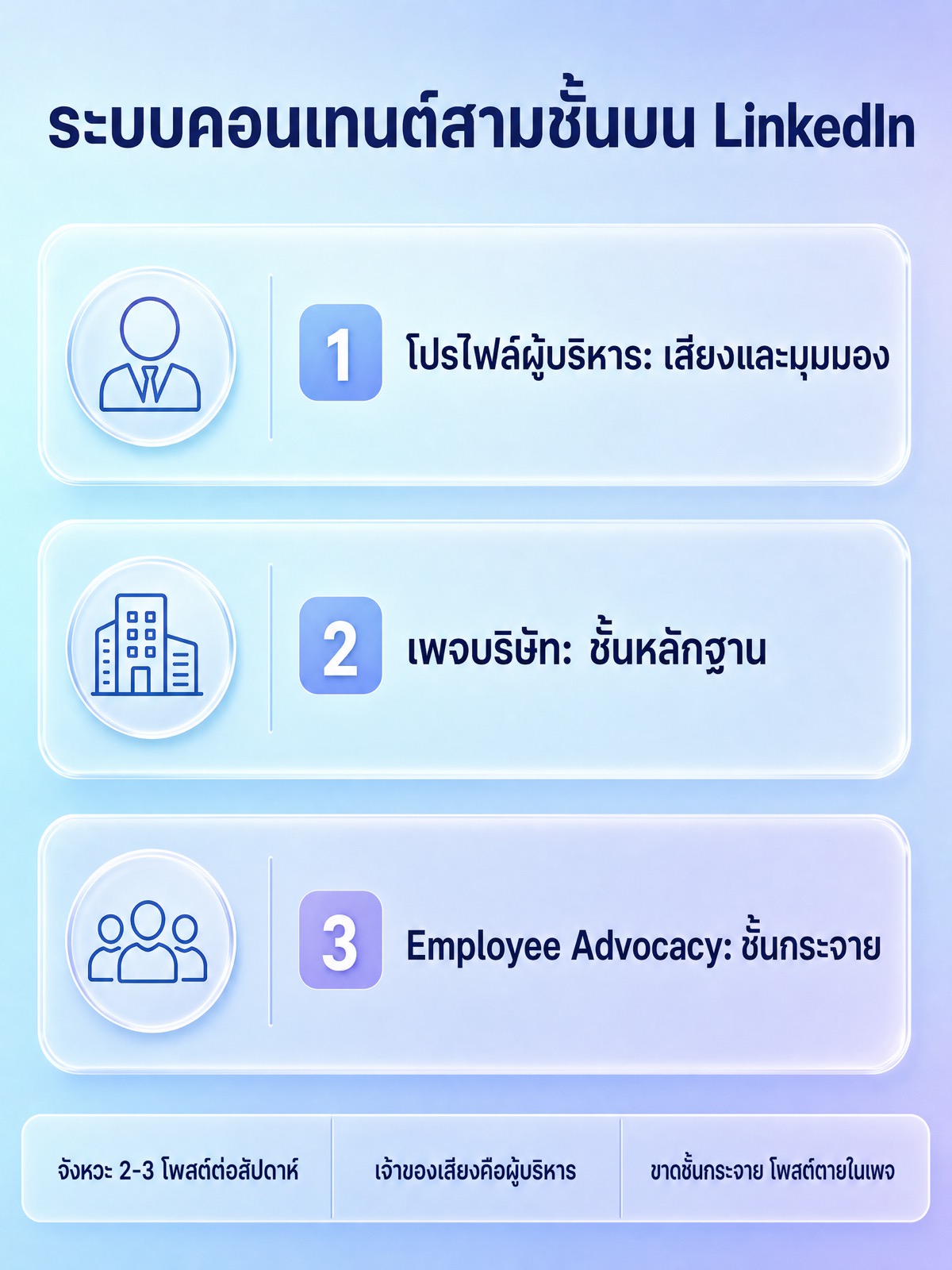
The three-layer LinkedIn content system splits the work by function, not by post format. Each layer answers a question buyers ask at a different moment, and once all three are in place a single post travels further than three posts from one source.
- Layer 1, the executive profile. The voice and point of view layer. It answers who is behind this company and what they think about my problem.
- Layer 2, the company page. The proof layer. It answers what this company does, for whom, and what confirms it can actually do it.
- Layer 3, LinkedIn employee advocacy. The distribution layer. It answers whether the people inside believe what the company says, and it carries posts beyond the page's follower list.
Layer 1, the executive profile: voice and point of view
This layer publishes opinions with an owner. What works: explaining the reasoning behind a decision you actually made in your role, pointing out what a frequently asked customer question reveals about a common misunderstanding, describing a rule change in your industry and whose costs it hits. What does not work: a press release rewritten in the first person.
A cadence a small team can hold is two to three posts a week, plus 10 to 15 minutes a day commenting on other people's posts in the same industry. The second half matters more than people expect, because a comment with substance under a post your buyers already follow puts your profile in front of that group without waiting for them to find your own post.
The executive owns the voice. That part is not flexible. A team can help with structure, cutting length, scheduling, and finding topics from questions sales hears repeatedly, but the position and the examples have to come from the person whose name is on the profile. What works in practice is a 30-minute interview with the executive each week, transcribed, and turned by the team into two or three drafts. The executive reads and edits before publishing. The team does not invent the opinion.
What has to be finished before you start posting is the profile itself. The headline should say who you help with what problem, not just repeat a job title. The About section should read as a paragraph that still makes sense when it is lifted out on its own. Featured should pin the work you want seen first. The profile URL should be set to a readable version of your real name. All of it takes about an hour to fix and affects every post you write afterwards.
Layer 2, the company page: the proof layer
The company page is not there to generate reach. It is there to receive people who were sent by another layer and now want to verify. Someone who reads an executive post and gets interested clicks the company name to see whether the company is real, what it does, what its customers look like, how many staff it has. If the page is empty or was last updated two years ago, the trust that layer 1 built leaks out at that point.
What this layer publishes is verifiable proof: the kind of work you do, service scope, use cases without naming clients if you do not yet have permission, factual announcements such as certifications, standards, a new production line, open roles, and knowledge content produced by several people on the team. The fields to complete are the tagline, company description, industry, organisation size, location, website and specialties. That set is what people and machines read to summarise what your company is. The page button should be set to match the next action you actually want, not left on the default.
Two to four posts a week is enough for this layer, and marketing owns it. The page calendar should be tied to the company's overall content plan rather than run as an island. If you already produce content on your website, the page is a distribution and verification channel. This part connects directly to content marketing work, and genuine news should also run through press release distribution, because having the same facts appear on outside media sites makes the information on your page checkable from outside.
Layer 3, employee advocacy: the distribution layer
A page post shared by ten staff travels differently from the same post pushed by the page alone, because each person places it in a network that does not overlap the page's followers, and because a post arriving from a personal account is read in a different context. The reader sees the name of someone they know rather than a logo. There is a second effect on trust: a buyer who sees three of your engineers add technical detail in the comments under one post learns that several people inside genuinely know the subject, not just an executive who speaks well.
The mechanism the platform provides is the My Company tab on the company page, where page admins can recommend a post to employees so they see it and can reshare. Employees who list your company on their profile see that list, and admins can review the results in the page Analytics section. What works is recommending one post a week rather than every post, and not sending employees a ready-made caption to copy and paste identically. People who follow several of your staff would see the same sentence repeated, and it reads as an instruction rather than an opinion. Ask them to write one line on why the topic matters to their own work, and let those lines differ.
This layer is owned by whoever handles internal communication together with sales, not by marketing alone, because what has to be managed is people rather than content. Participation has to be voluntary. Mandated sharing produces the habit of resharing without reading, which achieves nothing except a number in a report.
How the three layers feed each other, and what breaks when one is missing
The normal path is a loop. The executive in layer 1 raises a topic with a position. The comments that come back show which topics people actually care about. Marketing turns the topics people care about into content with proof in layer 2: an explanation of how something works, numbers from your own operation, or a service page. Layer 3 then carries that content beyond the page's followers. People who encounter you for the first time through an employee's reshare tend to go back to the executive profile to judge how much to believe. That closes the loop.
With layer 1 missing, the company has only a corporate voice. Content reads like a brochure, nobody comments because there is nobody to talk to, and reach stays capped at a follower count that grows slowly.
With layer 2 missing, the executive is better known than the company. People are interested in the individual, click through to the company, and find no proof of what can be bought. Deals stall at the point where a buyer has to take your name into their own internal meeting, because they have nothing they can forward to colleagues.
With the distribution layer missing, posts die on the page. The content is good but circulates among people who already know you, the numbers sit flat for months, and the team concludes wrongly that content does not work when the problem is distribution rather than quality.
LinkedIn thought leadership: what it is and what it is not
The term has been used until it means nothing. In practice it means holding a position that can be checked on a question your industry still argues about. It is not news summarising and it is not writing life lessons. An easy test: if a competitor could swap the logo, publish the same post, and nobody would notice, that post is not thought leadership. It is generic content with your name attached.
Only a few formats do this job in a B2B context. The first is disagreeing with a common practice, with reasons for where it breaks and for whom. The second is opening up numbers from your own operation that nobody else has, such as the real cost of one step in a production line or how long a process actually takes, without citing research that does not exist. The third is explaining a mechanism the industry mentions often and nobody explains to the end. All three need raw material from real work, which is why hiring an outsider to invent the opinion has never worked.
The three layers side by side: what each publishes, who holds it, what happens without it
This table puts the mechanics of each layer on one screen. The cadence figures in the middle column are a practical proposal for a small team that has to keep going, not an industry standard, because no public data supports a standard of that kind for the Thai market.
| Layer | What it publishes and a cadence you can hold | Who owns it, and what happens without it |
|---|---|---|
| Executive profile | Opinions with an owner, reasoning behind decisions, reasoned disagreement. Two to three posts a week plus 10 to 15 minutes of commenting a day | The executive owns the position, the team helps with drafting. Without it, content reads like a brochure and reach stays stuck at the page followers |
| Company page | Verifiable proof, service scope, use cases, factual announcements, complete company fields. Two to four posts a week | Marketing owns it. Without it, people are interested in the individual but have nothing to forward to the buying committee |
| Employees | Reshares carrying one line of their own view, comments adding technical detail. One recommended post a week via the My Company tab | Internal communication with sales owns it. Without it, content circulates only among people who already know you |
LinkedIn AI citation: why a profile and a page are among the easiest sources for a machine to read
When someone asks a conversational search tool what your company does or who a person is, what the machine needs is public text with clear structure, readable without logging in, and consistent with other sources. A LinkedIn profile and page meet all three conditions more easily than a typical company web page, because the information sits in labelled fields already: name, title, employer, dates, industry, location, website, skills. Those are pairs of a label and a value rather than promotional paragraphs that have to be interpreted.
There is no reliable public figure for what share of AI answers draws on LinkedIn, and the numbers circulated on this point are usually bent out of their original context until the meaning changes. What you can actually control is not that share. It is the accuracy of the information a machine can pick up. Here is the list worth checking.
- The company name on every team member's profile is spelled the same way and linked to the same company page, not typed as free text in several versions.
- Current roles and dates are correct, because that is what a machine uses to answer who is responsible for what.
- The About section reads as a paragraph that survives being lifted out, with a first sentence that says plainly what you do and for whom.
- The page description, industry, specialties and website link are complete. The website link is what ties your LinkedIn entity to your domain.
- Public profile visibility settings actually allow the sections you want outsiders to see to be displayed. If they are switched off, that information does not exist as far as a machine is concerned.
- The same facts appear consistently on your website, on your page, and in any news you publish. Conflicts between sources make the resulting answer unstable.
A simple way to test is to ask the tool you use directly what your company does and who runs it, then compare the answer with reality. Every wrong detail is a trace of stale or conflicting information in one of the sources. Fix it at source and wait. The limit you have to accept is that you can never know for certain what the machine used, and there is no button that tells it to update. What you can do is make the correct version the easiest one to find.
The traps that waste months
The first trap is posting on a schedule with nothing to say. The symptom is public holiday posts and inspirational quotes appearing in week four. The cost is not only time. It teaches the people who follow you that your posts can be skipped. The fix is to lower the cadence to match the volume of things you genuinely have to say. One post a week with substance beats four without.
The second trap is measuring impressions. Impressions rise when you post broad material anyone can read, which is the opposite direction from B2B work that needs a few specific roles. A team chasing that number gradually reshapes content to please a general audience and loses the people who can buy at the same time. The metric to watch instead is how many people in target roles commented or messaged you.
The third trap is never commenting on anyone else's post. If you only publish your own material, you are waiting for the algorithm to bring people to you. In a market where your buyers are limited in number, showing up where they already are is much faster.
The fourth trap is treating the page as the whole strategy. The page is useful in its own role as the proof layer, but it reaches people slowly and reads as an organisation talking. Companies that put all their effort into the page usually end up with a follower count that grows and no conversation.
The fifth trap is outsourcing the personal voice entirely. The problem is not writing quality. It is what happens when a buyer messages with a follow-up question and the answer does not match the tone and depth of the post. The trust built up over months disappears in one conversation. Hiring help with drafting is normal and fine, but the opinion has to belong to the account holder.
How this differs in the Thai market
The first point is language. Many Thai executives write their profile in English because the readers they care about include regional offices and overseas partners, while domestic buyers read Thai more comfortably. The platform supports adding a profile in another language, which gives you a Thai and an English version on one account, and company pages accept descriptions in several languages. For posts themselves, choose the language by the readers of that post rather than by the writer's convenience. A post explaining domestic regulation should be in Thai. A post addressed to a regional board should be in English.
The second point is that conversations move channel quickly. In Thailand a business discussion often ends up on LINE or email within a few messages, so the profile and page have to make the next step obvious. The contact field on the profile should carry an email address that is actually monitored, the page button should lead somewhere that receives enquiries, and there should be a destination for people who are not ready to talk yet, which is usually a newsletter. That part connects to email marketing work, because the person who finds you on LinkedIn today may buy next quarter, and email is the channel that keeps talking to them in between.
The third point is size. The Thai B2B buyer group for a specialised product is often small enough to get to know one person at a time, which changes what the correct strategy is. Instead of chasing reach, build a list of target companies with the relevant roles, then measure how many people from that list viewed your profile, commented, or accepted a connection this month. That number is small and meaningful, unlike a view count that is large and says nothing.
The fourth point is the buying committee. In many Thai organisations the person doing the research is at manager level, the person who signs is a director, and the people who can veto sit in procurement or IT. The three content layers speak to each of those groups. The executive layer talks to the person who signs. The page gives the manager a document to forward into a meeting. The employee layer supplies the technical detail that makes IT comfortable.
What to measure, and how to build your own reference numbers
Because there is no public standard for Thai B2B on this platform, the reference you can use is your own data. Collect it for 8 to 12 weeks, then take the median of that period as your baseline. After that, compare against your own previous quarter rather than against a number read off somebody's slide.
The list worth collecting is short. In layer 1, count comments from people in target roles, count messages that mention a specific post, and read the analytics on the profile to see what titles and companies your viewers come from. In layer 2, open the page Analytics section under visitors and followers and check whether the mix of job function and company size is moving toward your target group, along with the number of clicks on the page button. In layer 3, look at employee sharing data in the page Analytics to see how often recommended posts were actually reshared and how much response came from employees' networks.
Last is the connection to pipeline. Ask on the form or in the first call where they heard of you, and record it in the CRM consistently. This data is untidy and incomplete, but it is the only thing that links a post to revenue in deals that run for months.
FAQ: the questions that come up most
Where should a small company with one marketing person start?
Start with one executive profile plus complete basic information on the page, then add the third layer later. That order holds because the profile is what people look at before deciding to keep talking, and it can be fixed in a few hours without producing new content. The page needs its company fields completed so trust does not leak when someone clicks through to verify. Once the first two layers are stable, begin recommending one post a week to employees. Do not start all three layers at once with one person, because the layer that gets dropped is usually layer 1, which is the hardest to substitute.
Do I need to buy LinkedIn ads as well if the three layers are running?
Not to start, but an ad account is useful from day one as an audience sizing tool. You can create an account in Campaign Manager for free and use the audience builder to see an estimate of your addressable market without spending anything. Actually running ads makes sense once you know which content makes people in target roles talk to you, because at that point you are paying to widen something that already works rather than paying to discover what works.
Can a linkedin content service write everything for the executive?
It can write at the level of drafting, but it should not be hired to invent the opinion. The safe scope is an outside party helping with structure, length, scheduling, turning an interview into a draft, and finding topics from the questions sales keeps hearing. The position, the examples from real work, and the replies to comments have to belong to the account holder. The reason is practical rather than ethical: someone who messages after reading a post asks a follow-up immediately, and if the answer is shallower than the post, the buyer concludes on their own that the post was not yours.
Should posts be in Thai or English?
Choose by the readers of that post rather than making one choice for everything. Topics about domestic regulation, cost or how work gets done in country should be in Thai, because the people who need to read them are here. Topics addressed to a regional office or an overseas partner should be in English. The profile should exist in both languages using the add-a-profile-in-another-language feature, and a page can carry descriptions in several languages. Switching language mid-post across long paragraphs usually means neither group finishes reading.
How long until results show?
There is no honest single number for this, because it depends on the size of your buyer group, the length of your sales cycle, and the connections the executive already has. What you can do is separate leading signals from end results. Leading signals that should move within four to six weeks are the quality of comments, the job titles of people viewing the profile, and the number of conversations that start from a post. If none of the three moves, the problem is in the content or in distribution. End results such as closed deals follow your own sales cycle, and you can only measure them if you record lead source consistently from day one.
If you are about to start, pick one executive, finish the profile this week, complete the page fields, and only then think about a posting calendar. For the work of connecting all three layers into a system with real owners, Relevant Audience offers a LinkedIn executive branding service for the executive layer and content marketing for the page layer and the shared content calendar. If you want to talk through how this structure fits your own sales cycle, get in touch.