TL;DR
- An SEM campaign is a hierarchy: campaign holds budget, location and bidding; ad group holds keywords that mean one thing; each keyword carries a match type; each ad points at a landing page about that same thing.
- Match type decides waste. Exact and phrase keep volume tight, broad match reaches queries containing none of your words and needs both a negative keyword list and accurate conversion data behind it.
- No reliable published figure exists for Thai cost per click or a minimum viable budget. Pull bid estimates for your own terms in Keyword Planner and derive a ceiling from customer profit, close rate and click-to-lead rate.
- Quality Score is a diagnostic built from expected click-through rate, ad relevance and landing page experience. Treat a below-average component as a work item, not the score as a target.
- Many Thai businesses close in chat or by phone, so record chat and call button taps as conversions and send real sales outcomes back, or the campaign will read worse than it performed.
SEM (Search Engine Marketing) means buying advertising space on search results pages so your business appears in front of people who are typing a query for what you sell, and you pay mainly when someone clicks. Its clearest benefit is speed and control: you can launch a campaign today and read real search queries, real costs and real lead counts within a week, without waiting for a website to climb the rankings on its own.
This article is not a comparison piece. It explains what running SEM actually involves, from campaign structure and keyword match types through Quality Score, bidding, measurement, and how to work out a starting budget from numbers your own business already knows.
What SEM is and what sits inside it
SEM is search engine marketing paid for with an advertising budget. In everyday use today, SEM means paid search advertising, which in Thailand is almost entirely Google Ads because most search volume happens there. Microsoft Advertising runs on the same principles but carries far less Thai search volume.
What separates SEM from other advertising channels is its starting point. Social advertising begins with you choosing an audience and pushing a message at people who were not looking for anything. SEM begins with words people type themselves. Someone searching for urgent air conditioner repair is stating a need out loud. The job of SEM is to be standing there when they do.
Several parts have to fit together under the SEM umbrella: the keyword list you buy, the match types that tell the system which queries count as relevant, the negative keywords that block queries you should never pay for, the ad text people read on the results page, the landing page that receives the click, the bidding method, and the measurement setup that tells you which clicks turned into business. If any one piece is missing, your budget leaks out through that gap.
One vocabulary warning. In older textbooks, SEM was an umbrella term covering both paid advertising and organic ranking work. In current working conversation, when someone says they run SEM they mean paid search budget, not free rankings. If you are talking to an agency or an internal team, settle which meaning they use at the start, because it changes both the budget and the metrics you agree on.
Why you need to run SEM
The first reason is that SEM captures demand that already exists rather than creating new demand. Someone typing a product name, a price question or the words near me has already travelled part of the way to a decision. Persuading that person costs something different from nudging a person who was not thinking about buying at all.
The second reason is the speed of the answer you get. Once a campaign is live, the account records the real queries that triggered your ads. That record is worth more than guessing what customers call your product. Plenty of businesses discover from the search terms report that customers use a completely different word from the one the marketing team has used for years.
The third reason is granular control. You decide which provinces see the ads, at what hours, on which devices, and you can stop the whole thing immediately. A business that only serves Bangkok and the surrounding provinces has no reason to pay for clicks from Chiang Mai. A shop that answers the phone during business hours can reduce impressions outside those hours.
The fourth reason is that it is measurable down to the individual query. With measurement wired correctly, you can say which term produced leads and which term burned budget, then move money between the two in a single day. Very few marketing channels give you that resolution.
The last reason is that it is the cheapest message testing ground you have. Before rewriting a whole web page, you can test two headlines with a small budget and see which one produces more clicks and more form submissions. The answer transfers straight into your content and your sales conversations.
How many types of SEM are there
Counted by the campaign types people actually run in Google Ads, only a handful relate directly to search, and each one answers a different question.
Search campaigns
These are the core of SEM. You choose keywords, write text ads, and the ads appear on the search results page when a query satisfies the match conditions you set. This type gives the most control and the clearest reporting. Most businesses should start here.
Shopping campaigns
These suit online shops with individual products. The ad shows a product image, a price and the shop name, pulled from the product feed you submit to Google Merchant Center rather than from keywords you type. That means the real work sits in feed quality, product titles and category assignment rather than in word selection.
Performance Max campaigns
These let the system distribute budget across several Google surfaces using the text, images, video and audience signals you supply. The reach is broad. The limitation is that you see less query-level detail than in a Search campaign, and it needs accurate conversion data to work well. A business without reliable measurement should not start here.
Display and remarketing campaigns
These are not search, but they pair well with SEM. Someone who clicked a search ad and did not buy is a person whose need you already know, so following up with a reminder has context behind it, unlike advertising to strangers.
Video campaigns
These build awareness and collect audiences you can use later. In practice they do not capture demand the way a Search campaign does, and they should not be judged with the same set of metrics.
For a business starting out, a sensible order is to run Search until measurement is stable, then add remarketing, then consider Shopping or Performance Max once enough conversion history exists for the system to learn from. If you want help sequencing that from the beginning, the most direct place to start is one well-measured Search campaign rather than four half-built ones.
How SEM campaign structure works
Many people start SEM by dumping two hundred keywords into one group and then wonder why clicks are expensive. The problem is not the words, it is the structure. The Google Ads hierarchy runs top to bottom like this.
- Account holds shared settings such as conversion measurement, billing, and negative keyword lists that several campaigns can share.
- Campaign holds the daily budget, target locations, languages, ad schedule and bidding strategy. If you want to split budget between two product lines, you split the campaign.
- Ad group gathers keywords that mean the same thing, together with ads written to match that meaning.
- Keyword is the term you bid on, carrying a match type that governs which queries count as relevant.
- Ad is the text people actually see, built from several headlines and descriptions the system assembles.
- Landing page is where the click lands, and where money either becomes a lead or simply disappears.
A rule that holds in almost every account: the keywords in one ad group should mean the same thing closely enough that a single ad can answer all of them. If you cannot write one ad that covers the group, the group should be two groups.
A second rule is that the landing page must talk about the same thing as the query. If someone searches for CCTV installation for factories and you send them to a homepage listing ten services, you have handed them the work of finding what they wanted, and you already paid for that click.
Keyword match types and what each one really does
Keyword matching is the mechanism that decides whether a user query counts as relevant to the term you bought. It is the lever that controls both click volume and the share of clicks that are wasted. The table below sets out what each type matches and what you have to control when you use it.
| Match type | What it matches | What you have to control |
|---|---|---|
| Exact, written in square brackets, for example [web design service] | Queries with the same meaning as the keyword, including close spelling variants and terms that convey the same intent | Lowest volume of the three. Used alone it can miss demand, so you keep adding terms found in the search terms report |
| Phrase, written in quotation marks, for example "web design service" | Queries that keep the meaning of the phrase, with other words allowed before or after it | Clicks from irrelevant modifiers such as free, course or jobs, which have to be blocked with negative keywords |
| Broad, written as bare text, for example web design service | Queries the system judges related, including ones containing none of the words in your keyword | The most wasted spend if you have no accurate conversion signal and no negative keyword list holding it back |
The safe advice for a new account is to start with exact and phrase on terms you are confident describe your service, then open broad match in a separate campaign or group once conversion data has accumulated. Turning broad match on from day one with no measurement in place asks the system to guess on your behalf with nothing feeding back to it.
Negative keywords are the brake pedal
A negative keyword tells Google Ads not to show your ad when a query contains that word. In most accounts it is the single fastest way to save money, because it removes clicks that were never going to buy before you pay for them.
The way to find them is to open the search terms report in your Google Ads account, which shows the actual queries that triggered your ads. Read that list weekly in the early months and strip out anything that clearly is not a customer. The patterns repeat across industries: queries containing free, queries with implausibly low price expectations, queries that signal job hunting such as salary or hiring, queries that signal learning to do it yourself such as how to, tutorial or download, and product names you do not sell.
Negative keywords have their own match types, and you can apply them at campaign level, at ad group level, or as a shared list used by several campaigns. Shared lists earn their keep when several campaigns need the same exclusions, because you edit in one place and it applies everywhere.
The counter-risk is blocking too much. If you add a broad negative that overlaps a keyword you are buying, ads stop showing on terms that were making money. Before adding any negative, ask whether that word could also appear in a good query.
SEM strategy that makes the money work
Once the structure is right, the remaining work is making every baht defensible. This is where a well-managed account and a neglected one diverge most.
Quality Score and why it moves what you pay
Google Ads reports Quality Score as a diagnostic number at keyword level, built from three components: expected click-through rate, ad relevance to the query, and landing page experience. The point to understand is that it is not a beauty score. It is a diagnostic telling you which of your components is weaker than those of the competitors bidding on the same term.
Ad quality affects how ads rank in the auction, which means a more relevant ad can win a better position without always paying more. When a component is reported as below average, the work is already specified for you. Low ad relevance means your ad text is not using the same words as the query. Low landing page experience means the receiving page is slow, awkward on a phone, or not answering the question that brought the person there.
What you should not do is chase the score as a goal in itself. A term with a high score that never produces a lead is still a term to cut. Use the score as a map of what to fix first, not as a measure of success.
Bidding
A bid strategy is the instruction you give the system about what you are buying clicks for. Setting bids manually gives the most control but takes time and does not adjust to the context of each auction. Automated strategies adjust bids based on the opportunity the system estimates, using the conversion data you feed it.
A sensible sequence is this. Early on, with no conversion history, choose a strategy aimed at gathering clicks or holding cost per click within a ceiling you can live with. Once conversions arrive steadily and measurement is trustworthy, move to a strategy aimed at conversion volume or a target cost per conversion.
The honest limit is that an automated strategy cannot outperform the quality of the data it receives. If you count a button click anyone can make as a conversion, the system will learn to find people who click that button rather than people who pay. Cleaning up your conversion actions always comes before changing bid strategy. Teams that want a second pair of hands at this stage can compare their setup against the checklist used in paid search management.
Ad text and landing pages
Search ads are scanned, not read line by line. What works is putting the words people typed into the headline, following with something that separates you in a checkable way such as your service area, your warranty terms or the hours you answer, and closing with what you want the person to do next.
In responsive ad formats you supply several headlines and descriptions and the system assembles the combination that shows. To use that well, write each asset so it stands on its own and does not repeat another asset, because you do not know which pieces will be paired.
The landing page is where results actually happen. The checks before launch are short. Does the page address what the ad promised within the first screen? Is the contact method obvious and tappable on a phone? Does the form ask only for what you need? Does the page load quickly on a mobile connection? All of these can be fixed before you spend anything.
The main benefits of SEM for a business
The first benefit is revenue that comes from the buyer's own intent. When you pay to appear on the words people type when looking for your product, you are buying access to people at the end of a decision rather than visibility among the general public.
The second benefit is speed of testing business assumptions. If you are about to launch a new service, SEM answers within a few weeks whether anyone searches for it and what they call it. That information is as useful to product planning as it is to marketing.
The third benefit is that you can turn it up and down with cash flow. A business with clear seasons can push budget when search volume rises and pull back when it falls, without a long commitment.
The fourth benefit is data that feeds other work. Queries that produce leads are topics that deserve a page. Ad text with a strong click rate is a headline worth reusing on the site and in email. Objections that keep appearing in form submissions are answers your sales team should prepare.
The fifth benefit is that it builds an audience you can follow up with. People who clicked and did not decide can be collected as an audience for remarketing, which usually costs less per contact than starting from zero.
What SEM cannot do deserves saying just as plainly. It does not create demand for something nobody knows exists. It does not repair an offer people do not want. And it does not accumulate an asset the way a page that ranks does. When you stop paying, the impressions stop the same day.
How much budget do you need to start SEM
The direct answer is that no reliable market-wide figure exists for Thailand, and anyone quoting you a fixed Thai cost per click is describing someone else's account in another industry. Click prices come out of an auction shaped by your specific competitors, your specific terms, the quality of your ads and landing pages, the areas you target and the time of year. Those variables differ so much that published averages are not usable for planning.
What you can and should do is derive the budget from numbers your business already knows. The method below takes under an hour and produces a figure you can defend in a meeting.
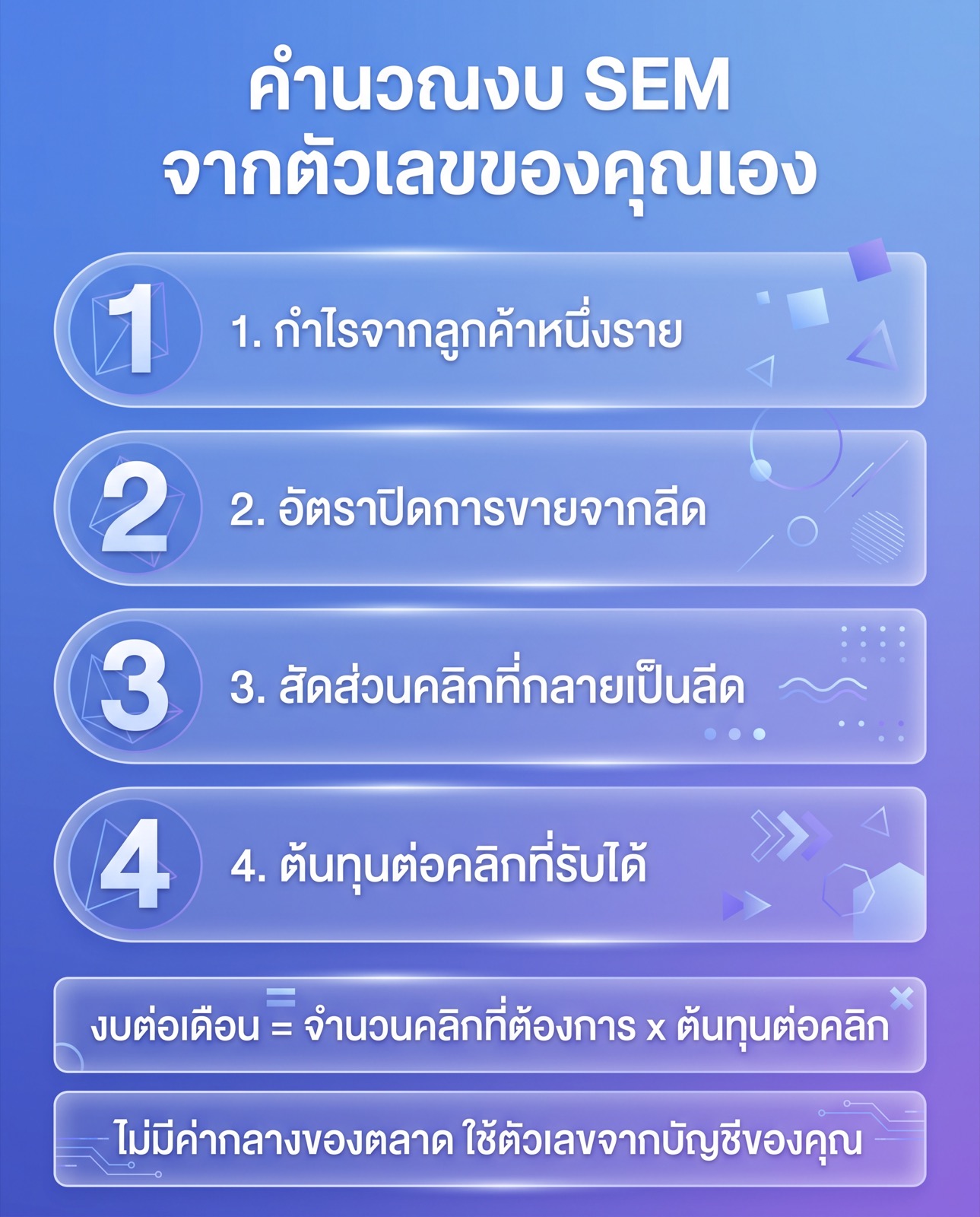
Step one: pull cost estimates for your own terms
Open Keyword Planner inside your own Google Ads account, enter the list of terms you intend to buy, set the country and language to match where you will actually advertise, and read the estimated bid ranges the tool returns. These are still estimates, but they reference your terms and your market, which beats an average from any article. If your terms are Thai and the data comes back thin, add close variants and the English words Thai searchers mix in.
Step two: work backwards from customer value
You need two numbers from your own business. The first is the profit a single customer produces over the relationship. The second is the share of that profit you are willing to spend to acquire one. Here is an illustrative example to show the method. Suppose one customer produces 5,000 baht in profit and you are willing to spend 20 percent of that on acquisition. Your allowable cost per new customer is 1,000 baht. Every number here is an invented illustration, not a market benchmark. Replace them with your own.
Step three: convert to an allowable cost per click
Now use your close rate and the share of clicks that become leads, both of which you can estimate from the sales work you already do. Continuing the same illustration, if you close one lead in five, you need 5 leads per customer, so your allowable cost per lead is 200 baht. If one click in twenty submits a form, your allowable cost per click is 10 baht. You now have a ceiling with reasoning behind it, and you can compare it directly against the bid ranges from step one. If your ceiling sits far below what those terms cost, you have three options: move to narrower and cheaper terms, raise the conversion rate of the landing page, or raise the value of a customer.
Step four: convert to a monthly budget
Monthly budget is the number of clicks you need multiplied by your allowable cost per click. How many clicks do you need? That comes from how many conversions you must see per month for the reporting to mean anything. If the whole month produces two or three leads, you cannot tell whether a change in results came from your optimisation or from chance, and automated bid strategies need a stock of conversion history before they can bid toward a target. Continuing the illustration, if you want 30 leads a month you need roughly 600 clicks, which at 10 baht per click is roughly 6,000 baht a month.
One warning: do not spread that budget across ten campaigns. Thin budgets in many campaigns perform worse than the same money concentrated on the few terms closest to a purchase. In the first month, aim to buy information rather than profit, then use that information to decide the second month.
How SEM on Google is measured
Measurement is not the final step. It has to be finished before the first baht is spent, because a campaign you cannot measure is an expense you can never prove was worth it.
Set conversion actions that represent real business
In Google Ads you create conversion actions for things that carry real value: a form submission, a call from the ad, a tap through to a chat conversation, a purchase. What to avoid is counting everything as a primary conversion. Scrolling a page or staying on it for ten seconds is not business, and when you let the system bid toward those signals, it will bring you people who are good at scrolling.
Separate primary from secondary conversions
Google Ads lets you decide which actions are used as bidding targets and which are only recorded for reference. Keep only the actions that stand for revenue as bidding targets, and hold smaller signals such as a visit to the contact page as supporting data. That way the automated strategy learns from the right thing.
Connect Google Analytics and Google Search Console
Google Analytics shows post-click behaviour, such as which page people leave from before completing a form. Google Search Console covers the organic side, which lets you check which terms you are paying for even though your pages already rank well, and which terms you have no near-term chance of ranking for and should keep buying.
Watch numbers you can act on, not numbers that look good
Click-through rate tells you whether the message is interesting, but not what the business got. The numbers to decide with are cost per qualified lead, cost per new customer, and return on ad spend for online shops, alongside impression share, which tells you whether you are missing opportunities because of budget or because of rank.
Do not forget conversions that happen off the site
Many Thai businesses close in a chat window or on the phone rather than on the website. If that describes you, counting only form submissions makes the campaign look far worse than it is. The fix is to record taps on chat buttons and call buttons as conversions, and where possible send actual sales outcomes back into the system so bidding learns from leads that closed rather than treating every lead as equal.
What this means in the Thai market
Running SEM in Thai differs from running it in English in ways that decide where budget leaks.
First, Thai does not put spaces between words, which makes word segmentation and matching less precise. You therefore need to read the search terms report more often than you would on an English account, especially in the first month.
Second, Thai users write the same word several ways: transliterated, in English, and misspelled out of habit. Brand names and product names should appear in your keyword list in several forms, and the search terms report will show you spellings you have not bought yet.
Third, Thai search volume data is often thinner than English data. Keyword Planner may show a very wide range or no data at all for a specialised term. Do not discard a term just because the tool has no data on it. Test it with a small budget and read the real search terms report instead.
Fourth, destination behaviour differs. Many Thai buyers want to talk before they buy, so a button leading into a chat conversation often outperforms a long form. If your landing page offers only a ten-field form, you are paying for the click and then closing the door on someone who was ready to talk.
Fifth, mobile use is high. A landing page that loads slowly or has buttons too small for a thumb will undo a well-built campaign. Test the real page on a phone over a mobile connection, not on an office computer.
Finally, some Thai words are ambiguous. The same string can be a product name, a place name and an ordinary word. Leaning on exact and phrase match early reduces that problem while you are still learning how people search in your category.
SEM or SEO: which should a business do first
Three criteria answer this without a long comparison. The first is time. SEM can produce results in the first week, while organic rankings take months to move. If you need leads this quarter, SEM is the more direct answer.
The second is how the cost behaves. Stop paying for SEM and impressions stop the same day, while a page that ranks keeps working after the work is done. That means the two are not really competing. They do different jobs inside the same budget.
The third is what the business needs first. If you are not yet sure the offer sells, use SEM to test it, because it answers fast and can be switched off. Once the offer is proven and cost per lead starts rising with competition, investing in SEO services reduces long-term dependence on ad budget, and if the goal is serious visibility in Thai-language results, an SEO strategy for Thailand is the part to plan alongside it.
In practice most businesses run both with divided roles. SEM takes the terms closest to purchase and the highly competitive terms that are slow to rank for, while organic content takes the research-stage terms, which are far more numerous than any budget could buy.
FAQ about SEM
Are SEM and Google Ads the same thing?
Not quite. SEM is the name of the activity and Google Ads is the platform used to do it. In Thailand almost all SEM runs on Google Ads because that is where most search volume sits, but other platforms such as Microsoft Advertising work on the same principles.
Do I need a website before I can run SEM?
You need at least one landing page you control, because every click has to land somewhere. A single page that explains the service, shows credible proof and offers a contact method tappable from a phone is enough to start. A full website is not a requirement, but a fast page matching the query is.
Why does cost per click vary so much between businesses?
Because the price comes out of an auction with variables specific to each account: how many competitors bid on that term and how aggressively, how relevant your ad and landing page are, the location and time you advertise in, and how valuable a customer is in that industry. This is why published averages cannot be used to plan a budget, and why you should pull estimates from your own account instead.
How many keywords should I start with?
Start with a small number you can justify one by one. One ad group holding a few terms that mean the same thing, with matching ad text and a matching landing page, beats launching a hundred terms at once, because you can read the results and fix them in time. Expand later using terms found in the search terms report.
How do I measure results if customers close by chat or phone?
Record taps on chat buttons and call buttons as conversions in Google Ads, then, where possible, send real sales outcomes back into the system so bidding learns from leads that actually closed. Counting only website forms makes campaigns look worse than they are for many Thai businesses.
Where to go from here
If you are starting this week, do three things in order. Install conversion measurement that stands for real business. Calculate your allowable cost per click from your own numbers using the method above. Then launch one Search campaign on the few terms closest to a purchase, with a starting negative keyword list. After that, read the search terms report every week and adjust.
If you want a team that does this daily to build the structure, wire the measurement and run the weekly adjustments, look at the digital marketing services for growing businesses, or talk to Relevant Audience about Google Ads management so your first budget goes to the terms where buyers are already waiting.