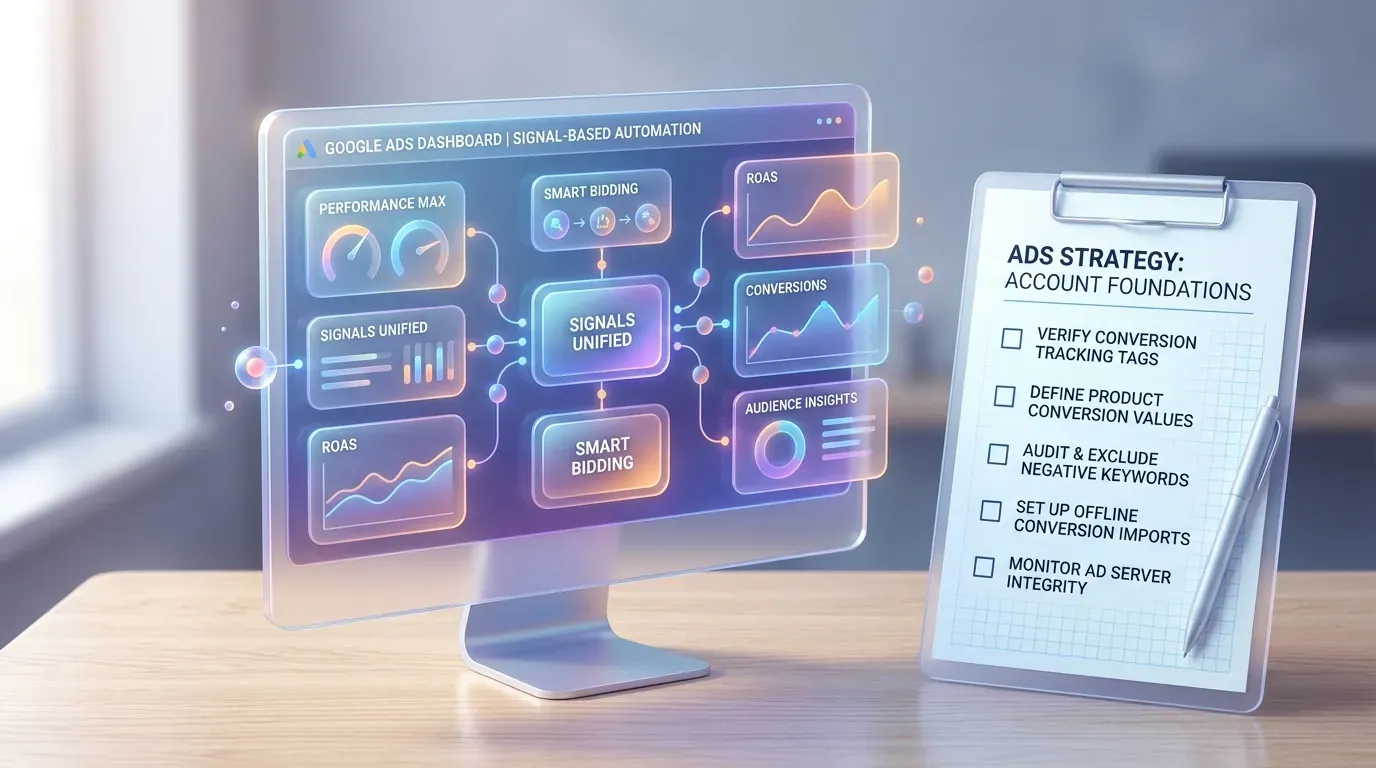
TL;DR
- AI Max treats keywords, landing pages and site content as signals rather than strict targeting rules, so it enters auctions for queries that were never on the keyword list.
- The eligibility table Google confirmed in the post: exact and phrase match are not eligible to serve in AI Overviews, while broad match, Performance Max and AI Max are, with AI Max giving the lowest query control.
- Independent testing is split. One analysis across 600 accounts found AI Max delivered 35 percent lower ROAS than traditional match types, while a separate 23-advertiser analysis found improved Quality Score and ROAS in mature accounts with strong signals.
- When AI Max swaps landing pages dynamically, tracking templates using the lpurl parameter can generate 404 errors that break conversion attribution silently, with no error notification fired.
- A conversion uplift after switching AI Max on may just be attribution moving: impressions previously credited to exact match keywords shift into the AI Max bucket, so check the Source column and AI Max match type values in search term reports.
Google’s reps are pushing AI Max for Search hard right now, particularly for brand campaigns. The pitch is straightforward enough: better AI surface eligibility, more conversions, smarter automation. But turning on AI Max before your account infrastructure is solid can quietly drain budget and scramble your attribution in ways that are genuinely hard to catch until the damage is already done.
AI Max is a real structural shift, moving you from keyword-level control to something more like signal governance. That change has real consequences for brand-sensitive advertisers who depend on predictable, efficient traffic. This article breaks down what makes an account ready (or not ready) for AI Max, so you can make an actual informed call rather than just checking a box because a rep recommended it.
- What AI Max Does
- The Non-Negotiable Foundations AI Max Needs to Perform
- How to Diagnose Whether AI Max Is Adding Real Value or Cannibalizing Your Traffic
What AI Max Does
Before deciding whether to enable AI Max, it helps to understand what it actually changes about how your campaigns work in Google Ads.
From Match Types to Intent Signals: The Real Paradigm Shift
Traditional keyword targeting works on a fairly simple principle. You define the queries you want to match, set match types to control how loosely those definitions apply, and the system finds auctions that fit within those parameters.
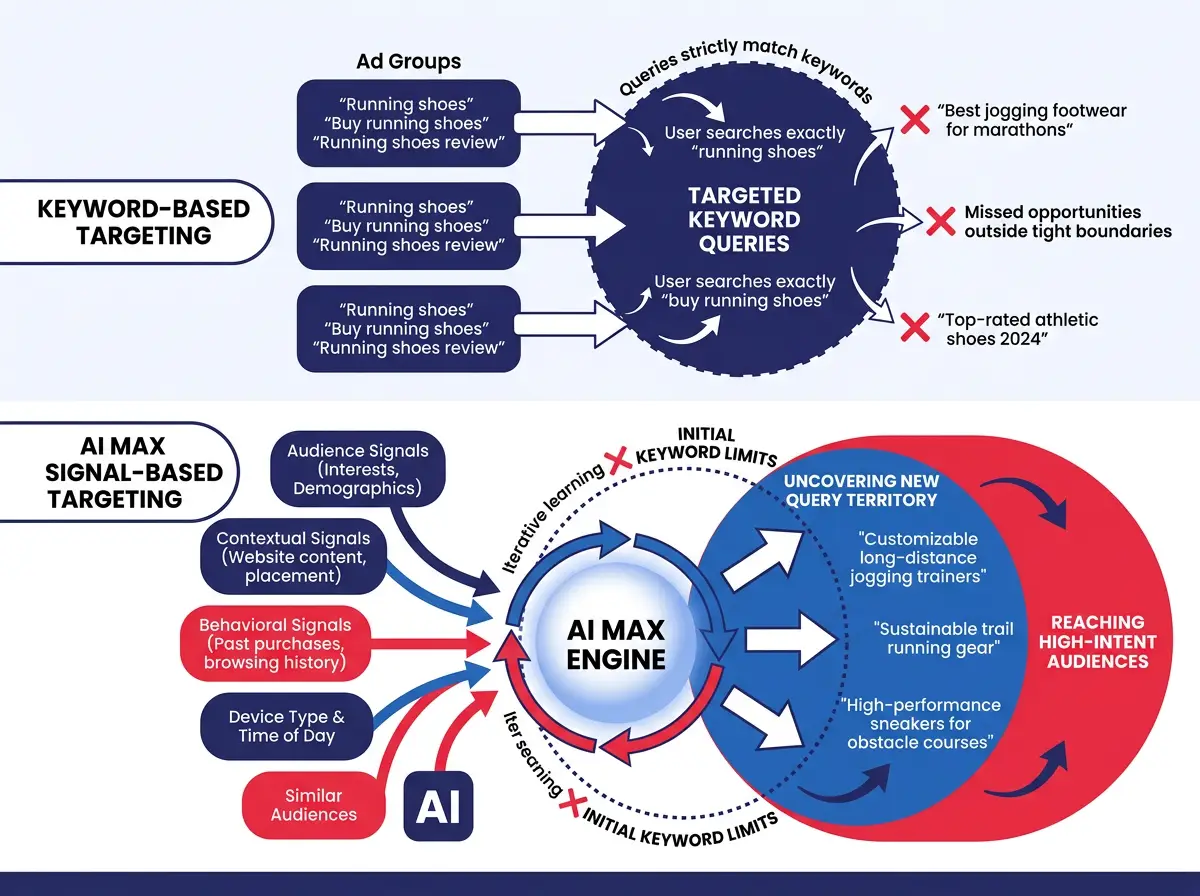
AI Max works differently. It treats your keywords, landing pages, and site content as signals rather than strict targeting rules. The system uses those signals to predict user intent and enter auctions for queries that fall within what it interprets as relevant, including queries that were never part of your keyword list and may stretch well beyond the intent your keyword set was actually designed to capture.
For brand campaigns, this is a meaningful structural change. A brand campaign built on exact match keywords is designed to be a controlled, defensive traffic source. When you introduce AI Max, you are giving the system permission to interpret what “brand intent” means rather than defining it yourself. That’s a bigger concession than it sounds.
AI Max vs. Dynamic Search Ads: Similarities, Differences, and the ‘Black Box’ Trade-off
Dynamic search ads already automated match expansion based on your site content. AI Max covers similar ground but goes further. DSA respects fairly clear semantic boundaries when matching queries to content. AI Max can reach outside those boundaries, pulling in queries that sit further from the intent your site content and keywords suggest.
Google has confirmed the following eligibility picture for AI Overviews:
| Campaign Type | AI Overview Eligible | Query Control |
|---|---|---|
| Exact Match | No | Highest |
| Phrase Match | No | Medium |
| Broad Match | Yes | Lower |
| Performance Max | Yes | Low |
| AI Max | Yes | Lowest |
This matters because exact match and phrase match keywords are not eligible to serve in AI Overviews at all. If you run Performance Max brand campaigns, you are already covered for AI surface eligibility. Adding AI Max on top does not unlock new surfaces. It just adds another automation layer with less query control on top of an account that is already eligible.
The core trade-off is fairly simple: AI Max can theoretically find growth opportunities you would have missed with tighter keyword management. In exchange, you hand over more control to the system and accept that some of what it matches will not line up with your targeting intent.
The Non-Negotiable Foundations AI Max Needs to Perform
Understanding how AI Max works is one thing. Knowing whether your account can actually support it is where the real evaluation happens.
Why Poor Conversion Signals Are the Fastest Way to Fail with AI Max
AI Max does not fix weak signals. It amplifies whatever it receives. If your conversion setup has problems, the automation will optimize toward those problems at scale. That’s not a hypothetical risk.
Before considering AI Max, audit the following:
- Macro vs. micro conversion separation: Are phone clicks and form fills counted alongside actual leads or sales? If everything is treated as equal, the system optimizes toward volume rather than quality.
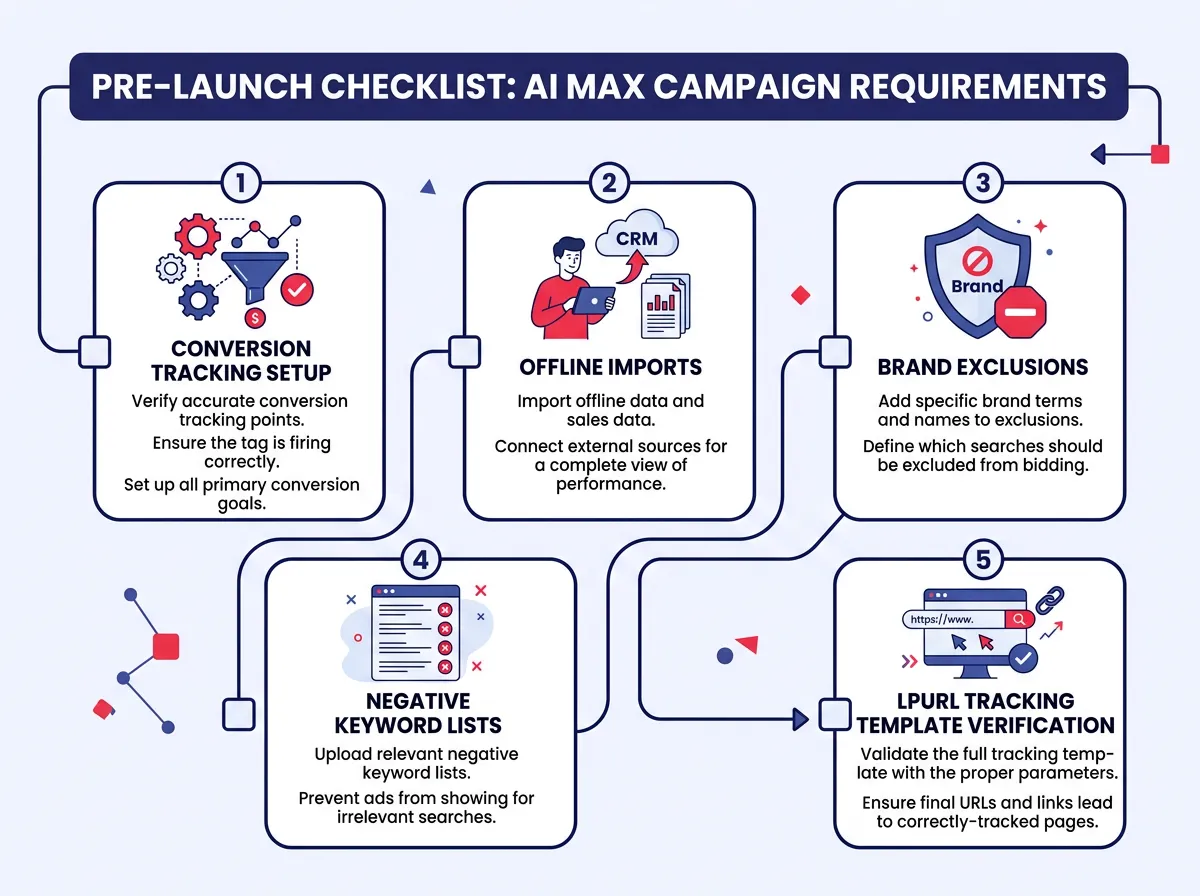
- Offline conversion imports: If your sales process moves offline after a form fill, and that outcome data never comes back into Google Ads, the platform is essentially bidding blind on what matters most.
- Lead quality feedback loops: If Google still treats every form submission as equally valuable regardless of whether those leads convert downstream, the automation is learning from incomplete information.
Accounts with these gaps often run brand campaigns that look efficient on paper, because brand traffic tends to convert well regardless of signal quality. Activating AI Max in that environment means the system inherits a skewed signal set and scales it.
Brand Controls, Negative Keywords, and the ‘lpurl’ Tagging Trap
Google’s pitch for AI Max leans on the brand controls built into the feature: brand exclusions, URL exclusions, text guidelines. The available evidence suggests these controls work inconsistently.
Independent testing has found that competitor terms occasionally slip through. Brand terms sometimes match to non-brand queries even when exclusions are configured. Overlap between brand and non-brand terms shows up in reporting without clear explanation. None of this is catastrophic on its own, but it adds up.
This makes negative keyword lists and brand exclusions structural requirements rather than optional cleanup tasks. Without them, AI Max can trigger ads on competitor queries, off-brand content, or irrelevant searches with no automatic alert.
There is also a technical risk that rarely gets discussed: when AI Max dynamically swaps landing pages, tracking templates using the {lpurl} parameter can generate 404 errors. This breaks conversion attribution silently. No error notification fires. Performance data simply stops flowing accurately for the affected URLs. Test this specifically before any launch, not after.
How to Diagnose Whether AI Max Is Adding Real Value or Cannibalizing Your Traffic
Getting AI Max live is the easy part. Evaluating it honestly requires knowing what to look for in the data.
Reading the Reporting: The ‘Source’ Column, AI Max Match Type Values, and What Uplift Really Means
When you activate AI Max, you may see an uptick in conversions fairly quickly. Before treating that as a win, check whether the traffic is genuinely incremental.
Because AI Max treats keywords as signals rather than strict targeting parameters, impressions that were previously attributed to your exact match keywords can shift attribution to AI Max. The total conversion number looks the same or higher, but no new demand was actually captured. The same branded queries are just appearing in a different reporting bucket.
To evaluate this accurately:
- Check the Source column in search term reports to see which queries AI Max is surfacing versus what your traditional keywords were already capturing.
- Review AI Max match type values to understand whether new query territory is actually being covered or whether existing branded terms are just being repackaged.
- Look at query-level data over the test period and compare it to the equivalent window before AI Max was enabled.
Independent testing has produced inconsistent results. One analysis across 600 accounts found AI Max delivered 35% lower ROAS than traditional match types. A separate 23-advertiser analysis found improved Quality Score and ROAS in mature accounts with strong signals. The difference in outcomes consistently traces back to account readiness.
The Compatibility Checklist: Ready vs. Not Ready Indicators for Your Account
Not every account is at the same stage. Use the following to make an honest assessment before enabling AI Max.
Accounts that are stronger candidates for AI Max:
- High conversion volume with clear, trustworthy conversion goals
- Offline conversion data flowing back into the platform
- Macro and micro conversions separated with proper weighting
- Existing generic campaigns already capturing most available growth
- Non-regulated industries with flexibility around ad copy and landing page variation
Accounts that should treat AI Max as a future goal rather than a current action:
- Legal or compliance requirements that restrict what ad copy can say
- Highly niche semantics where the system will misinterpret intent at scale
- Limited historical data that makes it hard for automation to learn meaningfully
- Thin margins where wasted spend on mismatched queries creates real financial damage
- Generic campaigns that are still underperforming because of budget constraints, weak landing page alignment, or outdated query management
That last point is worth sitting with. In many Google Ads accounts, generic campaigns have significant untapped growth sitting right there. Budget limits, poor structure, and weak landing pages often explain why brand campaigns look disproportionately strong. AI Max on a brand campaign will not fix that. It will deepen the account’s dependence on branded traffic while the actual growth opportunity remains unaddressed.
If your account currently falls into the “not ready” category, the work is clear: fix conversion signal quality, build out generic campaign structure, establish proper offline import pipelines, and review brand exclusion lists. Once those foundations are in place, AI Max becomes a more reasonable test.
When you do test, use campaign experiments with a defined hypothesis and a clear measurement plan. Set a timeline, identify the metrics that matter, and decide in advance what result would justify expanding AI Max versus pulling it back. Don’t wait until you’re looking at disappointing numbers to figure out what you were actually measuring.
The feature may mature into something more reliable as Google refines it, similar to how Performance Max improved after its rough early period. For now, the data and early testing suggest that AI Max for Search works best when it has high-quality signals to learn from, a well-structured account around it, and a team that knows how to read reporting critically rather than treating surface-level conversion bumps as proof that something real is happening.