Most global marketers wrote off Russia after 2022 and moved their budgets elsewhere. Meta pulled out. Google scaled back its ad business. LinkedIn shut down entirely. But a handful of APAC brands stayed, or entered fresh, and found something they weren't expecting: a channel still delivering high-intent traffic at a fraction of what Google used to charge. That channel is Yandex Ads.
Yandex isn't some workaround or fallback option. It's the main search and advertising infrastructure for over 140 million people across Russia and the CIS region. For APAC businesses in gaming, travel, B2B, and e-commerce, sitting this one out means handing demand straight to competitors from China, India, and Southeast Asia who already figured this out.
This blog covers what actually matters if you're entering this market: how the platform works, which entity structures let you operate without legal headaches, which verticals are producing real returns right now, and how to build a technical stack that doesn't burn your budget on bad data. No fluff, and nothing carried over from pre-2022 assumptions that no longer hold up.
Why Yandex Ads Is the Real Demand-Capture Layer in Russia and CIS
Search behavior in Russia never followed the global Google default, and it's worth understanding why. Yandex was built by Russian engineers who understood Cyrillic language processing, local search intent, and regional content in ways no Western competitor bothered to match. That early advantage never really went away.
The Market Share Reality: 64-74% Search Dominance
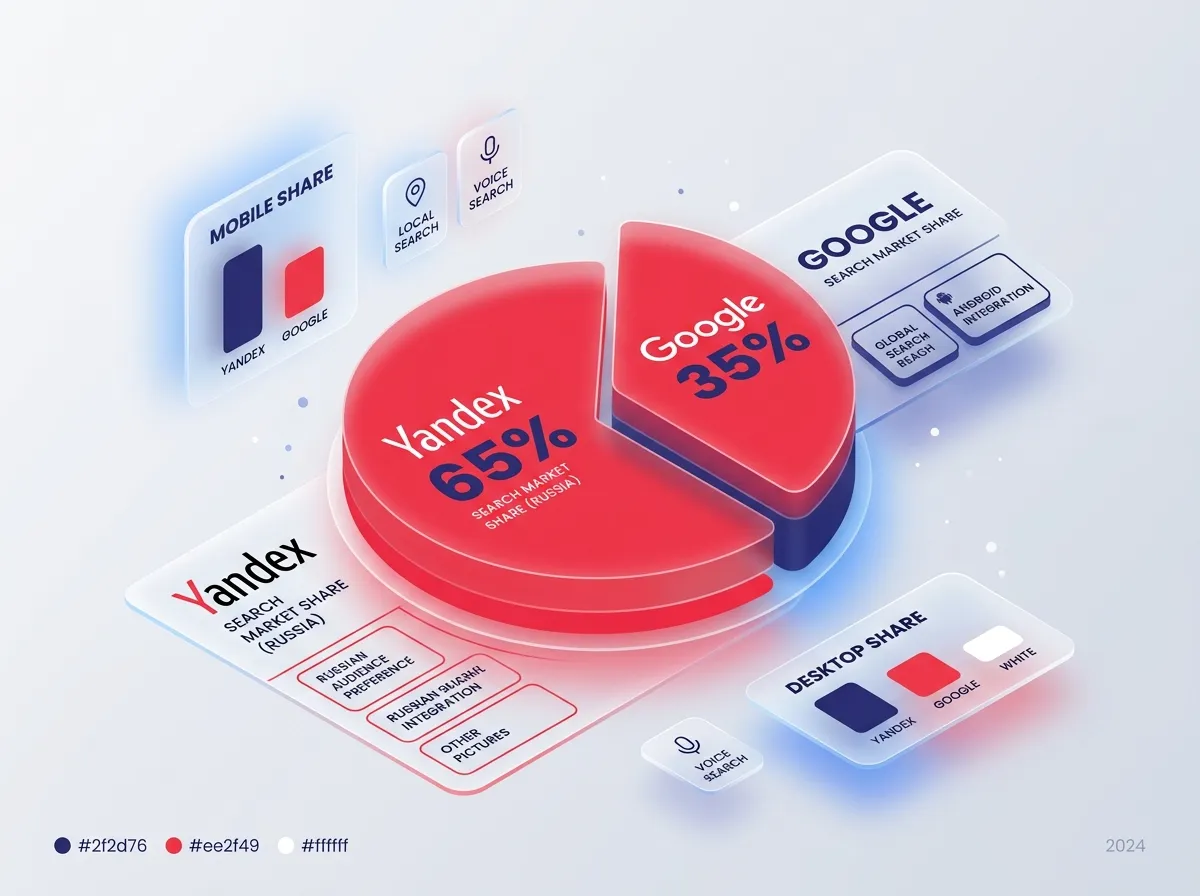
Depending on which tracking source you check and which month you pull data from, Yandex controls somewhere between 64% and 74% of search queries in Russia. Google sits in a distant second, and its ad products for Russian advertisers have been severely limited since 2022. Put plainly: if you're running paid search for this region and Yandex isn't your main channel, you're not really running a search strategy.
This dominance goes well beyond the search results page. Yandex runs its own display network (Yandex Advertising Network, or YAN), a mapping and local business product (Yandex Maps), an e-commerce marketplace (Yandex Market), and an analytics suite (Yandex.Metrica) that works a bit like Google Analytics but plugs into the ad platform far more tightly.
For APAC marketers used to Google's playbook, this requires a real mental shift. Keyword strategy, bidding logic, and audience targeting on Yandex don't translate one-to-one from Google Ads. Campaigns that are just a Google Ads structure translated into Russian tend to underperform, consistently. The platform rewards advertisers who learn its own logic, especially around automated bidding and its particular mix of search and network placements, which we'll get into shortly.
 ###
###
Navigating Entity Structure and Agency Partnerships
This is where most APAC businesses get stuck. Sanctions, banking restrictions, and payment processing limits make it genuinely hard for a foreign company to open a direct Yandex advertiser account and pay for campaigns through standard international payment methods.
There are 2 paths forward:
-
Work through a certified Yandex agency partner: These agencies are registered and operate inside Russia or CIS jurisdictions, hold direct billing relationships with Yandex, and handle campaign setup, verification, and compliance on behalf of foreign clients. This is by far the most common route for APAC companies, and it clears away nearly all the friction around account verification and payments.
-
Set up a properly structured local entity or subsidiary, usually in a CIS country with friendlier banking relationships (Kazakhstan and Armenia come up often), which then opens its own Yandex account and handles billing locally.
For most small and mid-sized APAC businesses, the agency route just makes more sense. Setting up a foreign entity means legal costs, ongoing compliance work, and banking relationships that take months to build. A certified agency partner can get a campaign live within days, and because these agencies already have billing history with Yandex, the verification issues that would flag a brand-new foreign advertiser rarely come up.
One thing worth saying directly: compliance matters here. Sanctions regimes differ by country, and APAC businesses need to check their own jurisdiction's rules before spending on Russian or CIS advertising. Singapore, Malaysia, Vietnam, Thailand, and Indonesia have generally kept trade relationships with Russia intact, which makes this legally straightforward for most companies based there, but confirm it with actual legal counsel rather than taking general market commentary at face value. Once that's sorted, working with an established agency partner is the fastest way to get compliant campaigns up and running.
3 Growth Verticals Where APAC Brands Are Winning Right Now
Market share and entity structure are useful context, but the question every marketer really wants answered is simpler: where's the money actually being made? Three verticals stand out clearly in 2026, and each has its own reason for why Yandex is outperforming other channels.
1. Mobile Gaming: Russia and CIS as a Top-5 Install Market
Mobile gaming publishers have quietly turned Russia and CIS into one of their top five markets for install volume. Western markets like the US and UK have gotten saturated and expensive, with cost-per-install climbing every year as competition piles up. Russia and CIS offer something increasingly hard to find: a large, digitally engaged population with money to spend on in-app purchases, at install costs that often run a third of what publishers pay in Tier 1 Western markets.
Yandex is the main acquisition channel for this vertical because it owns both the search intent (users looking for specific game genres or titles) and the network placements (in-app and web display inventory through YAN) that gaming publishers need for a full-funnel install strategy. Publishers from South Korea, Japan, and China have been running aggressive campaigns here for the past two years, and several APAC-based mid-core and hyper-casual studios report install costs 40-60% lower than their US or European campaigns, with retention rates that hold up just as well, sometimes better.
If your user acquisition team hasn't tested a Yandex campaign yet, you're probably missing a market that's still growing while your existing ones flatten out.
2. Outbound Travel: Capturing Russian Tourists in Southeast Asia
Russian outbound tourism to Southeast Asia has come back strong. Thailand alone pulled in well over a million Russian visitors recently, and Vietnam, Indonesia (Bali especially), and the UAE have all seen similar jumps as Russian travelers redirect spending away from destinations that became politically or logistically difficult after 2022.
Hotels, resorts, restaurants, and tour operators in these countries have a real opportunity sitting right in front of them, and most aren't touching it. A Russian traveler planning a trip to Phuket or Bali is searching in Russian, on Yandex, often using Yandex Maps to check out local businesses before booking. If your hotel or tour company has no Yandex Maps listing, isn't running Russian-language search campaigns, and has zero presence in Yandex's travel-related results, you simply don't exist for a huge chunk of this traveler segment.
The fix doesn't require a massive budget:
- Claim and fully build out a Yandex Maps listing with Russian-language descriptions, photos, and current contact details
- Run localized Yandex Search campaigns targeting travel intent keywords written in actual Russian, not machine-translated English
- Look at YAN placements timed around peak Russian booking windows (usually several months ahead of winter, since a lot of Russians head to Southeast Asia to escape the cold)
Tour operators and boutique hotels that have put in even basic versions of this strategy report booking increases that easily justify the ad spend, especially against the increasingly expensive, Google-dominated channels they were previously fighting over for the same travelers.
 ### 3. B2B, SaaS, and the E-commerce Void Left by Exiting Brands
When hundreds of European and American brands left the Russian market in 2022, they didn't take the demand with them. Consumers and businesses in Russia still need software tools, manufacturing components, fashion goods, and industrial equipment. That gap never closed. It's been filled, slowly and unevenly, by whoever was willing to step in, and APAC businesses are in a good position to be exactly that.
- B2B and Manufacturing: Procurement teams in Russia looking for industrial parts, machinery, or components they used to source from European suppliers that are now gone are actively hunting for alternatives. APAC manufacturers, particularly from South Korea, Japan, Taiwan, and India, can capture that demand through Yandex Search campaigns aimed at commercial and industrial search terms.
- SaaS: Software categories that Western companies exited (project management tools, marketing platforms, cloud infrastructure) leave Russian businesses searching for replacements. That's measurable, trackable search intent sitting right there in Yandex's data.
- Fashion and e-Commerce: Consumer fashion and lifestyle brands that pulled out of Russia left a real gap in the mid-to-premium segment. APAC fashion retailers, especially those with solid manufacturing and design capabilities behind them, have room to build a presence through Yandex Search and Yandex Market listings without running into the same crowded competition they'd face in Western markets.
The thread running through all three of these is the same: search intent data on Yandex shows exactly what Russian businesses and consumers are trying to buy right now, and there's less competition bidding on that intent than you'd find in almost any comparable Western or APAC market.
Building the Technical Stack: Attribution, Bidding, and Localized Creative
Getting a campaign live on Yandex is the easy part. Getting it to actually perform, and proving that performance to whoever's asking for results back home, takes a technical setup that looks pretty different from a standard Google Ads build. Three things matter most here.
Yandex.Metrica and CAPI
Yandex.Metrica is the platform's analytics and tracking tool, and it needs to be treated as core infrastructure, not something you bolt on later. Relying purely on browser-based pixel tracking creates the same blind spots iOS privacy changes created for Meta advertisers a few years back. Cookie restrictions, ad blockers, and privacy browser settings all chip away at pixel accuracy, and APAC advertisers who only set up basic pixel tracking end up making budget calls based on incomplete data.
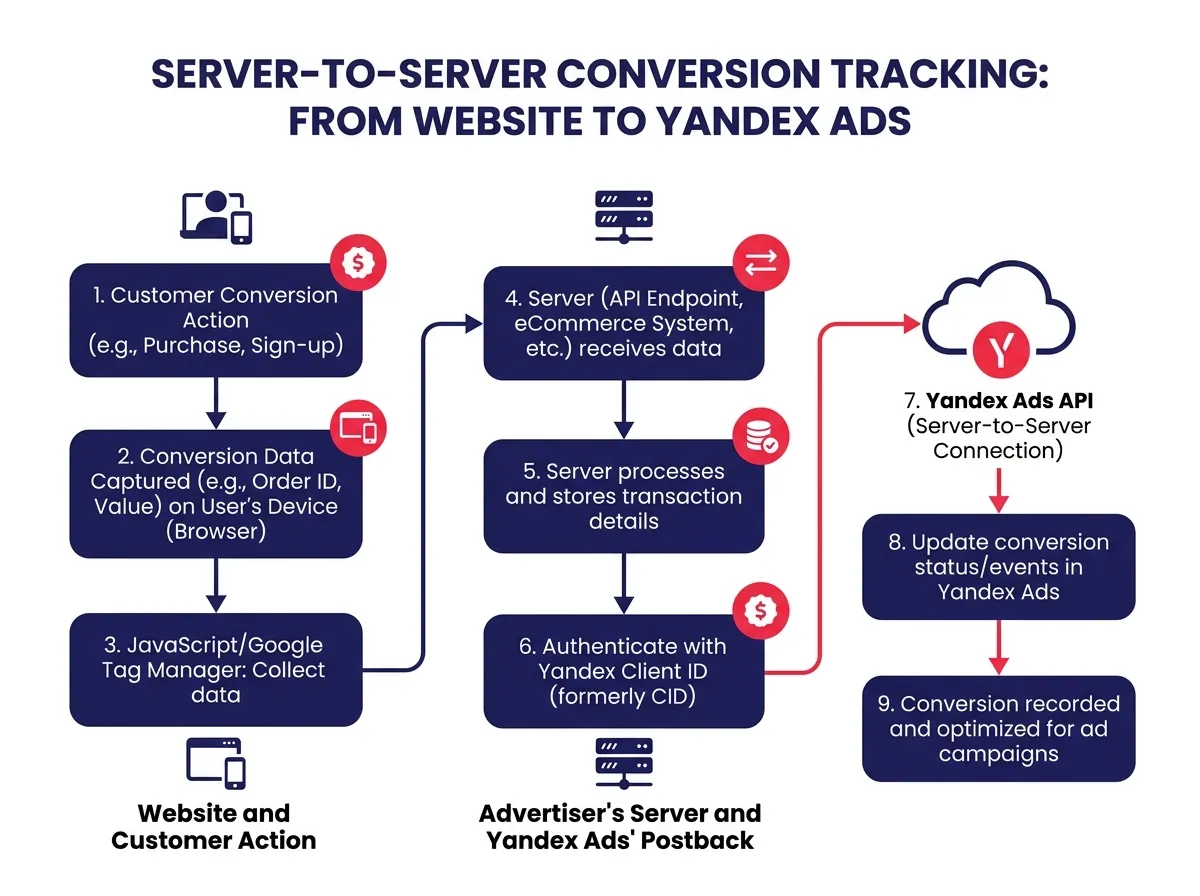
The fix is a server-to-server integration through Yandex's Conversions API (CAPI), which passes conversion events directly from your server to Yandex instead of depending on a browser pixel firing correctly. This matters most for:
- Mobile app advertisers who need accurate post-install event tracking (in-app purchases, level completions, subscription conversions)
- E-commerce businesses tracking purchases that happen after several visits across different devices
- B2B companies tracking longer sales cycles where a lead might convert weeks after the first ad click
Setting up Yandex.Metrica with CAPI takes some upfront technical work, usually your dev team or a technical partner at your agency. But the payoff is a real picture of return on ad spend and lifetime value, instead of an undercounted one that gets working campaigns cut too early.
Search Plus YAN, Powered by Automated Bidding
The best-performing Yandex accounts in 2026 tend to follow a similar pattern: a hybrid funnel that combines Search campaigns for hot, high-intent demand with YAN campaigns for awareness and retargeting.
Search campaigns catch people actively typing queries related to your product or service. That's bottom-of-funnel intent, and it converts well, but there's a ceiling on volume. YAN camp