TL;DR
- Keywords no longer function as commands. Platforms read them alongside user behaviour, landing page content and conversion history, then make their own calls about relevance and delivery.
- Google AI Max for Search is not a new campaign type but an optimisation layer inside an existing search campaign, reading keywords, ad copy and landing page content including H1s and H2s as signals.
- Google reports that advertisers using AI Max see 14 percent more conversions at similar CPA or ROAS, with campaigns using exact and phrase match seeing conversion lifts of up to 27 percent.
- First-party data has replaced keyword research as the foundation of account strategy, covering server-side tracking, CRM connections and deliberate conversion values, since a high-intent lead should not carry the same weight as a newsletter signup.
- The time allocation swap the post sets out: keyword list management to first-party data architecture, manual bid adjustments to conversion signal quality, ad group structure to creative strategy, and match type optimisation to landing page content and speed.
For three decades, the keyword was the center of the paid search universe. Marketing teams built campaigns around it, measured success through it, and structured entire workflows to control it. Bids, match types, negatives, ad group segmentation, all of it orbited the keyword list.
That era is over.
Automation now handles what practitioners used to manage by hand. Platforms make targeting, bidding, and creative decisions in real time. The keyword hasn’t disappeared, but it no longer sits at the center of the work. What sits there now is strategy. And marketing teams that haven’t updated their playbook are already behind.
- How search engine marketing has fundamentally changed
- The new levers that drive SEM performance for marketing teams
How Search Engine Marketing has Fundamentally Changed
The shift didn’t happen overnight, but it picked up speed fast. Search engine marketing used to reward the people who built tightly structured campaigns, obsessed over match types, and manually adjusted bids across thousands of terms. That level of hands-on control felt like a genuine edge.
Then, platforms absorbed most of that execution. Google, Meta, and Microsoft all moved toward AI-driven systems that handle targeting, bid optimization, and creative assembly on their own. The practitioner’s job didn’t go away. It moved upstream.
 ### From Keywords as Commands to Keywords as Signals
Keywords used to function as instructions. You told the platform exactly what to match, when to show an ad, and how much to bid. Today, they’re more like suggestions. Platforms read them alongside user behavior, landing page content, and conversion history to decide where and when to serve ads.
This is a real structural change in how search engine marketing works. The system is no longer treating your keyword list as a rulebook. It’s using your inputs as a starting context while making its own calls about relevance and delivery.
For marketing teams, keyword research still matters, but its role has shifted. You’re no longer building an exhaustive command structure. You’re handing the AI directional context about your business and who you’re trying to reach.
What Google AI Max and Performance Max Actually Mean for Your Campaigns
Google AI Max for Search is the clearest example of where this is heading. It’s not a new campaign type. It’s an optimization layer that changes how keywords function inside an existing search campaign. The system reads your keywords, ad copy, and landing page content (including H1s and H2s) as signals rather than hard rules, then uses all of that to find and serve ads.
Google reports that advertisers using AI Max see 14% more conversions at similar CPA or ROAS, with campaigns using exact and phrase match seeing conversion lifts of up to 27%. Add Performance Max running across Search, Shopping, YouTube, Display, and Discover, and the system’s reach expands considerably.
What this means practically is that the platform is doing more of the execution. That frees up time, but it also means the inputs you feed the system matter more than they ever did. Weak signals produce poor learning, and poor learning produces poor results.
New Levers that Drive SEM Performance for Marketing Teams
When strategy becomes the primary lever, the question is what that actually looks like in practice. For most marketing teams, it comes down to three inputs that now drive paid search performance more than any keyword list ever did.
First-party data is the new keyword research
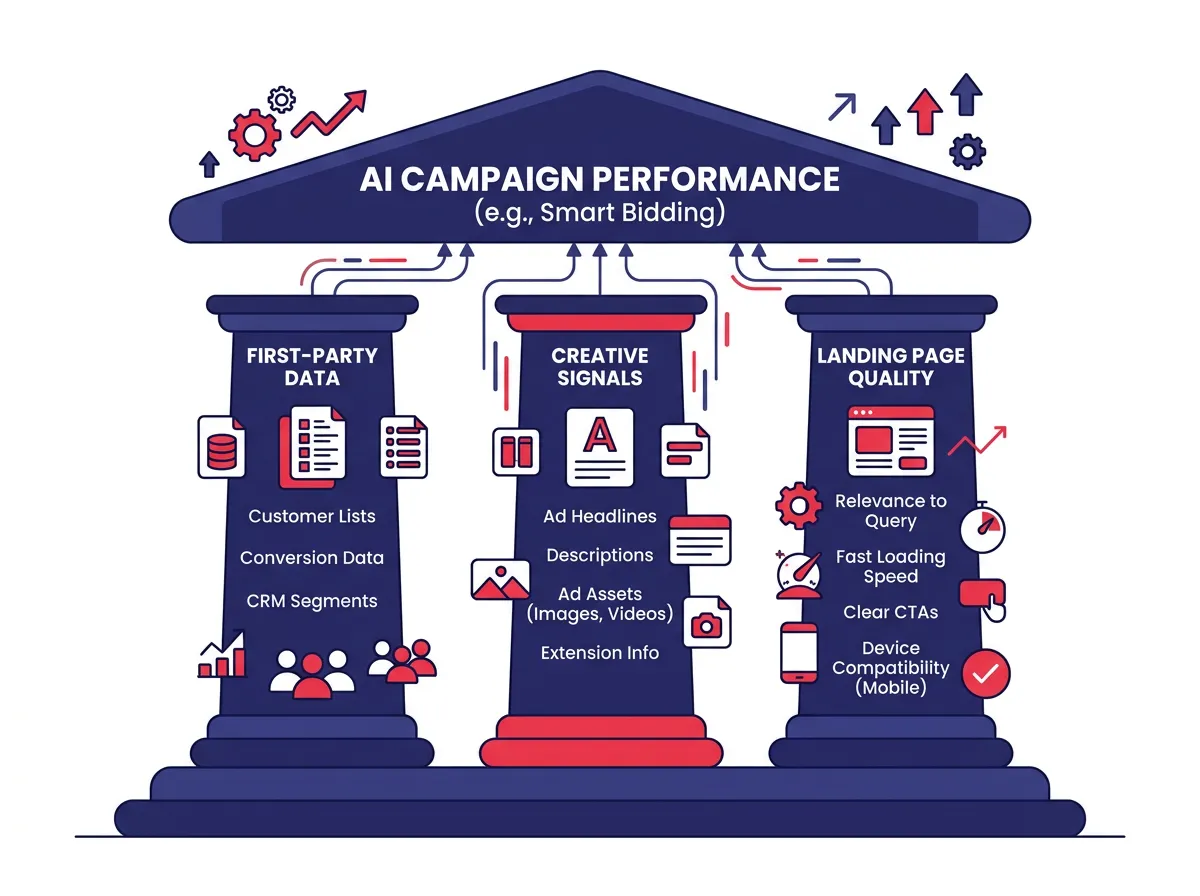
Conversion data quality has become the most important input in any SEM account. Google’s Smart Bidding and similar systems depend on clean, complete conversion signals to learn and improve. Without them, the system is guessing.
Server-side tracking is no longer optional. Connecting your CRM data to your ad platforms isn’t a nice-to-have. Being deliberate about which conversion events you pass and how much value you assign to each actually matters. A lead from a high-intent market segment should carry a different weight than a newsletter signup.
First-party customer data (website behavior, CRM records, offline conversion imports) has replaced keyword research as the foundation of account strategy. The richer and cleaner your data inputs, the better the system performs. This is where marketing teams should be putting time, not in refining match type structures.
 ### Creative and Landing Pages Have Become Paid Media Inputs
Creative used to be a production deliverable. Teams briefed it, approved it, and handed it off. Now it’s a strategic signal that platforms read to determine who sees your ads and when.
For Demand Gen and Display, creative functions as targeting. Platforms read your images, video, and copy to infer audience relevance. For AI Max, Google generates headline and description variations based on your landing page content. What your page says and how it’s structured directly shapes what ads the system writes and who it shows them to.
The strategic questions around creative have shifted:
- What messaging themes connect with which audience segments?
- What visual approaches work at different funnel stages?
- What content structures allow AI to generate strong variations?
These questions carry the weight that the keyword strategy used to carry.
Landing page quality follows the same logic. AI Max reads your page to decide which queries to match and which headlines to generate. Final URL expansion can send users to whichever page the system deems most relevant. Thin content, slow load times, and poor post-click experiences don’t just hurt conversion rates. They limit the system’s ability to serve your ads in the first place.
UX and CRO work now connect directly to paid search performance in ways they didn’t before. A weak landing page is a weak signal, and weak signals produce weak results.
How time allocation has shifted for marketing teams:
| Old priority | New priority |
|---|---|
| Keyword list management | First-party data architecture |
| Manual bid adjustments | Conversion signal quality |
| Ad group structure | Creative strategy and testing |
| Match type optimization | Landing page content and speed |
Practitioners who treat these strategic inputs as their primary work will be better positioned as platform automation keeps deepening. The keyword list isn’t gone. It’s just no longer the center of the work. Strategy is.